Showing posts with label 9/11. Show all posts

Sunday, September 11, 2016

9/11 and the New York Times Crossword Puzzle: 15 Years, Day by Day


The week leading up to a 9/11 anniversary in New York City is very distinct: all flavor of law enforcement is highly visible, from troopers in full riot gear and high-powered firearms greeting the morning rush hour crush at 96th street to groups of 3 officers dotting various other commuter platforms and the midtown beats.

It sends my mind wandering, how to absorb this fifteenth year since the mass murders down the block. I have written about many, many aspects of my 9/11 experiences since I started this blog in 2006.

This year my mind wandered to the New York Times crossword puzzle. They have done a great job putting up an archive of past puzzles, all the way back now to 1993.

I have been a crossword solver my entire life, starting with watching my parents do the Sunday crossword in the Magazine Section, and then in college I discovered daily puzzles in the physical paper. That evolved to the beauty and agile finger-dance of doing it online.

So this week I was drawn to doing the Tuesday, September 11, 2001 puzzle, which I'm sure I did not get to do on that day. Of course it would have been set weeks before.

I continued with the daily for the week, then started doing the Sunday puzzles, starting with September 16, 2001. I vividly remember the flag that the New York Times printed on its back page on that Sunday, I had it on my door for years.  I do not remember any note on the puzzle.

The 2006 documentary Wordplay explored the reasons people do the NYTimes crossword every day, talking with high-profile solvers including Ken Burns, Jon Stewart, and Bill Clinton.  We all share many of the same reasons: family  history, many solvers are continuing a parent's habit; a tiny space of order amid chaos; the 'aha" moments when clues set delicious twists in how we "hear" a word.

It's a cerebral communion with what can feel like all of civilization in microcosm. Margaret Farrar, the founding puzzle editor of the New York Times who mentored Will Weng and Eugene Maleska, started the "no disease, no wars" convention, and believed the puzzle should be "a commercial-free zone that leaves readers in a joyful mood." Bless her.

This year I found some grounding in redoing the 2001 puzzles, in walking in those very same footsteps I did 15 years ago. The puzzle was there, amid the chaos. Civilization was in tact, in the face of a people trying to kill it off.

Prufrock measured out his life with coffee-spoons: in this century, day by day, puzzle by puzzle, the city and I moved on.

I was curious about today's Sunday puzzle, falling on the 15th anniversary. There is no overt mention, as is appropriate.  But the theme resolves around the goodness of rest and sleeping in our own beds. You can even see the bed in the center of puzzle. Along with the idea--that we have all felt-- that there are monsters under the bed . . .

A  9/11 puzzle after all.


Tuesday, October 6, 2015

Kairos in Croatia, aka Carpe Diem, Trogir-Style

Left: Trogir, Croatia, Town Hall. Bas relief of Croatian hero, Petar Berislavić sculpted by  Ivan Meštrović. Right: Full-size bronze statue of Ivan Meštrović sculpted by American Malvina Hoffman.

I spent the week of Labor Day in the extraordinary country of Croatia, where history lives in layers and layers and layers.  And to these ancient layers I experienced current day, living layers of history that felt so dense I found it hard to think about, hard to write about when I got home. The trip was another in the series of "sing Renaissance polyphony and see the world."  I met up with a an international group of singers, brought together by an Englishman who runs Lacock Courses, in Trogir for a week of rehearsals, followed by a free concert in the famous St. Lawrence Cathedral.

When I got back to Gotham I found myself in the Brooklyn Museum, where I had not been in more than a decade, because a niece has moved into Brooklyn, right down the block.

It is a particularly wonderful museum. One exceptional feature is the Visible Storage on the 5th floor, where you can wonder amongst lots of the collection in storage while not on display. The space has a magical feel to it, like you have passed through some secret panel at the back of a closet into a realm of secret treasures.

The treasures are behind glass--that is how they store them. But in the middle of it all was a large-as life piece of sculpture. Because of the hand gesture I first thought it was Shakespearian of some sort. But the tag identified the figure as

Ivan Meštrović.

A month ago that would not have meant anything. But I now know that he is one of the master sculptors of the 20th century. And Croatian. And I have pictures of his work in Trogir. See photo above.

WHAT ARE THE ODDS?

Kairos Among the Winding Streets

Trogir was named a UNESCO Heritage site in 1997:

Because of the continuity of of its settlements since Ancient Greece. It is the best-preserved Romanesque-Gothic complex not only in the Adriatic, but in all of Central Europe. Trogir's medieval core, surrounded by walls, comprises a preserved castle and tower and a series of dwellings and palaces from the Romanesque, Gothic, Renaissance and Baroque periods.

Even a cursory synopsis of its history (courtesy Wiki) is dense:

Trogir was founded by Greeks 3 BC.  In the 9th century there were Croatian rulers, then 1123 it was nearly completely demolished by the Saracens. But the people rebound, and prosper. 1420 they are ruled by Venice, until its fall in 1797, when Trogir becomes part of the Hapsburg Empire, which ruled until 1918 (except for the French Occupation of 1806 to 1814). After WWI Trogir, along with Croatia, gets subsumed into Yugoslavia. During WWII it was occupied by Italy until 1944, when it was subsumed into second Yugoslavia. Croatia declared independence in 1991 and when the fighting stopped in`1995, it was a sovereign nation.


One of the city's treasures is a bas relief of Kairos, from the 3rd century BC.

Kairos is the god "of the moment" of the "fleeting opportunity."

He is an embodiment of the idea of Carpe Diem, from Horace's Odes. And he is almost a symbol of the city, you can find his likeness on every conceivable souvenir.

The poet Posidippos explained the iconography of the figure:

"He walks on tiptoe with wings on his feet because he's always in a hurry; clutches a razor because he is sharper than the tips of a knife; he has a tuft of hair over his forehead but he's bald in the back because people must grab him as they approach. Once he's gone by, it is too late."

And because of the layers of Trogir, this very important Hellenistic treasure is in the Benedictine monastery of St. Nicholas. I loved learning of this impish Greek god, the embodiment of the most human of desires to not miss out, and to see it everywhere in this ancient town.

Trogir is small, with narrow winding streets. I found it a little claustrophobic, and was very glad to be staying across the bridge, where there was more space, more air.

The church of St. Peter, where we had rehearsal each day.
The view of the walled city of Trogir from my B&B in  Ciovo, across the bridge

The Kamerlengo Fortress Castle, at the end of the town
Night in the Trogir town square


The Modern Layers Amidst the Ancient Stones 
As I wandered about this intriguing Eastern European nation, I was conscious of a complex intersection of current and recent tragedies. 

•The exodus from Syria, which has been going on for years,  hit a new critical point the end of August/beginning of September. The coverage was wall-to-wall on BBC.  The enormity of the suffering, the impotence of "Europe" to deal with it, were juxtaposed for me with holiday makers of every nationality on the beautiful island that is Trogir.  For the most part, my fellow vacationers looked like the solid middle class trying to enjoy its measured time away from work.  And then the enormous yachts came in. . . . 

•Burning Man 2015 paralleled my Croatian sojourn, Aug. 30 to Sept. 7.  70,000 + people choosing to wonder in the desert of Nevada, searching for creativity amidst the harsh conditions of the Playa,  paralleled 100,000 + immigrants in various deserts facing daily, literal,  life and deaths situations.  The two extreme ends of the human condition weighed upon my heart.

•Hope in the Turmoil of Tudor England: This was the theme of the week, devised by Patrick Craig, an English countertenor superstar.  He has an extraordinary talent to bring the historical context that music is written in to life and  is the most empathetic person I have ever met.

Patrick described--from his imagination--what it might have been like for Catholics during the English Religious Wars (I'm paraphrasing): 'So you are having your Mass at home, because the government will not allow you to worship how you wish. If there is a knock on the door--because you have been ratted out---everyone in the room would have a job: you scoop the Bible & the chalice into a basket, you help the priest into the "priest hole," you hide any music. And the music itself, from the genius of Byrd, reflected a depth of conviction combined with a frisson of people under constant siege." And most poignant of all to me: Patrick isn't Catholic.

*14 year anniversary of 9/11: This was the first 9/11 I have not be at home, the Upper West Side of Manhattan. It happened that the free concert the group was giving in the town's St. Lawrence Cathedral was on Sept. 11. And it happened that the dress rehearsal was at 3:00pm, which is 9:00am New York time.  And it happened that the first piece we rehearsed was a setting of the Lord's Prayer by John Sheppard.  So it happened that at 9:03 am NY time I was singing, "forgive us our trespasses, as we forgive them which trespass against us." No one ever said Christianity is easy.  And then I was more than happy to sing "but deliver us from evil . . . "

8:46 first plane hit North Tower; 9:03 second plane hit South Tower; 9:37 Pentagon hit; 9:59 South Tower falls; 10:03 Shanksville; 10:29 North Tower Falls.

The concert on September 11, 2015 in St. Lawrence Cathedral, Trogir. 


Thursday, September 11, 2014

The 9/11 Museum and Memorial: 13 Years On


I visited the 9/11 Museum and Memorial this weekend. It's a lot to take in, I will need to go back to really absorb everything.  The space itself is extraordinary. You descend down a series of very steep ramps. They do a good job showing schematics of how deep you are on different level, and where you on in relation to where the shopping mall once was, where the original PATH station was, etc.

I didn't take too many pictures, but I wanted to capture some of it.  I think they've done a good job. It's essential to tell the story of mass murder of 3,000 people who just went to work 13 years ago. The majority of the visitors on Saturday evening were foreign tourists, which I think is a good thing.

The photo above does not capture the piercing blues of the tiles.  Different artists were commissioned to try to capture the actual blue of Tuesday, September 11, 2001, a color that is seared into the memory of anyone who was there.


The actual slurry wall, that held, keeping back the Hudson River. A small miracle.


The broadcasting antenna from on top of the North Tower, which was the main broadcasting vehicle to NYC for decades. Close to my heart, given my career at Paley Center.   The intensity of the blue panels is captured more accurately in the background here than in the top photo.

Wednesday, September 11, 2013

Saturday, June 29, 2013

Superman: For Thine is the Kingdom, and the Power, and the Anger. . .


For thine is the Kingdom, and the Power, and the Anger, now and forever. Amen. The doxology of the Man of Steel, according to Zack Synder.

The Irish know a thing or two about anger, it's almost a national trait. The cute side is Maureen O'Hara in The Quiet Man, getting all angry at her feelings toward Sean Thornton. Sean himself, afraid of getting angry outside of the ring, because he could kill a man with a blow. And let's not forget George Bailey, so angry at his life he wants to throw it away over something as ridiculous as money.

Besides my celluloid kinsman, my own Irish-American dad had a lot of anger, and I've been told people have worried about my own temper. So let's say that I'm an authority of sorts on anger as a destructive force.

What struck me in the Man of Steel was the unchecked anger of the beloved Superman, and the unchecked cosmic anger that Zack Synder and, dare I say, Hollywood seems to be suffering from.

Declare Your Superman Creds
To write anything about SM requires some context, the spectrum of his devotees is so broad. I'm in the ranks of the casual Superman fan. I saw reruns of the 1950s classic TV show for years in the 60s.  (I remember so clearly the experience of the two Lois Lanes, and vaguely remember liking the more caustic Phyllis Coates. That actress switch at the dawn of TV laid the foundation for double Darrins and Beckys to come.)

The Superman opening credits were the first that I knew by heart, I had seen it so many times. An English major in the making, I knew it was 57 seconds of perfect exposition (and the best TV use of the harp).

Faster than a speeding bullet.
More powerful than a locomotive!
Able to leap tall buildings in a single bound!

("Look! Up in the sky!" "It's a bird!" "It's a plane!" "It's Superman!")... Yes, it's Superman ... strange visitor from another planet, who came to Earth with powers and abilities far beyond those of mortal men! Superman ... who can change the course of mighty rivers, bend steel in his bare hands, and who, disguised as Clark Kent, mild-mannered reporter for a great metropolitan newspaper, fights a never-ending battle for truth, justice, and the American way!


I wasn't into comic books, or the Justice League, and I saw the Christopher Reeve movies when they hit TV, but not before.

But I have some emotional bond to the character and the idea of Superman by cultural osmosis, and the musical manipulation of John Williams. I didn't like the cartoony Lois & Clark, but Smallville was an excellent series, with the perfect ending (as Lance Mannion well knows). So this is what I entered the theater with to see Man of Steel.

[Minor spoilers]

I found myself responding to the super-moments: Superman saving the guys on the oil rig; boy Clark saving the bus of kids; Superman's birth history; the first look at Caville in the suit, with the cape flying behind him; the kneel down on the ice to the great leap into the sky. All iconographic, all tingle points, event for the casual fan.

And then there are the HUGE problems, neatly articulated by Super-fan Mark Waid.

Broad points:

Superman's oblivious, literal destruction of Smallville & Metropolis is horrific. The loss of life amongst all those building being destroyed is incalculable and obscene. This is not who Superman is.

Some of Mark's great lines:

"Superman making absolutely no effort to take the fight, like, ONE BLOCK AWAY INTO A CORNFIELD INSTEAD OF ON MAIN STREET." [I love this point.]

"From everything shown to us from the moment he put on the suit, Superman rarely if ever bothered to give the safety and welfare of the people around him one bit of thought."

"As the credits rolled, I told myself I was upset because Superman doesn’t kill. Full-stop. Superman doesn’t kill."

Grief, Anger, and 9/11
I don't know the whole Superman canon for examples of previous anger. The casual fan saw Christopher Reeve's profound grief in Superman II over the death of Lois Lane turn into an anger so great that he could fly against the rotation of the earth and reset time. Cool. That was anger channeled to do something positive. Plus, it was the beginning of the 1980s, big things seemed possible.

Zack Snyder's Superman is oblivious to the anger that drives him to destroy the buildings of his hometown, and then blocks and blocks of the skyscrapers of Metropolis. That's what's so terrible.

Here are interesting points from some real fans, back in 2006 for Superman Returns. The thread? Angry Superman:

•I think its an awful idea to make Superman behave in an angry irrational manner. He should stand for truth and justice and balance.

•Among all his other gifts one of his greatest powers was his instinctive knowledge of right and wrong. you cant exactly have that if your raging around being mad at everything. his cool head has kept him on top even in the worst of situations.

•And while it might be nice to see Big Blue go up against someone who could take a punch without their head splattering, the last thing I want to see is Superman throwing a hissy-fit. Save the angry-all-the-time crap for folks like Batman or Wolverine; Superman's supposed to be someone you actually like.

Of course it's really Zack Snyder calling the shots. One has to ask: What is he so blindly angry about that he doesn't see how over-the-top, unnecessary, fatiguing, repetitive, and obscene his last battle sequence is. Is this a sign of broader zeitgeist anger—about the collapsed economy, government hacking, wars that don't end, corporate malfeasance—that is showing up as a super serious Superman, a World War Z, a Pacific Rim of rock 'em sock 'em robots. Humanity is getting quite a bashing.

My own angry moments of the film experience came from the 9/11 imagery. It's stupid to level Metropolis; it's sad and offensive to do it matching 9/11 imagery frame by frame. Vulture's Kyle Buchanan used Man of Steel to write about, "Is it Possible to Make Hollywood Blockbuster Without Evoking 9/11?"

His point: "It’s lazy, it’s cheap, it’s deadening, and it needs to stop." Amen.

But it's the change in Superman himself that I find the more telling point.

In the days and weeks after 9/11, phrases like "nothing will ever be the same" and  "everything is now entirely different" were everywhere. They were empty words for me at the time, so trite, so small in comparison to the monstrosity.

A decade out, this change in the ethos of Superman, part of the very DNA of pop culture America born of immigration, seems to be a real example. Damn.

Tuesday, September 11, 2012

"Out of the Clear Blue Sky": The Story of Cantor Fitzgerald and 9/11


In August I attended some of the DocuDays films at IFC, and one that has stayed with me is Out of the Clear Blue Sky: it's an insider's look at the story of Cantor Fitzgerald and 9/11. With the distance of 10 years it tells the sad, unique story of this company and how people have picked up and moved on as they can from such personal devastation.

Cantor Fitzgerald is a financial services company that specializes in bond trading: it's one of twenty primary dealers who trade U.S. government securities directly with the Fed. In 2001 its corporate headquarters were floors 101 to 105 of the North Tower at the World Trade Center. When terrorists flew American Airlines Flight 11 into the tower, the Cantor people were 2 to 6 floors above impact. Of the 960 employees who worked there, the 658 people who were at their desk all died. The only Cantor employees who lived weren't at the office, or had left the floors for one reason or another.

The deaths from this one company were 24% of all WTC victims.

Filmmaker Danielle Gardner gained the trust of the company and the families to weave the many sides of the complicated overall story together very well: the rise, fall, and rise again of the CEO then and now, Howard Lutnick, who was often seen on TV in the days immediately following the attacks; how the executives regrouped and tried to see who was alive, who was dead, and in the next breath had to decide whether they would fold the company or try to go on; what it meant that they had to borrow $70 billion dollars, which they were given a very short time to pay back.

The story of the cold business of literally making money for people alongside the obscene loss of life gets at the very heart of the attacks. The Towers were targeted because of their connection to the very center of the capitalist system: this wasn't a museum, this is where much of the business of making money in a global economy took palace.

As distasteful as it might seem to be thinking of money at that time, to close the company would be giving the terrorists what they wanted. And so, while in complete shock, Lutnick—who lived because he happened to be taking his son to the first day of school that morning—–set up a crisis center at the Pierre Hotel in midtown for the families as he huddled with whomever was still alive to see if the company could remain open. In those first days relatives still hoped that loved ones would be found, and the agony and despair of that crisis center makes the enormity of the day easier to grasp for the viewer because of its personal level.

One ugly fact on the business side is the phone call the major bond companies had in the afternoon of the the 11th. Lutnick says that a major competitor pushed for the bond floor to reopen on Thursday, the 13. The stock exchange didn't reopen until the following Monday, and there was no reason the bond trades had to go earlier, except that the competitor was hoping to pick up some of the business that Cantor couldn't handle, if they came back on line at all. Yup, capitalism as cold-blooded as it gets.

Cantor did get back online on Thursday, just barely, and that side of the story is fascinating to see unfold told by the people who were there, completely parallel to what was going on in the family crisis center at the Pierre.

I don't remember Howard Lutnick on TV, crying. Apparently he went on nearly every morning/talk program in the week after the attacks. Then there was a controversy that Cantor stopped paychecks for the 658 the week after the attacks. There are nuances to the situation, which I'll leave to the film. But the company fairly quickly set up support groups for the families. First they did it by geography--North Jersey, Long Island, Connecticut, etc---but they soon learned that people needed to be with those shared the same pain, and so it became Widows, Parents, Fiancees, Siblings, etc. All brought together because someone worked at a specific company.

The Cantor Culture

I experienced a small taste of the financial services culture myself. In the late 1980s I worked for a mutual fund company, Lord, Abbett & Co, as a shareholder reports writer/editor. Wall Street had a glamor back then, and I was curious.

Lord Abbett wasn't as high-powered as Cantor in my day. But the bond traders were connected to the world in a unique way at a time  before the internet. Topical jokes went like lightening across their network, and it was a band of brothers, where women were few and far between. It was often a frat party atmosphere, but it was only the smartest guys and they who knew the stakes were very big and very serious. Hence Oliver Stone's Wall Street.

Cantor Fitzgerald was started in 1945 by B. Gerald Cantor and John Fitzgerald. From the stories from the surviving family members, you see Cantor as a company that encouraged bringing in qualified friends and siblings. That's why the number of parents who lost 2 children in the collapse was 27. Widows also lost brothers, because friends brought friends in and marriage ensued. 955 children lost a parent. 38 pregnant wives were left behind. It just can't be said enough: the personal toll of this one company is enormous, and the interviews with some of the parents 10 years out are some of the most poignant moments of the film. So calm, so eloquent, still in shock.

I hope Out of the Clear Blue Sky is shown on TV. The interviews with employees about what it was like to work up in the clouds as well as the attacks and aftermath are a valuable and important oral history. And the last shots of the film, which I won't give away, are very moving as they softly portray the important message, 11 years out: never forget.

Cantor Fitzgerald now has 1,700 employees. The terrorists just didn't get it: you can't kill an idea. Thank God.

A clip from the film.

Monday, September 10, 2012

Travels with Cadfael: The Songs of Elba


"I wanted to ask you why you stopped at the Isle of Elba."

"It was to carry out an order from Captain Leclère. As he was dying he gave me a package to deliver to Marshal Bertrand there.
"

So that was Edmond Dantes’s excuse—a deathbed promise. Cadfael and I had no such noble focus. Did you know that Dumas decided to write The Count of Monte Cristo after visiting Elba himself? He was traveling with a nephew of Bonaparte’s, and as they sailed back from Elba he saw the other islands in the Tuscan Archipelago——Gorgona, Capraia, Pianosa, Montecristo, Giglio, and Giannutri——and vowed to write a novel in memory of the trip. So there must be something captivating going on there. . . .

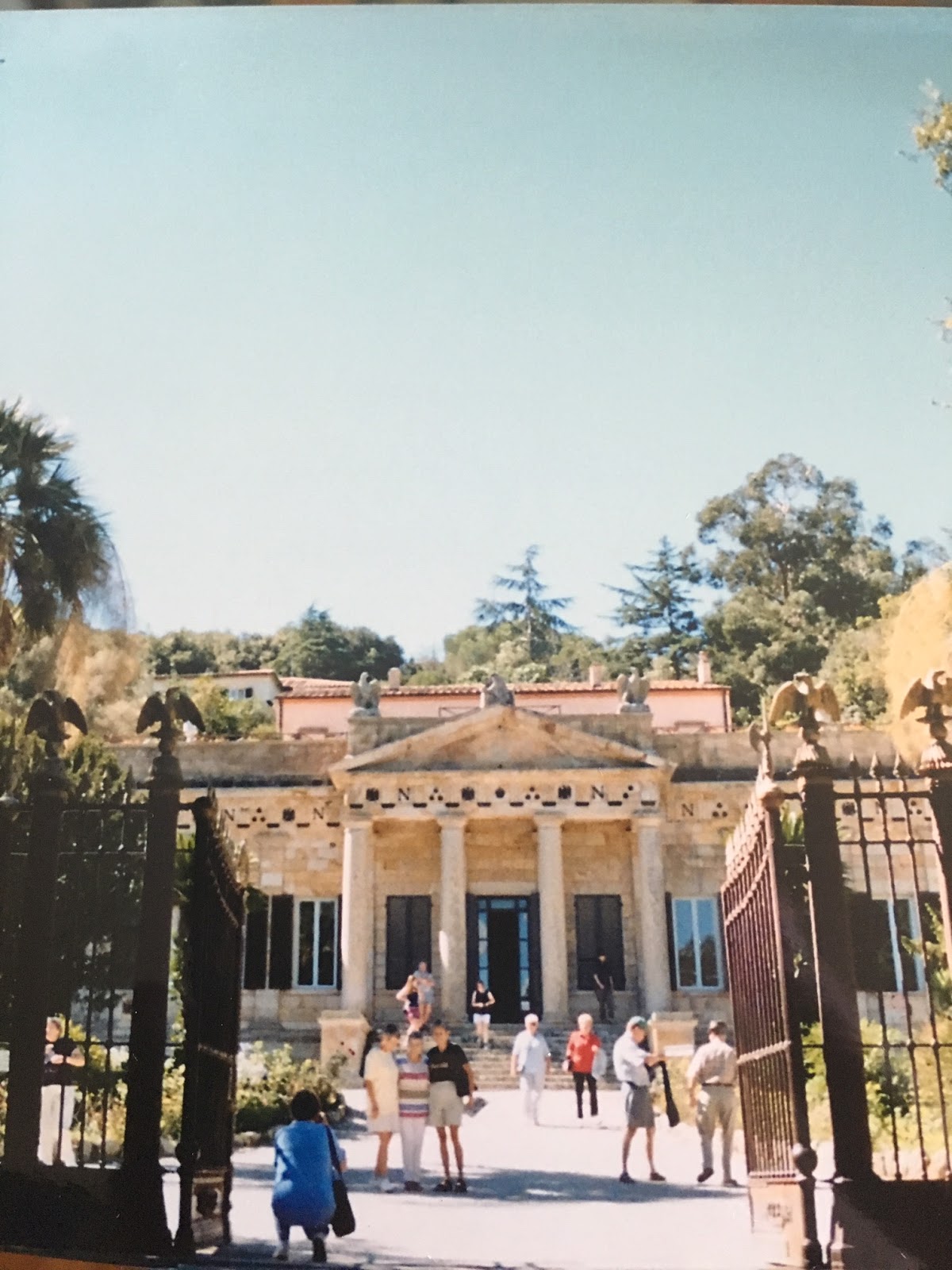
I visited Elba during my heady days of travel with my friend the Benedictine monk Cadfael. We were visiting Tuscany, and I wanted to be a completist, so off to Elba we went, driving southwest from San Gimignano to the port of Piombino for the ferry to Portoferraio, the city of Napolean Bonaparte’s first exile.

Our first foray to visit the Emperor’s town residence--Palazzina dei Mulini, located in the highest part of Portoferraio between Fort Stella and Fort Falcone--was nearly thwarted by the port’s tiny stone streets, and the fact that there is no place to park. Being a New Yorker I thought I understood the meaning of those words, but I was close to weeping after circling through an eternity of narrow stone streets that wouldn’t allow us to get where we needed. Luckily, Cad is deeply unflappable, and an extremely skilled driver. He piloted the Micra onto sidewalks, performed the drive-backwards-up-an-entire-hilled-street maneuver, and coaxed the mighty Micra down a flight of stairs—all to outflank those one-way signs.

Cad won, as usual, and the Micra was finally parked. We bounded up to the Palazzina only to see “Chiuso,” those most dreaded of Italian letters. Undaunted, we took ourselves to the Emperor’s summer residence, Villa di San Martino, at 6 km from Portoferraio along the road to Marciana. The man was only on the island for a total of 10 months, but decorum at all times.


I am not an imperialist at heart, but I was jazzed to be walking through the exiled Bonaparte’s bedroom, and his study, and to look out where he surveyed the sea, when we finally got into his town residence the next day.

But what I remember most about Elba overall is color and sky: the pink of Bonaparte’s town residence under a huge, tropical blue sky. Later in the day we drove west, away from the towns, on a mountainous road above the sea. The sky there was huge, majestic, and humbling, and we drove into layers of grey and blue offset by the sun’s gold. Peter Gabriel was our soundtrack as we egg-and-darted along the rising road, going deeper and deeper into that space between sea and sky. I understood what could have made such an impression on Dumas.


It was September 2002 . . . 
This trip had a very poignant timing. I got on a plane in New York on September 12, 2002, the day after the first anniversary of the attacks.  It was still a sad, dark, heavy time, and unease all around, as we didn't know if there would be more murders a year after. But as we said, we have to keep moving, and so to the airport I went to start this trip.

We spent our first Elban evening in the hotel. The lobby was pleasant—-the white tile floors spoke to the beachiness of the location, and the décor was clean and modern. To the left of the bar was a baby grand piano. Cad plays by ear, and has a good tenor voice. He asked the manager if he could play for a bit, and he said yes. There were small clusters of guests scattered throughout the lobby, mostly German tourists.

Actually there are so many German visitors on Elba, and the language is so prevalent, that it is a little disorienting. “M.A., can we please go back to Italy?"

At the piano, Cad’s repertoire is easy listening on the sentimental side, but with a musician’s flair. I sat by his side as he sang Piano Man and She's Always a Woman and joined in for some harmonies on Thunder Road and Four Green Fields. He sang out, but it was not intrusive and we could hear the soft conversation buzz throughout. There was some sweet applause when the set ended. It was nice.

Ah, the drink break.

Refueled, Cad started playing again, noodling around a theme, then playing it straight out: Oh my gosh, it was America the Beautiful. I was stunned to hear the tune. I hadn’t been thinking at all about home, and that haunting melody can put a lump in my throat at the very best of times.

To keep from crying I tried to focus on Cad’s expressive phrasing, and somewhere in the second verse I heard myself adding the harmony. Cad modulated during a verse interlude, and we sang the last verse in a higher key, putting the “alabaster cities gleam/undimmed by human tears” into a stronger part of vocal ranges.

When the song ended, we realized that everyone in the room had stopped talking. I felt a little numb, very self-conscious, and a little embarrassed. How cheesy was this? Would we come across as obnoxious Americans?

There were several beats of complete, palpable, silence . . . and then the conversation buzz picked up again. A hug from the strangers in the room would not have felt more embracing.

Cad went to get us drinks, and we sat and drank, for quite a while.

The next day we left to go back to Rome.

Saturday, September 10, 2011

Why I Want to Remember


Because the tales of the few survivors from near the impact zones are harrowing beyond belief. The 911 tapes released reveal the desperate, terrified people calling for help, screaming about the heat and the flames and the smoke, begging for someone to “come get us,” until they succumbed to the fire or died when the towers collapsed.

Because the tales of people who weren’t killed on impact had to choose——try to go higher in the buildings because they couldn’t breathe or battle to walk down-—and too many chose to go up and walked to their certain death.

Of course there are layers and layers of issues and reality to “9/11.” And the cultural personification of all of that can sometimes be bewildering, tedious, crass, empty-feeling.

But none of that is important. All that matters is remembering, as best we can, that so many of the nearly 3,000 had the agony of knowing they were in mortal danger---whether trapped in an airplane hijacked by terrorists, or in the Twin Towers or the Pentagon--with absolutely no preparation or context, and they died violently, into oblivion. So few bodies were recovered from any of the attack areas.

Our brothers and sisters were murdered for no other reason than that they worked in one of the world’s great symbols of freedom.

We simply can’t remember these people enough.

Rest in peace.

(Flag from back page of NYTimes from Sept. 16, 2001)

Friday, September 9, 2011

Saturday, September 11, 2010

9/11 9 Years Out


The remains of the South Tower, taken by photographer Joel Meyerowitz.

No politics, just impressions.

A post by my film blog spouse Mr. Peel about Die Hard 3 reminded me of part of my ongoing reaction to the attacks. If I’m watching a film or tv show where I expect to see the Trade Center-—like Working Girl, or Die Hard 3, or Sports Night—-then I don’t think about them much.

But when I’m surprised by seeing them in fiction, then my reaction goes from flinching to sobbing. It's happened watching Friends in syndication years after the attack, in early episodes that sometimes used quick cuts of lower Manhattan. Rewatching Northern Exposure for the July anniversary—Joel in “The Quest” steps into the fog in Alaska and emerges on the Staten Island Ferry in front of the Towers. And watching Spike Lee’s 25th Hour in a mall in Budapest (Pest) in 2003. That lead to much sobbing in the dark because I had no idea what the story was about going in to it.

Spike Lee Got It
From David Edelstein’s Slate review: “Although the novel and the screenplay (both by David Benioff) were written before 9/11, Lee injects New York's tragedy into the mix. He opens with a shot of two beams of light where the twin towers once stood. And as Monty and a dog he has picked up wander the city—perhaps for the last time—-we see a steady stream of American flags and memorials, even Ground Zero itself.”

This doesn’t work for Edelstein: “There is simply no connection between the themes of Benioff's screenplay and 9/11, and every time Lee over-inflates the story, he loses its real pulse. In one sequence, Jacob and Slaughtery stand before a large picture window with a prime view of Ground Zero. . . . All that registers for the audience is the pit; and Lee ends the scene with a long, mournful shot of bulldozers clearing away what once was the World Trade Center.”

Edelstein has a unique take on the film, but I disagree about the 9/11 “not working.” The movie was filmed in New York in 2002 and Ed Norton’s "father" is a firefighter. Spike Lee knew that the enormity and obscenity of the attacks became a part of every story of every New Yorker, even the fictional ones.

Treme: New Orleans Knows New York

The most recent example of flinching happened watching the HBO series Treme in April, which is set in post-Katrina New Orleans.

Spoiler Alert!

One of the characters drives to the Canal Street Ferry, which brings people to Algiers on the West Bank. He is seen in the stern on of the ferry smoking a cigarette, and then he’s gone, drowning himself in the Mississippi.

The last shot of the episode is of a parked, empty car. As the camera pulls slowly back, you see that it the parking lot at the Canal Street, ferry dock and his is the only car left.

The car left in the parking lot.

I’m a girl of the suburbs, and so it reminded me of all the cars sitting in commuter train stations on Long Island and New Jersey and Connecticut because their drivers went to work on a Tuesday morning and did not come home. It’s one of the saddest, most telling mental images of the day for me.

And the thought of all those wives, husbands, mother, fathers, brothers or sisters who at some point had to go and get those cars is a small, heartbreaking detail of the devastating picture.

A picture of 2,977 flags on the lawn of village hall, Massapequa Park.

Friday, September 11, 2009

9/11: My Story

I’ve heard it said that the indiscriminate nature of the attack transformed all of us on that island into victims of attempted murder, but I’m not at all sure that geographic proximity to the catastrophe confers this status on me or anybody else. Let’s not forget that when it all happened I was a rubbernecker in Midtown, watching the same television images I’d have watched in Madagascar. . . . If ever, out of a wish to appear more interesting or simply to make conversation, I’m tempted to place myself closer to those events—I only have to think of the waving little figures who were visible for a while and then not.

Netherland, Joseph O’Neill

O’Neill’s postcolonial, updated Gatsby, multilayered novel about a Dutch man and his family in New York brings the attacks to a personal level of an average New Yorker. His character’s experience happens to mirror my own: I was in midtown, at work, watching on tv. Witness is a sincere form of honoring a memory. And so for the 3,000 who lost their lives, I offer my witness of their last day.

* * * * * * *

The sky was piercing blue and sparkling that Tuesday morning as I walked to the subway. You could not help but note it, as we learned later scores and scores of people did. I had just recently returned to work after a relapse of a csf (cerebral spinal fluid) leak in late August. I was so happy to be out of bed.

When I got to the office, I saw a young guy at the elevator whom I didn’t know. It’s a small company, so that was unusual. It turned out it was his first day in a new position. He looked unsettled. In elevator chatter he said, “I saw an accident this morning. A plane flew into the World Trade Center.” “Oh,” I said, “that happened to the Empire State Building in the forties.” The first moment of the sickening day. It’s why we turned the tv on.

We were slow to process the reality of the attacks. We had a public event scheduled that night with Bob Costas. Even after the second tower fell, we were talking about whether or not we should cancel the event. We didn't want him to be angry with us for canceling him. Looking back, I see it was the shock of what was happening, wrenching everyone out of “business as usual” but with such disbelief that we couldn’t see the obvious. The sister of a colleague worked for Cantor Fitzgerald, we started to hear whispers of their devastation, trading desks to trading desks, to someone at Paley. Mercifully for my colleague, her sister was one of the lucky ones who was running late to work and wasn't in the building. Years later I saw a documentary about the Cantor Fitzgerald story. They have re-edited it since I saw an early cut in a documentary film festival. I wrote about the original.

We closed the office around noon. We didn’t know if there were going to be more attacks, and midtown felt vulnerable to me. I considered it might be safer to stay in my office, but I wanted to be home. The subways had been shut down, so I started walking. The 53 blocks isn’t a terrible haul—people in Brooklyn and Queens and the suburbs had much bigger travel problems—but I was afraid the exertion would further aggravate the csf leak that I had just gotten under control. The buses were still running, and I got on something going north that cut down the walking a bit. I had never been so happy to see my front door.

These were my days with The Talented Mr. Ripley, and that evening he was on my doorstep. We went up to my roof, where sadly, we could see the cloud of smoke from Ground Zero, more than half the length of Manhattan away. We watched the tv coverage, until we could watch no more. And then, Mr. Ripley sat down at the piano. He is an extremely accomplished pianist with a startling ability to improvise. He played through some jazz standards, with the saddest of sad blue notes. He segued into a medley of patriotic songs, “My Country ‘Tis of Thee,” “America the Beautiful,” all in minor keys. He played Aaron Copland’s Appalachian Spring like a dirge. He played through the most sacred of hymns and chant melodies--Pange Lingua, Christus Factus Est, Jesu Dulcis, Memoria.

Music filled the apartment where we could no longer summon words from the emotional exhaustion of the day. He played for a long time. In the morning, he played again, yearning and striving for hope with huge lush improvisations on “Morning Has Broken,” and “You’ll Never Walk Alone."

The office reopened on Thursday. The mayor asked people to go back to work, and so we did. I remember overwhelming dread at the thought of getting on the subway, countered by a strong sense of not letting the terrorists take any more of our lives away. Down the stairs I went, with just enough numbness to overcome the fear. I remember how palpably nice everyone was to one another. The usual apathetic coldness most New Yorkers exude in mass transit was replaced by a general sense of softness, which was nice, but very unnerving.

The rest of the week, the month, the year, is a blur in my memory. That's okay with me. 

Wednesday, September 10, 2008

9/11: The Formal Feeling Comes


After great pain a formal feeling comes--
The nerves sit ceremonious like tombs;
The stiff Heart questions--was it He that bore?
And yesterday--or centuries before?

The feet, mechanical, go round
A wooden way
Of ground, or air, or ought,
Regardless grown,
A quartz contentment, like a stone.

This is the hour of lead
Remembered if outlived,
As freezing persons recollect the snow--
First chill, then stupor, then the letting go.


As I thought about this seventh sad year from the attacks, Emily Dickinson’s poem filled my head and would not leave. Seven years, and a sinking disbelief remains.

Lives directly affected have moved on in varying ways, from bodies healing as they will to others who developed aftermath conditions from working on the pile.

I had no direct physical experience of the attacks, working in midtown and living on the Upper West Side. I am only part of the larger New Yorker experience, and that’s where I’m feeling stuck in the formal feeling. It’s not the stupor of the day or the first year, but there is not yet the release of letting go-—which for me might be when the Memorial and Museum are completed.

That process is itself somewhat stupefying-—from the complexity of the plans to bureaucratic delays to all the changes in designs. Even yesterday the NY Times reported “Latest Design for 9/11 Museum Merges Old and New.” Given the process to date, there will likely be yet more, other, different designs.

This description from Wikipedia is the clearest I have seen on the whole plan, called Memory Foundations, from Daniel Libeskind:

“Memory Foundations places at the center of the New World Trade Center a large memorial to the victims of the September 11th attacks. Surrounding the memorial will be five large office buildings arranged in an ascending spiral upward from the southeast of the site. The spiral's pinnacle — the tallest building at the site — will be the 1776 foot (541 m) Freedom Tower, designed by David Childs. Also included will be a transit station designed by Santiago Calatrava, a museum being designed by architectural firm Snøhetta, a cultural complex being designed by Frank Gehry, and various parks and public spaces.”

I find that there is little energy or momentum to the 9/11 Memorial and Museum: the enormity of the emotional challenge in addition to the bureaucracy has thwarted the creative process to date. There is little real focus on the fundraising for it-—no celebrity has taken on the spokesperson role.

A memorial just opened at Logan Airport. It looks perfectly fitting in scale and thoughtful in elements.

The graveyard that is Ground Zero however needs transformation that will require enormous depth of vision and strength of will. I think the delays and changes in the design are just an outward sign of the collective damage we are all still feeling.

I know the memorial will rise, in its own time, when its creators and we inheritors are at the right place to receive it. And, I believe, it will have a palpable spiritual dimension, guided by the souls it seeks honors.


(Logan Airport Memorial photo: Travis Dove for The Boston Globe)

Tuesday, September 11, 2007

For Moments of Silence


8:46 first plane hit North Tower

9:03 second plane hit South Tower

9:37 Pentagon hit

9:59 South Tower falls

10:03 Shanksville

10:29 North Tower Falls

God help all who struggled in that inferno and died, and all who are left to mourn. This was an unprovoked attack on civilians of monstrous proportions, and if we ever feel fatigue from respecting this day, our humanity will be sadly diminished.

Sunday, September 9, 2007

September 11, 2007


In July I was walking along the stunning waterfront of Lake Maggiore in Stresa, Italy, with some Californians, when a piece of sculpture caught my eye because it was an American flag running vertically. We went over to look at it, and the plaque said that it was a 9/11 memorial, dedicated to the victims of the terrorist attack from the townspeople of Stresa. When we looked again, we could see that the stripes were actually the twin towers. It was a simple, brilliant design. As we took pictures, I found myself weeping from the emotional generosity of what the piece stood for: that these Northern Italians had taken the time and money and energy to express their heartfelt commiseration with a city far from their own home because of the enormity of that obscene day.

The NY Times recently had an unnecessary article “reporting” 9/11 memorial fatigue. But I don’t think the heaviness surrounding this anniversary is about the day or the events. I think it’s the relentless disarray of our foreign policy, and the almost daily deaths of our young soldiers over a war we can’t define and therefore can’t win. That’s the fatigue. And some days, it feels overwhelming.

The deepest tribute to our neighbors’ violent deaths is in our aching hearts, as corny as that sounds, because it’s the only place we can comprehend the magnitude of loss, and all the death on foreign soil since then.

But there is a need for community and memory. In my own hometown, Massapequa Park, someone thought of a very appropriate combination of the two: the Boy Scouts put a small flag for every victim, by name, on the lawn of the Village Hall. The sea of stars and stripes is striking, but more than that, kids who were infants six years ago are learning what happened on 9/11 in a tangible way.

For adults, there are alternatives to the main ceremony at Ground Zero. One is Mygooddeed.org. It’s similar to a movement to add dimension to Martin Luther King Day. You could decide any day of the year to volunteer or donate blood or help someone, but if you haven’t actually done any of those things, let 9/11 kick you into gear.

Another is the September Concert Foundation. They are taking the very long view, that 100 years from now September 11 will be seen as a day of live music performance for peace. For New Yorkers there are some great concerts planned all over the city, especially in midtown. But it’s a global effort. See what’s happening by you.

On the Sunday following 9/11, the NY Times printed a flag on its back page. I put that flag on my door. I do wonder when I will take it down, but I’m sure it shouldn't be now.