Showing posts with label holidays. Show all posts

Friday, April 10, 2020

Good Friday: Saint Peter's Worst Day


Thanks to Gwen Toth, the amazing director of music of the early music group ARTEK, I learned an astonishing piece by the great Renaissance composer Orlando di Lassus.

It's Lagrime di San Pietro, The Tears of Saint Peter, a setting of a twenty-verse poem by the Italian poet Luigi Tansillo (published in 1560), to which Lassus added a final motet.

The music is rich and soaring and dense and transparent all at the same time, like all the masterworks of Renaissance polyphony.

But it is the text that is such a discovery for me. The poet Tansillo imagines the grief beyond grief that Peter feels after he has actively denied Christ three times before the cock crows. 

At the Last Supper Jesus told Peter that he would disown him three times before the cock crowed.

Peter replied: "Even if all fall away on account of you, I never will." "I tell you the truth."

OF course that's not what happens. From Gospel of Luke, the third denial:

About an hour later another asserted, “Certainly this fellow was with him, for he is a Galilean." Peter replied, “Man, I don’t know what you’re talking about!” Just as he was speaking, the rooster crowed. The Lord turned and looked straight at Peter. Then Peter remembered the word the Lord had spoken to him: “Before the rooster crows today, you will disown me three times.” And he went outside and wept bitterly.


When Eyes Met

Tansillo's verse focuses on the image of Jesus turning and looking straight at Peter, imagining what it must have been like for their eyes to meet and for Peter to comprehend the magnitude of what he had done.

The entire poem is worth reading, because it tells such moving story, but these excerpts give you an idea. Peter projects his fear and shame onto Christ, that Christ is angry at him for the denial. But Christ has no such anger or hatred of Peter, and when Peter realizes this, he can barely stand it.


When noble Peter, who had sworn
that midst a thousand spears and a thousand swords
he would die beside his beloved Lord,
realized that, overcome by cowardice,
his faith had failed him in his great moment of need,
the shame, sorrow and pity
for his own failure and for Christ's suffering
pierced his breast with a thousand darts.

But the bows which hurled
the sharpest and most deadly arrows
into his breast were the Lord's eyes, as they looked at him;

It looked as if his Lord, surrounded by many
enemies and abandoned by his peers, wanted to say:
"What I foretold him has now come to pass,
disloyal friend, proud disciple"

"More cruel", He seemed to say, "are your eyes
than the godless hands that will put me on the cross;
nor have I felt a blow that struck me as hard,
among the many that did strike me,
as the one that came out of your mouth.

I found no one faithful, nor kind,
among the many that I deemed worthy to be called mine:
but you, for whom my love was so intense,
are more deceitful and ungrateful above all the others.
Each of them offended me only by leaving me:
but you denied me"

The words full of anger and love
that Peter seemed to see written
on the serene, holy eyes of Christ,
would shatter whoever who heard them.

Like a snowbank which, having lain frozen
and hidden in the depth of the valley all winter,
and then in springtime, warmed by the sun,
falls apart and melts into streams,
such was the fear which had lain like ice
in Peter's heart and made him repress the truth;
when Christ turned His eyes on him,
it melted and was changed into tears.

...

By denying my Lord, I denied
life itself from which every spirit springs:
a tranquil life that neither fears nor desires,
whose course flows on without end:
because then I denied the one true life,
there is no reason, none at all, to continue this false life.
Go then, vain life, quickly leave me:
since I denied true life, 1 do not want its shadow.”

So Peter is in despair, almost it seems to the point of suicide. But we know he rallies, and is the rock upon whom the Church is built. The stone rejected by the builders is now the cornerstone.

The end of the Lassus piece is an older, Latin motet re-set. Its words are also pretty incredible: Christ on the cross telling us that as horrific and painful are the nails and spears, they are nothing to the pain of ingratitude. Imagine that.


Behold, mankind, what I suffer for you,
To you I cry, I who am dying for you;
behold the pains with which I am afflicted;
behold the nails with which I am pierced.
There is no pain like that of the cross;
and great though my body’s suffering might be,
the pain of ingratitude, however, is worse,
such ingratitude as I have experienced from you.


Images
Caravaggio, The Denial of Saint Peter, 1610
 Peter's Denial by Rembrandt, 1660. Jesus is shown in the upper right hand corner, his hands bound behind him, turning to look at Peter

Tuesday, November 24, 2015

Giving Thanks for John Thaw and Inspector Morse

"People who do crosswords..... have blanks in their lives, and no clue how to fill them"  

Adele to Morse, Death Is Now My Neighbour


My inaction to get a flu shot in October lead to--or at least contributed to--enduring a terrible bout of influenza in November. Maybe not of the magnitude of the pandemic of 1918 that killed more people than battlefields of WWl  (Wiki says 50 to 100 million, or 3 to 5% of the world's population) but it felt as deadly.

To make matters worse, I needed to keep going into work, as many do. And so began 14 days of a weird, feverish stumbling about between waking periods in pain and discomfort, and unrestful sleeping periods, not always at night. Living in the fog of the flu is the closest to being a zombie that I ever wish to experience.

Within the fog I was searching for anything to help me feel better, including surfing channels hither and yon, when I stumbled across CUNY NYC that was playing the second half of Inspector Morse, "Fat Chance."

Morse. 

Endorphins immediately flooded my brain at the first sight of John Thaw. Here the world made sense: it was visually beautiful and aurally sublime.  There was strength of thought and mind, not weakness of body (well, not yet).

I watched the 1991 episode with Zoe Wanamaker about theology students who wish to enter the Anglican priesthood (Church of England approved ordination of women in 1992, and the first are ordained in 1994) entwined with complications from a diet pill, with the Mozart Laudate Dominum playing throughout. 

That half episode transported me to a place where I felt a little better, for a little bit of time. And to try to continue any sense of well-being I launched into 2 weeks of a Morse marathon, from the beginning, through all 33 episodes. 

I watched sequentially, but it felt like a mosaic of bits & pieces as I dozed off here and there with the flu fatigue.

"You never married?" "You never married?" "You never married?"

"No,  I didn't, why do you keep asking?" I snap to no one. 

Oh, the fog of the flu. They're not asking  me. In the early episodes of the series someone is always questioning Morse about this. His answer: "Too choosy, too hesitant, too lazy, too busy."  I can go with that.

As I burrow into each story,  I meet several old friends. They are all so young, I first recognize their voices, and then the facial recognition snaps it. 


It's the 9th Doctor! (1991 Second Time Around)


It's Doc Martin! (1992 Happy Families)


It's Chief Superintendent Foyle! (1992 The Death of the Self)


It's Boromir! I mean Ned Stark! (1992: Absolution Conviction)

I knew none of these actors when I first watched Inspector Morse, back in the 90s. It was appointment TV for me, as for many.  You knew it was going to be a special series from its first distinctive opening sequence of The Dead of Jericho: glimpses of disparate scenes, which didn't yet make sense, intercut with black title cards, usually to the strains of some soaring piece of classical music.

The music was the most breathtaking for me. I had recently started singing with a choir and learning much of the basic choral repertoire.

Scene up on The Dead of Jericho, and we hear Vivaldi's Gloria.  It's actually very funny, given the later swipes that Morse will take at the piece, putting it down, particularly in relation to the greatness of Wagner.

There is lots of Wagner during the series.  Lots & lots of Mozart, Brahms, more Mozart, the cascades of the Allegri Miserere (years before it was overused).

No other episodic series has ever used classical music with such conviction of its worth, and implicitly, its ability to connect to wide audience.

There series is also imbued with poetry and poetic references of all kinds.  The one that jumped out at me was in "The Last Enemy"  when "the guy" [as Monk would said] is in hospital, and from his bed starts in with:

I FLED Him, down the nights and down the days;
 I fled Him, down the arches of the years;
 I fled Him, down the labyrinthine ways
  Of my own mind; and in the mist of tears
   I hid from Him, 

It is the very distinct opening of Francis Thompson's feverish "The Hound of Heaven."  (Well. everything Thompson wrote was feverish, as is wont for a Jack the Ripper suspect.)

Morse then jumps in with the end of the first stanza.

But with unhurrying chase, 
And unperturbèd pace, 
Deliberate speed, majestic instancy, 
They beat--and a Voice beat 
More instant than the Feet-- 
'All things betray thee, who betrayest Me.'


Ok. Maybe.  Then the guy continues

"Yet ever and anon a trumpet sounds 
From the hid battlements of Eternity"

and finishes with couplets that actually come a little earlier, and is not the end of the poem:

My days have crackled and gone up in smoke, 
Have puffed and burst as sun-starts on a stream. 
Yea, faileth now even dream 
The dreamer, and the lute the lutanist;  

"The Hound of Heaven" is a very long poem. I fear that gone are the days when people committed stanza upon stanza to memory. But the series committed to poetry as deeply as it did to classical music.

The distinct cinematography and Barrington Pheloung's whistful, witty, haunting, Morse Code-influenced theme music, that beautiful Jaguar sliding through the canyons and exquisite spires of Oxford are all compelling, but the real draw are John Thaw and Kevin Whately.  

Thaw inhabits Morse with enormous authenticity: the misanthrope who accepts being alone, but continues to try to connect with women. The lover of logic and rules and law, who finds some release for his emotion in music. Who loves crossword puzzles (the Brit kind, not the simpler US type that I do) and good ale to a startling degree. 

And at his side, Whately's epitome of the "comfortable in me skin" man. Genuinely baffled by much of Morse, but drawn to the talent and a shared love of the rule of law.

Their work marriage--both the characters and the actors--is a joy to experience. 

In between watching episodes I was reading 30 years of articles on the series.  When the Blue-Ray 25th anniversary came out lots more articles were written, now with lots of comments.  One sentiment that I saw over and over was "I can't watch 'The Remorseful Day' again."  That is the episode where Endeavour Morse dies, set beautifully to the strains of the Faure Requiem.  I hadn't thought of it in years.

When my own marathon brought me to that point in the story, I thought I was ready. But my fellow fans were right.  It was terrible to watch again, to lose that special character again. My congested chest started heaving amongst deep sobs drowning out "Libera me Dominum . . ."

I knew what I had to do.  

A few clicks of the fingers, and Morse is back creating havoc trying to get his Jaguar fixed at the closed garage, set against the cheery Vivaldi's Gloria, intercut with a choir room rehearsal of Parry's "My Soul, There is a Country," until Morse slips into his front-row seat in the choir, and the story is off and running. All the sorrow of "The Remorseful Day" is gone, and I can visit Oxford again now whenever I want, outside of the fog of the flu. 


Happy Thanksgiving everyone!

Sunday, April 5, 2015

Easter Sunday 2015: And Mad Men's Era Begins Its Descent into TV History


This is not today's table, but a picture of the lovely dining room of the bed & breakfast I stayed in in Antrain, France, for my polyphony workshop. It captures a chic Easter-ness for me, in that effortlessly French kind of way. Happy Easter to all who celebrate (and to the Jews, "nice try"--funny line on Saturday Night Live Weekend Update last night!)

The Madness Starts to End


Today is a unique Easter Sunday in the annals of this Christian celebration because it is also the premiere of the second half of the last season of Mad Men.  Don & company certainly look dressed for Easter, circa late '60s/early '70s. 

As a fan of Burn Notice, I found an interesting comparison between the series when I was researching Michael and Fiona, not Don and Betty/Megan/Suzanne/Midge/Faye, etc.
Burn Notice  made its debut during the first summer of Mad Men (AMC), with .006 percent of its buzz but an audience many times its size. 
Gina Bellafante, Jan. 2009, The New York Times

And that audience size has remained relatively small: 

        'Mad Men' brings prestige, if not powerful ratings, to AMC

        Frank Pallotta for ABC, April, 2015.

What the audience lacks in size it makes up for in passion.  Personally I found the first two seasons excruciatingly slow.  All style, with a very compelling & tantalizing lead in Don Draper and the early, interesting 'who is he?' but overall the storytelling lacked momentum. I enjoyed the later seasons more, but have never loved the series. 

What I love is the community around the series, starting with the live blogging that my good friend Tom Watson and I did at the beginning, way back in 2007 before Twitter took over. I have written 25 posts on Mad Men, covering a lot of pop culture from many angles. And I still eagerly wait for recaps from Matt Zoller Seitz and Alan Sepinwall, and for the comments on both sites.

As for Don? Of all the Sundays that Matt Weiner could have brought back MM, it turns out to be Easter Sunday, the very definition of redemption. The series has not explored much of Don's spiritual side, maybe this coinciding signals redeeming of some sort will be a theme for the end of the story.

And of course, we're all very interested in what that final episode will be, how Weiner will end his story, though I am a firm believer in the Wimsatt's Intentional Fallacy: the author is not the oracle. What he intends, is not necessarily what happens, or what a reasonable audience reads. For me,  there is no question that Tony Soprano is dead.  I also believe that Walter White died in that car in New Hampshire, and the eerie, oddly lit last scenes where he visited key people in his life and tried to make amends is in his head as he is freezing to death.

All to say that I don't care as much about the character of Don Draper as I do the ending of one of the most distinct series on the TV landscape.

And because it still is Easter Sunday, I share a picture of my dad, back in his own #MadMen time before the crazy plaids descended. (I seem to be under siege by a very big bow.)

Friday, April 3, 2015

Good Friday, 2015: Pilgrims & Grief of All the Ages


A country road in the small town of Antrain, Brittany, France, a remnant of the path pilgrims used to take to the nearby Mont Saint Michel (much more about that later). The modern-day pilgrims/sightseers take a different route now. But we are all pilgrims of many kinds throughout our life, with many journeys having nothing to do with religion, as by pure happenstance is beautifully signaled by the telephone poles that visually mirror the crucifix but are only of the mortal world.

I had the privilege of spending the 5th week of Lent with Catholics in Suffolk, England, in Aldeburgh; then Palm Sunday with the Bretons in Antrain; and back with the home team for the Triduum. Worship on the parish level is incredibly nourishing. The nationalities are important, but the Catholic bond is deeper and the shared knowledge of the Mass and what it means is a moment of human connection like no other.

I also happened to be away when the Germanwings plane was deliberately crashed by the copilot. The European coverage was extensive and beyond heartbreaking, from the 16 German teenagers from the same school returning from their cultural exchange in Barcelona, to the mother and daughter from Virginia, Yvonne and Emily Selke.

Then the third American killed was identified, Robert Oliver Calvo.  And that lead me to learn this: he worked for the Barcelona-based design company Desigual.  I have a lovely Desigual coat that I bought in Century One last year. I get many compliments on it, because it is very striking. Now, when I thank the women who stop me in the street to say how much they like it,  I will remember Robert Oliver Calvo, married with 2 children, and his colleague Laura Altimara, who recently married, in my heart. May they rest in peace and their families find consolation—maybe in the great love of the top picture, or wherever they can.


Sunday, November 30, 2014

Advent: The Spiritual & Commercial Countdowns to Christmas


I grew up with cardboard Advent calendars of various types. There were 25 little cutout doors that when you opened, showed a picture underneath of some sort of present, and on December 25th the picture was of the baby Jesus, he being the ultimate gift. It took some real restraint as a child, not to open them all at once the first week.

There is a wonderful online version of the classic idea from Jacquie Lawson. You enter through a snow globe that you download, and by clicking an ornament on the background you get an animated scene with music or an interactive tableau, like decorating a wreath or gingerbread men.  You cannot click ahead, because the the flash activations are connected to a clock. Petty sneaky.

I try to use this time—marked by both the commercial world's great expectations for the season and the spiritual rites of Advent, both leading to the end-of-year odometer turnover that is our New Years—to see where I am spiritually.  Sometimes I find grace in the most unlikely places. Other times, like now,  I feel parched, yearning for the cool, enlivening sense of life and love and purpose that started with the waters of baptism.


T.S. Eliot captured this sense of dryness in The Waste Land

From 'What the Thunder Said'

Here is no water but only rock
Rock and no water and the sandy road
The road winding above among the mountains
Which are mountains of rock without water
If there were water we should stop and drink
Amongst the rock one cannot stop or think
Sweat is dry and feet are in the sand
If there were only water amongst the rock
Dead mountain mouth of carious teeth that cannot spit
Here one can neither stand nor lie nor sit
There is not even silence in the mountains
But dry sterile thunder without rain
There is not even solitude in the mountains
But red sullen faces sneer and snarl
From doors of mudcracked houses


Of course It's not all parched out there. There are clever people who have made wine rack advent calendars. Now, that's the spirit.


Friday, July 4, 2014

Independence Day: A Slight Refresher Course in the Events that Changed the World


Happy Birthday, USA. Another  Independence Day when we stop commerce, close the Stock Market, hit the beaches, go to baseballs games, gather in backyards for the very idea of our Declaration of Independence.

It's the anniversary of our legal separation from Great Britain, but not the anniversary of our independence—though we call it that—because we were still fighting the Revolutionary War. There were many points after this legal separation when the tide turned toward a Redcoats victory. It is possible that the Continental Congress would have written and adopted the masterpiece that is

When in the Course of human events, it becomes necessary for one people to dissolve the political bands which have connected them with another, and to assume among the powers of the earth, the separate and equal station to which the Laws of Nature and of Nature's God entitle them, a decent respect to the opinions of mankind requires that they should declare the causes which impel them to the separation. 


We hold these truths to be self-evident, that all men are created equal, that they are endowed by their Creator with certain unalienable Rights, that among these are Life, Liberty and the pursuit of Happiness.

but it would have been no more than a poetic moment and not the start of a nation that has meant a great deal to so many if the brave farmers and craftsmen who fought hadn't won. And the odds were definitely stacked against the rebels, as Wiki so succinctly puts it:

The Americans began the war with significant disadvantages compared to the British. They had no national government, no national army or navy, no financial system, no banks, no established credit, and no functioning government departments, such as a treasury.

The Revolutionary War went on for a brutal 8 years, 1775 to 1783, marked from the date of the Boston Massacre on April 19, and for us ending with the Siege of Yorktown, when Cornwallis surrendered on October 19, 1781. Fighting continued in Gibraltar and the East and West Indies, reminding us of the international complexities as the war grew, which finally ended on September 3, 1873, with the Treaty of Paris. That other masterpiece, the US Constitution, is adopted on September 17, 1783, and went into effect on March 4, 1789.

I went on a four-hour tour of Revolutionary sites in lower Manhattan, organized by Fraunces Tavern.  They run it in the middle of the night, from 3:00am to 7:00 am, just to make it extra special. The guide paints a picture of lots of history that New Yorkers walk by every day.

Remembering Evacuation Day Hijinx

The last invading, garrisoned British troops left our beloved NYC on November 25, 1783. It's known as Evacuation Day, and was celebrated as a holiday in NY for a century.  Washington would not formally enter the city while any Union Jack was flying. One was seen near the Battery, and when the Patriots went to get it down, they found the Brits had greased the flagpole, and our guys couldn't scrammble to the top to get it down.  The Pats then made a series of cleats to hammer in, and veteran John Van Arsdale got to the top, took down the last British flag, and put up the Stars & Stripes. Enter the victorious George Washington.

The flagpole at Bowling Green, behind the Wall Street Bull, has a plaque commemorating this original Evacuation Day, just another part of hidden New York.


Sunday, April 20, 2014

Happy Easter from Irving, Fred, Bing, (and the Guys at Kings)


Irving Berlin gave us our one great pop culture Easter song, Easter Parade, published in 1933 and first sung in the Broadway revue As Thousands Cheer, the same year. As my mother told me long ago, Berlin first wrote the melody way back in 1917 with lyrics, "Smile and Show Your Dimple." It was a flop, but he was smart enough to bring back the lilting tune for the revue.

Berlin then used it in his 1942 film Holiday Inn as the Easter song, with Bing Crosby singing to Marjorie Reynolds.


The song then become the basis for the story for the 1948 film from Charles Walters and Arthur Freed with Fred Astaire and Judy Garland.  It is for the me the epitome of the movie musical. Every number is a classic. It's where I learned word "rotogravure" as a kid and loved seeing the shot of St. Patrick's Cathedral "on the avenue, Fifth Avenue."

In your Easter bonnet with all the frills upon it
You'll be the grandest fella in the Easter Parade
I'll be all in clover and when they look us over
We'll be the proudest couple in the Easter Parade

On the avenue, Fifth Avenue, the photographers will snap us
And you'll find that you're in the rotogravure
Oh, I could write a sonnet about your Easter bonnet
And of the guy, I'm taking to the Easter Parade


And, just because they are so good, the men & boy's from King's College, Cambridge, because it's not Easter without the Hallelujah Chorus. Happy Easter to all who celebrate, and everyone can enjoy the great music.


Thursday, November 28, 2013

Sunday, July 14, 2013

National Days, a Mystery Song, & Gordon Sinclair

Many people aren't in the mood for a "rah-rah" American post this morning, following the Zimmerman verdict. I like what Ta-Nehisi Coates has to say a lot. Though our legal system is flawed,  it is still one of the great ones in the world.

I know today is what the English speaking countries call Bastille Day, commemorating the famous storming thereof in 1789. Wiki says the French don't refer to the fortress at all. For them it is La Fete Nationale, or Le quatorze juillet, and they are celebrating the whole idea of the birth of the Republic.

But I missed Canada Day, July 1, celebrating the anniversary of 1867 when the British American colonies  Nova Scotia, New Brunswick, and the Province of Canada became the country Canada within the British Empire. And Canada Day would have been the perfect time for this post, except I didn't yet have the knowledge I needed yet. Hence segueing from the French.

As an aside, I'd like to say "hi" and "thank you" to the many Canadian readers of this blog. I'm looking at you, Moncton, NB; Vancouver, BC; Montreal, Saint-Eustache, Chateauguay, Quebec; and Ottawa & Toronto, Ontario.

Memories of a National Embarrassment and a Song
The Guardian started publishing its series of revelations about the NSA spying in June 6, and the scandal unfolded throughout the month, with Edward Snowden being charged by U.S. federal prosecutors with espionage and theft of government property on June 14.

The revelation of this spying is another in a long line of disappointments in our government. My mind harkened back to Watergate, which I experienced as a child. I was not a budding news junkie, but I knew something bad for the country had happened.

And that memory was tied to a dim but nagging memory of a novelty patriotic song. Not really a song, more like speaking a song with some music. I thought it had something to do with the energy crisis, and my impression was it was a counterbalance to the badness of Watergate.

One line that stuck with me was something like, "do we hide our scandals? No, we put them on the front page for all to see." And I vaguely remembered "America the Beautiful" playing at the end.

So I started asking friends and family of a certain age with, prompting them with my little shards of factoids, and

NOBODY KNEW WHAT I WAS TALKING ABOUT.

It was the strangest thing that nobody, even people with big knowledge of popular music, had even the vaguest notion of this song.

Could I have made it up? It seemed so real.

Mystery Solved: "The Americans"
So I started googling: 1970s, patriotic song, watergate, and all permutations.

Got lots of hits, but none of them were it: "Proud to be an American." Dickie Goodman parody songs. John Wayne speaking different songs.

Then I asked my brother, and he found it.

It was a record of an actual Canadian broadcast by a commentator named Gordon Sinclair. (Born in Toronto in 1900, there is lots of information at the site for the Gordon Sinclair Foundation, which gives yearly journalism awards.)

On June 5, 1973, on his usual CFRB radio show, he lambasted "the world" for not appreciating "The Americans," which is what the commentary came to be known as, and for not offering help whenever they were in crisis.

For him, it was just one show of thousands, but it took on a life of its own.  It was as though one of Any Roony's 60 Minutes segments went seriously viral.

There are various versions about just how it happened. One is that Sinclair had read in the paper that morning that the American Red Cross was bankrupt, and he was disgusted that no country was stepping in to help, and so his diatribe.

Anchor Bryon MacGregor then read a transcript of the show on CKLW in Ontario (also reaching Detroit), and U.S. News & World Reports published a full transcript.

Demand for a copy of the speech was so high a Canadian record label released it with "The Battle Hymn of the Republic" as soundtrack, and an American label with "America the Beautiful."

From Wiki:  "The Americans (A Canadian's Opinion)" went to #24 on the Billboard Hot 100, making the 73-year-old Sinclair the 2nd-oldest living person ever to have a Billboard U.S."

All the ones on YouTube are the Canadian version, so I still haven't actually heard the song as I did in the 1970s. It ran on AM radio in its heyday, which is why I heard it so many times.

The line about Watergate that I remembered is

You talk about scandals and the Americans put theirs right in the store window for everyone to look at.

When the Americans get out of this bind ... 

They will come out of this thing with their flag high.

It was odd and eerie to hear that strong, distinctive voice again on the YouTube uploads. I have no emotional connection to the piece or to Sinclair, but I had such a clear idea of it in my head, with no resonance from any one I asked, and then it was found. I had not understood the song as a kid, and clearly didn't get that it was a Canadian talking about US. There's lots more complexity behind the politics of what he's talking about (what were we really doing in Nicaragua?), but you can appreciate some of the big picture he's talking about.

Sinclair later remarked he was tired of the phenomenon of this one piece, and regretted the errors that were in it, but said he stood behind the perspective. He died in 1984.

Here is a transcript and the Canadian version of the record.

"The Americans: A Canadian's Opinion" 

The United States dollar took another pounding on German, French and British exchanges this morning, hitting the lowest point ever known in West Germany.

It has declined there by 41% since 1971 and this Canadian thinks it is time to speak up for the Americans as the most generous and possibly the least-appreciated people in all the earth.

As long as sixty years ago, when I first started to read newspapers), I read of floods on the Yellow River and the Yangtse. Who rushed in with men and money to help?

The Americans did.

They have helped control floods on the Nile, the Amazon, the Ganges and the Niger. Today, the rich bottom land of the Misssissippi is under water and no foreign land has sent a dollar to help.

Germany, Japan and, to a lesser extent, Britain and Italy, were lifted out of the debris of war by the Americans who poured in billions of dollars and forgave other billions in debts. None of those countries is today paying even the interest on its remaining debts to the United States.

When the franc was in danger of collapsing in 1956, it was the Americans who propped it up and their reward was to be insulted and swindled on the streets of Paris. I was there. I saw it.

When distant cities are hit by earthquakes, it is the United States that hurries into help... Managua Nicaragua is one of the most recent examples. So far this spring, 59 American communities have been flattened by tornadoes. Nobody has helped. The Marshall Plan .. the Truman Policy .. all pumped billions upon billions of dollars into discouraged countries. Now, newspapers in those countries are writing about the decadent war-mongering Americans. I'd like to see one of those countries that is gloating over the erosion of the United States dollar build its own airplanes. Come on... let's hear it!

Does any other country in the world have a plane to equal the Boeing Jumbo Jet, the Lockheed Tristar or the Douglas 107? If so, why don't they fly them? Why do all international lines except Russia fly American planes?

Why does no other land on earth even consider putting a man or women on the moon? You talk about Japanese technocracy and you get radios. You talk about German technocracy and you get automobiles. You talk about American technocracy and you find men on the moon, not once, but several times ... and safely home again.

You talk about scandals and the Americans put theirs right in the store window for everyone to look at.  Even the draft dodgers are not pursued and hounded. They are here on our streets, most of them ... unless they are breaking Canadian laws..are getting American dollars from Ma and Pa at home to spend here.

When the Americans get out of this bind ... as they will... who could blame them if they said 'the hell with the rest of the world'. Let someone else buy the Israel bonds, Let someone else build or repair foreign dams or design foreign buildings that won't shake apart in earthquakes.

When the Pennsylvania Railroad and the New York Central went broke, nobody loaned them an old caboose. Both are still broke. I can name to you 5,000 times when the Americans raced to the help of other people in trouble. Can you name me even one time when someone else raced to the Americans in trouble?

I don't think there was outside help even during the San Francisco earthquake. Our neighbours have faced it alone and I am one Canadian who is damned tired of hearing them kicked around.

They will come out of this thing with their flag high. And when they do, they are entitled to thumb their nose at the lands that are gloating over their present troubles. I hope Canada is not one of these. But there are many smug, self-righteous Canadians.

And finally, the American Red Cross was told at its 48th Annual meeting in New Orleans this morning that it was broke. This year's disasters .. with the year less than half-over… has taken it all and nobody...but nobody... has helped.

* * *

Wiki said that it was brought back after 9/11, but I never heard it then, which is surprising, being one of the few people of my generation who had remembered it at all.

Tuesday, February 1, 2011

February: Tradition Soup

February is a month unique for its multiple holidays that virtually cascade into each other.

February 2 is Candlemas, the Feast of the Purification of the Blessed Virgin and the Presentation of Jesus at the Temple, considered the end of Epiphany by C of E. (In ancient times, a woman who gave birth to a man child was considered unclean for 7 days, and was to remain for 33 days “in the blood of her purification.” After 40 days, Mary redeemed her first born from the temple, and was purified by the prayer of Simeon. Which lead to the great chorale tradition centuries later of the Magnificat and Nunc dimittis, which I have enjoyed singing immensely.)

The name Candlemas arose from the tradition of the priest blessing candles (which must be of beeswax) at the mass to use the rest of the year.

It’s also Groundhog Day. Wiki tells us:

“An early American reference to Groundhog Day can be found in a diary entry dated February 5, 1841, of Berks County, Pennsylvania storekeeper James Morris:

Last Tuesday, the 2nd, was Candlemas day, the day on which, according to the Germans, the Groundhog peeps out of his winter quarters and if he sees his shadow he pops back for another six weeks nap, but if the day be cloudy he remains out, as the weather is to be moderate.

So the New World Germans are responsible for Punxsutawney Phil and Staten Island Chuck, which begat the great Harold Ramis flick with Billy Murrary and Andie MacDowell. One of the landmark films of the 1990s, a look at the “what if” we had world enough and time to redo days until we got talents and love right. The friend I saw it with questioned if the Bill Murrary character had really changed. A unique interpretation.

Pagans had their own deal with Imbolc, an early Celtic feast demarking the midway between winter solstice and spring equinox, which was Christianized into the feast of St. Brigid. Neopagans and Wiccans continue the celebrations in their own ways today.

February 2 this year is also Chinese New Year’s Eve for the Year of the Rabbit that begins on February 3. The Rabbit year is traditionally seen as a year to catch your breath after the more volatile TIger year.

Brad Pitt, Angelina Jolie, and Johnny Depp are all Rabbits. Now try saying there isn’t something behind this!

The stamp this year was designed by Kam Mark, who grew up in Chinatown. It features kumquats, which are given as gifts and eaten for good luck.

And this is all only in the first 72 hours, long before we get the heavy hitters of Valentine’s Day and President’s Day. Not sure how much these holidays mean any more as we tiptoe deeper into the 21st century. Someday maybe they’ll be the grandchild of a Wiki entry that says, “In a blog in 2011, M.A.Peel looked at some of quaint 20th century communal ideas that made their way into the very beginnings of the 21st century, in what was then The United States of America.”

Saturday, December 4, 2010

I Would Follow Bergdof's Anywhere

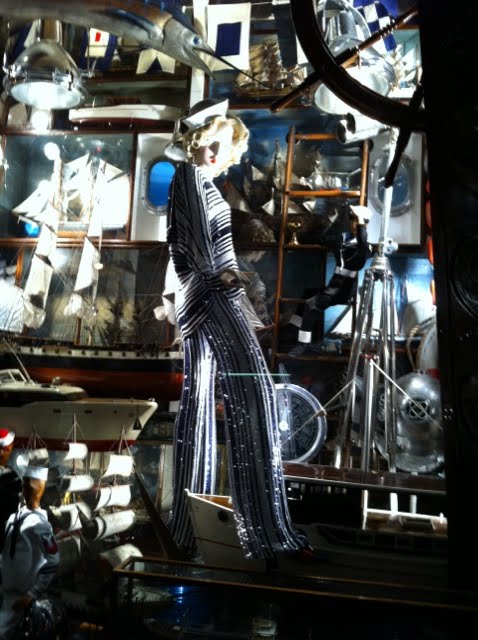
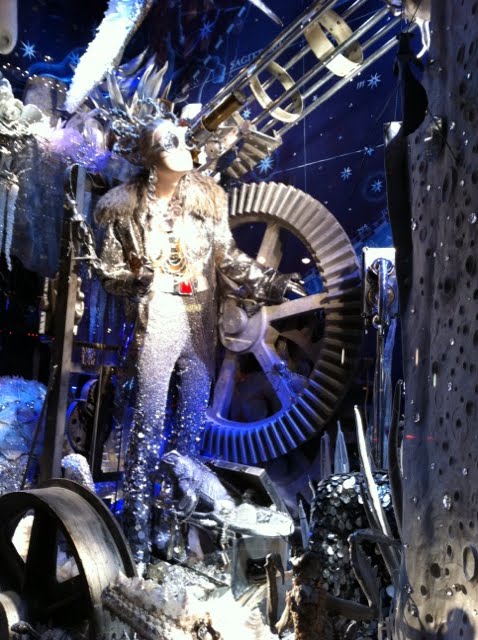
My own official kickoff of the Christmas season begins with my visit to the windows at Bergof’s. Midtown is so glutted with tourists that it took me almost 15 minutes to make the 5 blocks journey north on 5th Avenue between my office and BGs.

The arduous trek was well worth it. The theme of the windows this year is one near and dear to my heart: TRAVEL.

They’re called “Wish You Were Here,” and David Hoey’s signature wildly sophisticated vistas are visual meditations on the romance of different modes of travel: train, ship, mythological Pegasus; "day tripper" to the stars; hot air balloon; and Chitty-Chitty Bang Bang-like jalopy; as well as fantastic features of stunning ensembles with globes and maps. The zodiac pops up in various windows as part of the detail of the heavens.

Each window really is a masterpiece of art and design. The ultimate holiday windows for grownups.

What I also like about them is the “making of” video that Bergdof produced uses the song “Follow Me” by 17-year old Audrianna Cole. She’s the aural cousin of Pamplamoose, the other holiday go-to group this year (you know, those Hyundai commercials). Cole’s song is a nice echo of Twitter’s constant entreaty, and thoughts that travelers often have about loved ones who are nontravellers: Why don’t you follow me?

TV Imitating My Life

After my Bergdof’s visit I caught an episode of CSI: New York, which I never watch. But the plot was that Gary Sinises and Sela Ward go see the unveling of a department store’s holiday windows. And they see a pickpocket working the crowd, lifting wallets while people’s attention is focused on the windows.

That exact thing happened to me!! The ONLY time I have had my pocket picked in Gotham was many years ago, while I was looking at the windows of Lord & Taylor. I was working down on Wall Street at the time, but a meeting brought me to 42 street, and so I took the opportunity to see the windows. I felt so stupid. I live here, I’m supposed to know better. So this year I was extra careful and alert, and I left Bergdof’s with wallet and spirits intact.

Saturday, November 27, 2010

Where's M.A.?

I was happily one of 15,000 people on Thanksgiving morning in Manchester, CT, participating in a 74-year-old tradition of running 4.7 miles to usher in the holiday season.

The Manchester Road Race started in 1927 when the captain of the Manchester High School cross-country team was sad that his track season was over in early November, and thought it would be fun if there were a Thanksgiving Day cross-country race for the town. The Manchester recreation director got on board and then the town government, and so a tradition was started.

Today it’s competitors and customs. Generations of families run together, and there’s a contingent of imaginative costumes, including: blue bodied smurfs; suit and sunglassed Blues Brothers; an entire Thanksgiving dinner; a running Christmas tree; and several different groups of men in Hawaiian hulu outfits. Townspeople line most of the route, cheering people on, some blaring some inspiring music, which really does help. Various homegrown bands play for the crowd: rock bands play some mean Leonard Skynard and the Stones; there was a brass quintet; an accordion band; and the St. Patrick's bagpipe band from Glastonbury. The whole atmosphere is incredibly festive.

I was happy with my 63 minutes finish time for 4.7 miles. I had to power-walk up the big hill, but since I’ve been power walking in NY a lot longer than I’ve been trying to run, I didn’t fall too far behind in time.


Manchester, Then & Now
I wasn’t familiar with Manchester before my friends invited me along. I learned it was the site of the first successful professional silk mill in the US, founded by Ralph, Ward, and Frank Cheney in 1838. With the success of Cheney silks, Manchester grew into a quintessential company town. The town has preserved the remnants of the dynasty’s homes and mills, and its archives are an important source of knowledge for the mill production work of New England.

The family ran the company until they were bought out by JP Stevens in 1954. The town never recovered its company town prosperity and it has suffered in the recnt economic downturns. It is sprinkled with antique stores, and I guess it sees some business from the NY to Boston “antique-ing” seekers.

The race begins with the "Star Spangled-Banner," and after “on your marks, get set, go” is proclaimed, the race kicks off to a recording of Kate Smith singing “God Bless America” followed by Springsteen’s “Born in the USA.”

Somewhere amid all this ceremony I heard the announcer say something like “let us remember our neighbors,” and he read a fairly long list of names.

And then a chill went down my spine. I remembered. Manchester. There was a shooting in Manchester in August. A worker at a beer distributor was accused of stealing, and was asked by his boss to resign or be fired. After viewing videotape surveillance they had of him stealing from his route, he signed a resignation. He then asked to go get a drink of water, and he picked up 2 guns he had brought with him in his lunch pail. He shot eight people, and then himself. He had complained to his mother and girlfriend of racist treatment from his employers, though he had never filed a complaint with the union.

The announcer was reading the names of the those who were shot dead. Standing amid 15,000 people it was a poignant reminder how much our lives are affected by our neighbors. There are times when we celebrate together, sometimes even in running shoes. But the fabric of individual life and collective society is always very, very fragile.

Update 11/29: Turns out that Sports Illustrated columnist Peter King was at the race too. Here's his account (h/t my brother):

A good time was had by all at the 74th annual Manchester (Conn.) Road Race in central Connecticut Thanksgiving morning. What a slice of Americana. Ran in memory of my late brother Bob with his widow, Caroline; visiting daughters Laura and Mary Beth; nephew Evan and niece Laila, Bob and Caroline's children; along with their teammates from the South Windsor (Conn.) High cross-country team ... all in bright green "Bob's Team'' T-shirts designed by Laila. A great morning, though it was 29 degrees at the start of the race.

This was one of those leisure 4.8-milers, even with a mile-long winding hill early in the race, with 15 bands playing by the side of the Manchester roadways, and some of the most incredible costumes. Eight guys streamed past at one point in little loincloths and native-American feathers around their heads, wearing nothing else but running shoes. As one of the rock bands played "Fortunate Son'' on a lawn 1.5 miles into it, a guy dressed as one of the Hanson brothers from "Slapshot'' danced on the lawn with a woman dressed from head to toe as a bright red lobster. And so it went. Never had more fun running a race, even though I finished around 11,000th out of 15,000. At least I edged out 90-year-old Betty Hutchinson. Now that would have been embarrassing.

Wednesday, November 24, 2010

Counting My Blessings


Happy Thanksgiving everyone. I'll be running in the 4K Manchester Road Race this year. It's quite the tradition in Connecticut. Here are some wise words from Mr. Irving Berlin:

When I'm worried and I can't sleep
I count my blessings instead of sheep
And I fall asleep counting my blessings
When my bankroll is getting small
I think of when I had none at all
And I fall asleep counting my blessings