Showing posts with label current events. Show all posts

Tuesday, April 26, 2022

Et in Arcadia ego: Brideshead Revisited, Revisited


 I drank soda water and smoked and freted
until light began to break 
 and the rustle of a rising breeze 
turned me back to my bed.  
Charles Ryder, Brideshead Revisited
 
April 2022: the weather remains oddly cold, dreary.  Where, oh where is our Spring?

Nature's chill sends me back to my relationship with Evelyn Waugh's Brideshead Revisited. I am now Charles Ryder at the beginning of the novel, dealing with middle age--some regrets, some peace at where I am.

I came to the novel through the heralded 1981 Granada TV adaptation, which was the most lyrical, visually stunning program anyone had ever seen produced for TV.

The novel was one of many that my father picked up for me in the church thriftstore he and my mother visited every week, quietly building an impressive library for me until I was ready to partake.

The beauty of Brideshead is that it gives several of the ages of man a touchstone: I was in college when Sebastian & Charles seduced a TV generation. It was a thrill to be so young and read so young, to feel an affinity for the elan of their Oxford even in the quads of Rutgers.  Now I feel the weight and lightness of Charles's middle age, loving/understanding with a middle-age depth that the sanctuary light at the end does make all the difference.  (It's a nice touch that the first American edition of the novel was printed with a "sanctuary light" red cover. )

 ******

I first wrote this post several years ago when I had a very visceral reaction to a freakishly cold August. Same now for April 2022.

Thoughts of Brideshead flooded my thinking, along with long forgotten, but very stirring memories of my own visit to Oxford during my college years.

Midautumn has descended into the beauty of April. No, no, I’m not ready. I long for the warmth of air and brightness of the spring sun.

The relentless chill to rain will not last, they say.

This unnatural coldness has a strange affect on memory, summoning long unvisited thoughts. As I put on yet another sweater, Oxford 30 years ago fill my consciousness.

It’s Eights Weeks, and visitors are teeming everywhere. I’m with friends of friends at Wadham College boathouse to watch the races, followed by an "End of the Empire" dance.


We see a musical Alice in Wonderland performed in the Christ Church Cathedral Gardens. It is a magical, site-specific event: the Dean of Christ Church in Dodgson's day was Dr. Liddell & it was his daughters that Carroll wrote for. The Dean's Garden is next to the Cathedral Garden. The chestnut tree in the Dean's Garden is the one in which the Cheshire Cat sat, and Alice's little green door joins the two gardens. I feel like I have gone beyond the looking glass.

We attend a sung Eucharist at Christ Church Cathedral, the exquisite lines of Victoria Missa O Quam Gloriosum soaring up to Heaven. It was my fist experience of an English choir, and I did not know the tradition of boy sopranos. I kept looking for the women who were singing such extraordinary notes.

Then over to the Turf for lunch. In memory there is much sunshine and warmth and beauty.


These real experience of Oxford entwine in my heart with Waugh’s Brideshead Revisited.

In the coldness of August I feel his epithet for book 1: Et in Arcadia ego: the haunting Latin phrase on the tomb in Poussin’s pastoral painting, considered to be uttered by Death, “I am also in Arcadia.” I quietly despair the mirror Ryder is for me "I'm homeless, childless, middle-aged, loveless, Hopper."

The cold days in a New York August--a memento mori in the summer of a life. Yet. I am glad to be reminded of mortality, and Waugh, but thrilled that the warmth and sun of the season are coming back. It’s not over, there is eternally more. Something Captain Charles Ryder himself "found this morning, burning anew amid the old stones." I quickened my pace to the subway . . .

Monday, December 27, 2021

A New Year’s Reverie: When Memoirs Meet (Patti Smith, James Wolcott, Pauline Kael)

The streets are cold, it’s hard to get a cab, and your jacket isn’t warm enough--Metropolitan captures that chill discomfort and how the conversations that string between two people walking from one bleak stretch of the block to the corner are part of the invisible wiring of the city, the connective tissue through which memories, memoirs, novels, and, yes, movies are eventually made.

James Wolcott offered a Christmas Nocturne that pointed out why Metropolitan is a great Christmas movie.

For me, this part of his passage envisions the other holiday bookend, New Year’s Eve: wherever go you, you have to get back. However engaging the festivities are inside, they are so often connected by those cold, bleak, deserted streets in the middle of the night. And that connective tissue that spools out far beyond the chatter in the street is, as Wolcott says, the thing of memories and memoirs, which seems an appropriate subject for a December 31 post.

I read Patti Smith’s memoir Just Kids in September of this year, and segued into Wolcott’s memoir, Lucking Out. The two together captured the art and soul of the 70s and pinged points in my own timeline. Reading the first-person tales of these cultural players I felt like a little ripple in the water from their radiating splashes, if I may be allowed such an aquatic metaphor.  My timeline put me at Rutgers College, in New Brunswick, NJ, in the midst of two of its vibrant scenes—indie/punk music, and poetry.

The Court and the Melody

Patti’s description of the beginning of her performing life and Jim’s description of the CBGB scene from its birth rippled into my later memories of the Court Tavern and the Melody Bar, New Brunswick, circa 1981, a nexus for new bands finding their voice in reaction to the revolution of Horses, Talking Heads 77, the Dead Kennedys, the B-52s, to name some of the standouts. When live bands weren't playing, the speakers thumped the new sounds, new rhythms (Ce que j'ai fait ce soir-là, Ce qu'elle a dit ce soir-là . . . . .Ay Ay Ay Ay Ay Ay Ay Ay). It was a good time to be young and dancing, dancing, dancing, with the thoughts of those papers that needed writing sliding away in waves of sweat.

Even some frats, Fiji in particular, had the vibe in the early eighties, at least for their parties. “Pulled me up” shook the house following Donna Summer, and jocks and denizens of the artistic dorm, Demarest, jumped “up, up, up” together, rubbing elbows and other body parts for the duration of the song, replacing the antipathy the cliques had when the same people passed each other on College Ave.

Wolcott from the epicenter:
“If I can pinpoint the moment the Heads burst through the attic and pointed north, it was the night when they introduced a new number, “Pulled Up,” where the joy whoop of “you pulled me up, up, up, up, up, up!” expressed a giddy, salvational energy that left Warholishm behind like a toy-model village as Astronaut Byrne shed gravity and saw angels knocking around. Not Blakean angels, like Patti’s, but Japanese toys.”

Patti in the epicenter:
In 2010 Patti played a benefit for the Court Tavern, along with The Smithereens and Slaves of New Brunswick, at the State Theater. She had never played there herself, but knew of its historical importance and current need for young bands.


“Smith had two raps for the night, one being about not just saving the Court, not just saving New Jersey, but saving “the whole fucking world!,” her arms often outstretched to hold, or pumped in fists over her head in triumph. The other was about simple perseverance being the key to almost any undertaking in life. Be it music, art, or owning a bar, she hammered home, passionately, that it was the people who kept going that matter, despite being thrown down and fucked over again and again, the people who get back up and keep going, despite the odds, despite what others may care or think, are the ones who triumph.” Mike Black, The Aquarian


William Blake & Allen Ginsberg

 I lived off campus for 2 years in the town of New Brunswick, for a short time in Kevin Hayes's apartment on Plum Street that was party central for the academic set. 

Kevin had a tradition of an annual blow-out party for the vibrant poetry scene in NB. One party from 1981 or ‘82 stands out: Alicia Ostriker, a poet who taught at Douglas, edited an edition of complete Blake poems for Penguin, which Allen Ginsberg liked and used for his own work. I think Kevin had arranged for Ginsberg to come for a reading, and then there they were in my old living room, along with the editors of the newly launched lit journal Long Shot, Eliot Katz and Danny Shot, and 100 others on couches, under couches, virtually hanging from the chandeliers. It was the scene from the film Breakfast at Tiffany’s, minus the suits (but with several B-52's inspired bouffants).

At one point I was in the kitchen talking to someone about my Milton class with the delectable William Keach when Gregory Corso walked in looking for a bottle opener for his beer, and saying, “Milton. So here’s where all the intelligent people are.” What a great opening line. I’m sorry to report I was too unsure of myself to engage him in conversation. The graduate students, however, pounced.

Somewhere long after midnight I was standing on the 4th or 5th step down from the top of the stairs to the apartment, having a conversation with someone sitting on the landing. The door opened and Allen Ginsberg and some of his entourage were leaving. As he walked down the stairs behind me, he turned and kissed the back of my head. A literary benediction of the highest order. A little of just what an English major hopes to find at college.

Patti from the epicenter:

“...I went through our belongings and found exactly fifty-five cents, slipped on my grey trench-coat and Mayakovsky cap, and headed to the Automat. I got my tray and slipped in my coins but the window wouldn’t open. I tried again without luck and then I noticed that the price had gone up to sixty-five cents. I was disappointed, to say the least, when I heard a voice say, “Can I help?”I turned around and it was Allen Ginsberg.

We had never met but there was no mistaking the face of one of our great poets and activists. I looked into those intense dark eyes punctuated by his dark curly beard and just nodded. Allen added the extra dime and also stood me to a cup of coffee. I wordlessly followed him to his table, and then plowed into the sandwich. Allen introduced himself. He was talking about Walt Whitman and I mentioned that I was raised near Camden, where Whitman was buried, when he leaned forward and looked at me intently.

“Are you a girl?” he asked
“Yeah, I said, Is that a problem?”.
He just laughed. “I’m sorry. I took you for a very pretty boy.”
I got the picture immediately.
"Well, does this mean I return the sandwich?"
"No, enjoy it. It was my mistake."

He told me he was writing a long elegy for Jack Kerouac, who had recently passed away. “Three days after Rimbaud’s birthday”, I said. I shook his hand and we parted company.
Sometime later Allen became my good friend and teacher. We often reminisced about our first encounter and he once asked how I would describe how we met. “I would say you fed me when I was hungry”, I told him. And he did.”


Circles and Squares
 I took one film theory class in college, where we worked our way through the big Gerald Mast/Marshall Cohen compendium, which put Pauline Kael’s "Circles and Squares" right after Andrew Sarris’s "Notes on the Auteur Theory in 1962" so you can easily read the two together.

That’s a treat everyone should enjoy once in their lives.

Kael eviscerates Sarris with the simplest of tools: a close reading of the text, with her passion for what she sees as the idiocy of the approach—-and particularly his use of “internal meaning” and “élan” which she hammers on repeatedly-—making the pages almost too hot to turn.

One example, but there are so many:

"Sarris believes that what makes an auteur is 'an élan of the soul.'(This critical language is barbarous. Where else should élan come from? It’s like saying “a digestion of the stomach.” A film critic need not be a theoretician, but it is necessary that he know how to use words. This might, indeed, be a first premise for a theory.)"

Later she cries, “I am angry, but am I unjust?”

Wolcott from the epicenter:

"She couldn’t stand 'stiffs,' whose tastes were fully formed, rigidified, and stuck in the petrified forest of the past, and those of us sitting in the Algonquin were on the upswing of our careers, just starting our scouting missions. These were the years of encouragement. Some would stray off target, disappear into the reeds, defect from criticism under the pressure of unfulfilled expectations and career frustrations, or simply find something more frolicking to do, Pauline being more ambitious for them than they were for themselves. In a sense we would all fail Pauline because none of us would surpass her defiant nerve, her resounding impact.”

Pauline Kael was the second film critic I became aware of as a teen, when I discovered The New Yorker. (The first was Vincent Canby, because my parents were New York Times readers). I loved her writing, her voice, her mind.  Fast forward to September 3, 2001, I happened to be walking through a nighttime Times Square with The Talented Mr. Ripley and Cadfael, itself quite a moment in my own timeline. I looked up to see Pauline Kael dead at 83 making its way along the zipper. Neither of companions felt the pang of that news, which surprised me. Crossroads of the world, a crossroad of my life (although I didn’t know it then) and now the end of era, which was just a week away from the end of life as we knew it. Not what Kael had in mind when she opposed Sarris's Circles with Squares, but a cinematic moment I hope she would appreciate.

Happy New Years everyone! 

Patti Smith at State Theater Court Tavern Benefit, cover of Jim Carroll's "People Who Died"

Friday, November 9, 2018

The Centenary of the Armistice: A Personal Cycle Closes and a Gash That Never Heals


"Every war is ironic because every war is worse than expected... Its means are so melodramatically disproportionate to its ends... Millions were destroyed because two people, the Archduke Francis Ferdinand and his consort, were shot... But the Great War was more ironic than any before or since. It was a hideous embarrassment to the prevailing meliorist myth... It reversed the idea of Progress."
Paul Fussell


This Sunday, November 11, 2018, at 11:00 am, a personal gyre of history closes for me.

I entered college with an attachment to the First World War, if that’s what you can call it, because of T.E.Lawrence. I had read through Seven Pillars of Wisdom in high school and fallen under its heady spell. Lawrence was a gifted writer who embodied the English literary tradition from the inside, and he wrote his own mythology simply because he could: he knew the power of the trope and how to wield it (and saw an opportunity in the newsreels of his own personal Barnum, Lowell Thomas).

To my Freshmen amazement, there was a class on World War One Literature, taught by Paul Fussell, based on his own National Book Award-winning The Great War and Modern Memory. It’s a cultural study/close reading of the literary tradition before WW1—particularly poetry--- and how it changed during and in relation to the war.

We did not study Lawrence, but I discovered the vast and profound literature of Siegfried Sassoon, Robert Graves, Wilfred Owen, and the work of Sir Martin Gilbert, John Keegan, and Bernard Bergonzi. Few people were looking at this work in the 1980s, and it made a deep impression on me.

The Shell Shocked Lord Peter

Also in college I discovered the novels of Dorothy L. Sayers, and her Lord Peter Wimsey novels. Her novels are murder mysteries, not Zola-like realistic drama but it is notable that her sleuth is suffering from shell shock.  It is worked into the stories in such a matter-of-fact way, such was the reality of the fate of the returning servicemen from World War 1.

Wimsey is seen as a foolish ass in some ways to start, but we learn that he was severely injured by artillery fire near Caudry, France, and suffered a complete breakdown when he was demobbed. The foolish demeanor is his way of coping with the shell shock.

In Whose Body, the first Wimsey novel, when he pushes himself too far it leads him to hallucinate he is back in the trenches. Luckily his manservant Bunter is nearby:

"Put that light out, damn you!" said Wimsey. "Listen—-over there-—listen—can't you hear it?"

"It's nothing, my lord," said Mr. Bunter, hastily getting out of bed and catching hold of his master; "it's all right, you get to bed quick and I'll fetch you a drop of bromide. Why, you're all shivering—you've been sitting up too late."

"Hush! no, no—it's the water," said Lord Peter with chattering teeth, "it's up to their waists down there, poor devils. But listen! can't you hear it? Tap, tap, tap—they're mining us—but I don't know where—I can't hear—I can't. Listen, you! There it is again—we must find it—we must stop it . . . Listen! Oh, my God! I can't hear—I can't hear anything for the noise of the guns. Can't they stop the guns?"

"Oh, dear!" said Mr. Bunter to himself. "No, no—it's all right, Major—don't you worry."

"But I hear it," protested Peter.

"So do I," said Mr. Bunter stoutly; "very good hearing, too, my lord. That's our own sappers at work in the communication trench. Don't you fret about that, sir."

Lord Peter grasped his wrist with a feverish hand.

"Our own sappers," he said; "sure of that?"

"To be sure they will," said Mr. Bunter, "and very nice, too. You just come and lay down a bit, sir—they've come to take over this section."

"You're sure it's safe to leave it?" said Lord Peter.

A later novel, The Unpleasantness at the Belladonna Club, begins on Armistice Day, 1928, and the plot revolves around the fact that for the 2 minutes of silence at 11:00 am on November 11, nobody moves, so the killer can get to his target unseen.

It’s also notable for this exchange between Wimsey and Captain Fentiman from the war:

George: "I wish to God Jerry had put me out with the rest of ‘em. What’s the good of coming through for this sort of thing? What’ll you have?”

Wimsey: “Dry Martini.  Cheer up. All this Remembrance-day business gets on your nerves, don’t it? It’s my belief most of us would only be too pleased to chuck these community hysterics if the beastly newspapers didn’t run it for all it’s worth. However, it won’t do to say so. . . .How are things going for you?

George: “Oh rotten as usual. Tummy all wrong and no money. What’s the damn good of it, Wimsey? A man goes and fights for his country, gets his inside gassed out, and loses his job, and all they give him is the privilege of marching past the Cenotaph once a year and paying four shillings in the pound income-tax.”

* * * * *

That negative feeling toward the Remembrance Day services has been around since they began, particularly from the men and women who served. They ceremonies provide a psychological balm for some, and not for others. If there were no ceremonies, no remembrance, would that be better?

This lucite statue was created by the Commonwealth War Graves Foundation in collaboration with the Remembered and its inaugural Armistice 2018 Project, There But Not There. The poppy is from the gift shop at the Flanders Museum in Ypres, Belgium, the medieval Cloth Hall that was completely razed in WW1 and then rebuilt.

The problem of shell shock, of PTSD of the gash to the souls of the combatants--will continue as long as soldiers are sent to war to kill each other.  It's a matter of life and death for us all.

Saturday, November 4, 2017

Thomas Hardy's Guy Fawkes Bonfire & the Lessons of Eustacia Vye


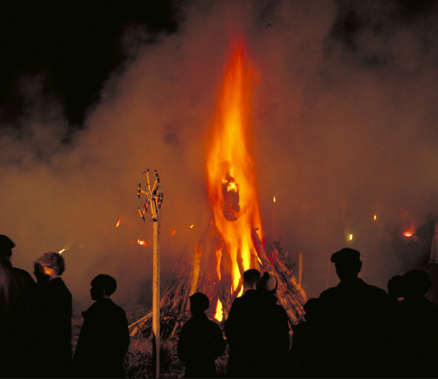
While the men and lads were building the pile, a change took place in the mass of shade which denoted the distant landscape. Red suns and tufts of fire one by one began to arise, flecking the whole country round. They were the bonfires of other parishes and hamlets that were engaged in the same sort of commemoration. Perhaps as many as thirty bonfires could be counted within the whole bounds of the district.

It was as if these men and boys had suddenly dived into past ages, and fetched therefrom an hour and deed which had before been familiar with this spot. The ashes of the original British pyre which blazed from that summit lay fresh and undisturbed in the barrow beneath their tread. Festival fires to Thor and Woden had followed on the same ground and duly had their day. Indeed, it is pretty well known that such blazes as this the heathmen were now enjoying are rather the lineal descendants from jumbled Druidical rites and Saxon ceremonies than the invention of popular feeling about the Gunpowder Plot.

Moreover to light a fire is the instinctive and resistant act of man when, at the winter ingress, the curfew is sounded throughout Nature. It indicates a spontaneous, Promethean rebelliousness against that fiat that this recurrent season shall bring foul times, cold darkness, misery and death. Black chaos comes, and the fettered gods of the earth say, Let there be light.

Thomas Hardy set his beguiling The Return of the Native in his beloved Wessex, around Guy Fawkes Day. 


Hardy's Bonfire on Egdon Heath and Eustacia Vye
Hardy wrote Return of the Native in 1878.  I love that he focuses on the primal urges of the bonfire—the Lux Fiat against the darkness—as the heart of the tradition, and not the echoes of the Gunpowder Plot with its religious baggage.

I read The Return of the Native in high school, a novel well matched to that time and place. Wildeve, the heath, the bonfires, the odd, red Diggory Venn character, cross-dressing mummers, burning a foe in effigy, Hardy’s relentless themes of loneliness and isolation—does anything more clearly speak to the surging angst of high school?

And to top it off, I connected with the tortured, sad, exotic figure of Eustacia Vye, deemed by a chapter heading to be Queen of the Night. It’s hard not to read Hardy as mocking his heroine, but this was a serialized novel during Victorian times, and modern irony was still waiting just over the horizon in the No Man's Land of World War I:

"Eustacia Vye was the raw material of a divinity. On Olympus she would have done well with a little preparation. She had the passions and instincts which make a model goddess, that is, those which make not quite a model woman."

Hardy’s Tess has gotten the serious attention through the years, and we won’t even talk about the effect Jude the Obscure's Sue Bridehead and Father Time have had on subsequent literature.

But for me, Eustacia is the character that made me feel less lonely in high school, because she was so solitary.

She enters the story silhouetted against the Guy Fawkes bonfire:

"When the whole Egdon concourse had left the site of the bonfire to its accustomed loneliness, a closely wrapped female figure approached the barrow from that quarter of the heath in which the little fire lay.

Her reason for standing so dead still as the pivot of this circle of heath-country was just as obscure. Her extraordinary fixity, her conspicuous loneliness, her heedlessness of night, betokened among other things an utter absence of fear."

A tract of country unaltered from that sinister condition which made Caesar anxious every year to get clear of its glooms before the autumnal equinox . . . was not, on the face of it, friendly to women."


Hardy's language is a joy: "extraordinary fixity." It is astounding that he would write of a woman in terms of such strength—"utter absence of fear"—while understanding that such fearless independence can also be isolating. That was comforting to hear in high school.

Eustacia suffers from yearnings of grandeur: she is trapped by class and circumstance to live on the heath, which she detests, while she’s tormented by delusions of living in Paris. She yearns for love in an equally distraught way. Much of the book is overwrought passages about her comings and goings on the heath, as she walks between bonfires.

Yet, amid all the hype, I found a metaphor that seared into my teenage memory.

". . . a clue to her abstraction was afforded by a trivial incident. A bramble caught hold of her skirt, and checked her progress. Instead of putting it off and hastening along, she yielded herself up to the pull, and stood passively still. When she began to extricate herself it was by turning round and round, and so unwinding the prickly switch. She was in a desponding reverie."

Important lesson for women: beware the brambles of life because they will snag the hem of your dress if you are not careful. If you are not vigilant, they will keep you motionless, throw you into a desponding reverie,  or worse. Clear them away, or at the least, walk around them.

Here's the rub: It’s not always easy to see these low-growing thorns, especially when your gaze is focused elsewhere than on your feet, like when looking up at a glorious sky or into the eyes of a beloved or at the bobbing head of a toddler. And that's when you can get ensnared . . .

But since high school, I have been on the outlook for those brambles. And it has helped. Thanks, Hardy.

Thursday, August 31, 2017

Two Women for the Ages: Princess Diana & Mother Teresa, 20 Years in Heaven

 Time marches on. It is twenty years now since these two extraordinary women died 6 days apart in 1997. They had met just two months earlier that year, June 18, 1997, when Diana visited one of the Missionaries of Charity in the Bronx. 

How oddly fitting that Princess Diana and Mother Teresa, who had some connections in life, are connected to each other in death because they died six days apart in 1997. The coverage of Diana’s death made for a somewhat memorable Labor Day weekend that year, which then rolled right into the coverage of Mother Teresa.

And now, this week, we pause to remember that it has been twenty years since Diana died in a car crash. At the ten year anniversary, the book Mother Teresa: Come Be My Light came out, along with an article in Time that put forth the extraordinary idea that Mother Teresa basically lost her faith just at the moment she started the work with the poorest of the poor for which she is known.

Princess Diana, Escaping for Love
I happened to be awake 20 years ago when the first reports of Diana’s car accident broke into CNN. Shortly after, her death was announced, and it was shocking, in the way that John F. Kennedy Jr.’s death was. Young people with all the earthly gifts possible, dying in sudden, violent ways makes one stop for a moment. You intellectually know that this very day can be your last, but incidents like this make that idea more tangible.

I haven’t read Tina Brown’s book nor any of the cottage industry of tell all rags on the princess, but I have kept up with her story over the years. We share a birth year, but while she was getting married in 1981, I was off crewing on a schooner and didn’t get to see the wedding. My feminist friends at college had given me a “Don’t Do It Di” button, which their English counterparts had made up following a headline in the feminist magazine Spare Rib. But I didn’t understand it back then. I didn’t know what they were talking about, why shouldn’t she marry her prince, an actual prince? I think theirs was a general invective against the patriarchal monarchy, but how eerily prophetic was their warning.

The draw of the Royals, for most people, is simply that it’s a family writ larger than in our own homes. The saddest part of their particular mess is the triangle of Charles and Camilla and Di. Having a husband/lover who is always thinking of another is a soul crushing, living hell. It’s a shattering experience, and whatever personal struggles and demons Diana had herself—-bipolar/borderline personality, bulimia-—the unrelenting presence of Camilla in her marriage doomed any spec of happiness she might have known.

And to make it worse, Diana was horribly subjected to the subtle and not so subtle power plays from everyone around her. For instance, Camilla supposedly is responsible for Di getting into that monstrosity of a wedding dress, under the guise of the old guard helping her. Parker-Bowles supposedly laughed and laughed with her friends at how successful she was in making the wedding of the century look buffoonish. (This sickening power play is at least a plausible explanation for that nightmare in taffeta.)

It also illuminates how utterly Diana’s mother was missing from the whole equation, and what a devastating absence it proved to be. Frances Althorp Shand Kydd was an enigmatic woman. She also married young, to an older man of stature, and found herself in an unhappy marriage. She had an affair with Peter Shand Rydd, and a year later divorced Diana’s father and married him. (He would leave her years later for a younger woman.) It seems that with this kind of split, where Lady Althorp's own mother testified against her in the custody hearing in favor of Lord Althorp getting custody of their children, she wasn’t very close to her daughter at all, and that’s very sad for both of them.

In the end, I admired Diana for playing the hand she was dealt. She developed her dazzling style and looks as a way to parry the blows to her self esteem from the Royal family. She refused to stay in a sham marriage, and believed that she could have actual love with the right man, if she could find him. She saw two little boys through their early childhood with much genuine love and caring. And in the larger historical dimension, she reinvigorated the monarchy for all time. It was a short life well lived.

Mother Teresa, Losing Her Faith
Mother Teresa died six days later on Sept. 5. She was 87 years old, and her death was neither sudden nor violent. The ten-year mark saw the publication of Mother Teresa: Come Be My Light, a collection of letters in her own hand that speak to her loss of belief in God. Teresa had been an ordinary teaching nun of the Sisters of Loreto of Ireland for 15 years when she received a “call within the call” to leave her convent and work with the misery of the world’s poorest poor.

What follows is a life that has been lionized and pulled apart from every angle. Either her homes for the poor are badly run or they aren’t. There are questions of where all the donations to her Sisters of Charity go—so the accounting is questionable. There’s the question of her judgment, in aligning herself with the likes of Charles Keating. Nothing here is surprising. Human institutions and their leaders are always corrupt in some way.

But her internal loss of faith is startling. For fifty years she struggled to regain her faith in Christ: “for there is such terrible darkness within me, as if everything was dead. It has been like this more or less from the time I started 'the work.'"

Even the Eucharist had no meaning for her, which pretty much caps it: “I just have the joy of having nothing — not even the reality of the Presence of God [in the Eucharist]."

For the cynics team, this means she lead a life of complete hypocrisy. That she “knew” there was no God, and she didn’t have the courage to admit it. Of course she has no more actual knowledge on the subject than any of us. She was canonized a saint in the Roman Catholic Church on September 4, 2016.

Just as Princess Diana was subjected to much armchair psychology, there are theories in the Time piece that Mother Teresa needed to sabotage her own success. Maybe. Maybe she wanted to leave her institution just as much as Diana wanted to leave hers, but didn’t have the strength or ability to make it happen.


I find much to learn from both of these larger-than-life women, and it all comes back to love. As a late teenager Diana thought she had found it in Charles, and she paid for her misperception for the rest of her life, and one could argue, with her life. Mother Teresa once felt a presence of Christ’s love so strong that it negated the need for the love of an earthly kind. She was surprised and saddened when she later felt that His love had abandoned her, and she faced fifty years in a depressed darkness where she simply continued on as best she could. Such is the reality of many lives.

The two women admired one another, and I read somewhere that Diana is buried with a rosary that was a gift from Mother Teresa. Considering what an RC custom that is, it seems a little unlikely, but it’s a lovely thought.

Here’s the stirring hymn from Diana’s funeral, I Vow to Thee My Country.

Saturday, April 22, 2017

Massive MTA Failure: Sadly, Nothing New.

The MTA has been failing its costumers on an epic scale lately.  Yesterday's commuting nightmare also had Con Edison pitching in: NY Times "Why a Midtown Power Failure Snarled Your Morning Commute."  Snarled is a pretty cozy word for soul-sapping mess.  

Funny thing, when I was googling for info about yesterday's mess (April 21, 2017), I kept landing on articles I thought were about it, but were about other recent messes: "Chaos as power blackout hits New York's Grand Central bringing trains to a standstill" is from January, 2013

There really are too many examples to list, except perhaps for the one I've pasted below. From August 1980!

Kudos to The New York Times archives.  I started commuting from Long Island into Manhattan in high school during the summer of my junior year when I got an internship at The Metropolitan Museum of Art. It was soul-sapping (I know I've said that before.)  I was young and wanted to shout and scream about how awful this daily experience was, and of course was really thrilled when the NY Times ran it.

Even more satisfying: my brother, who also commuted, was on a Penn Station platform, trying to get to the stairs to get to the street, hemmed in by too many people who can but shuffle inch by inch to keep going, when he heard a guy say to his friend, "This is just what she was talking about."  He had read the article!  

Thirty years on, and commuters are still cattle. Maybe that is simply the fate of city dwellers.  


Friday, April 14, 2017

Mystical Connections This Weekend: Our Titanic Catharsis, Lincoln’s Assassination, and My Dad’s Easter Memorial


The wheels of history have turned to align us today to the same days to dates as 1865.

In Daniel Mendelsohn's excellent 2012 New Yorker article "Unsinkable, why we can't let go of the Titanic" he noted an historian once quipped that "three most written about subjects of all time are Jesus, the Civil War, and the Titanic."

This weekend hits this trifecta perfectly. 

1. Abraham Lincoln was shot on Good Friday, April 14, 1865, and died at 7:22 am on April 15, Holy Saturday. Just how mystical was that extraordinary man?

2. Not aligned to 2017’s days, but we still have the annual parallel to Lincoln’s assassination: The Titanic hit an iceberg on April 14, 1912, at 11:40pm,  and broke in two and foundered at 2:20am on April 15.

3.  Easter Sunday, April 16, happens to be 32 years since my father died.


******

I have felt some connection to the Titanic my whole life. I have an early memory of my dad in the kitchen filling the old metal ice cube trays. He brought it up, for no particular reason, saying that the Titanic was supposed to be unsinkable because of its watertight compartment, but that they didn't have tops, like this tray.

"Nearer My God to Thee" was in my Magnus Organ book. I knew those words and that tune since I was 6, and later learned it was what the musicians played as the Titanic sank. (Apocryphal or not, the NY Times had the music for "Autumn" on their page as part of their coverage the next day in 1912.)

It happened that I went to college in Southampton, England, where the Titanic started her voyage with such hope. I visited the small museum they had in the 1980s, but they have just opened a new, more elaborate center. Later I moved to 106 Street and Broadway, where Straus Park is. It has a memorial called "Memory" to Isidor and Ida, the Macy's magnates, who died together rather than being separated. The sculpture is by Augustus Lukeman, and this line from 2 Samuel 23 is etched into the bench: "Lovely and pleasant were they in their lives and in their death they were not parted.” The original reflecting pool has been replaced with a flower bed. (My photos above and below.)

I remember weeping through A Night to Remember when I saw it as a kid. It was directed by Roy Baker, who went on to direct 8 of the best 1965/66 Avengers episodes, another connection!


Following Mendelsohn's rhetorical "why we can't let go of the Titanic," here are some of the usual reasons pointed to:
*The hubris of declaring a ship "unsinkable" was just begging for karma to act; naming the ship after the gods was bad enough

*"Tall as an 11-story building and constructed from 46,000 tons of steel, it was the largest moving object on earth" -- so what was it doing trying to float?

*The Carpathia steaming to the rescue, but too late for most, the much closer California tragically asleep

*Captain Edward Smith going down with the ship but the ship line owner J. Bruce Ismay jumping into a lifeboat and surviving to a lifetime of shame

*The New York Times has pdfs of their original coverage, all of which is fascinating. It started the reports of the first time "women and children" had been given as an order, and the first time SOS is actually used for distress, in addition to the longer standing CQD [ based on the French for secur, help, then the word distress].

But somehow the place Titanic has had in our minds for generations since April 15 is more than all those points.

My Titanic Thoughts:

*People had been crossing the Atlantic commercially since the mid1800s. They were on the boat for vacation, to see the world, to join family, to go to a new job, to start a new life. It's every circumstance of living in one defined place subjected to the cruelest way to die: unexpectedly, and in great pain.

•A ship on the ocean is powerful and vulnerable at the same time. It is a floating small city built not on concrete, but on the Archimedes principle: "Any floating object displaces its own weight of fluid. " Buoyancy is great while it works, until it doesn't.

*Then what seemed as solid as Manhattan is but a speck easily swallowed up by the might of the world's oceans.

As flies to wanton boys are we to the gods; They kill us for their sport

*What haunts my mind is the overwhelming force of the water filling the ship, taking over every physical space where there once was oxygen, including in the lungs of those on board. The men in the engine room, who worked the brutal job of keeping the boilers stoked to make the steam, died first . . .

*That horrible feeling the moment something has happened: like hearing your knee pop and knowing that it's going to need surgery. The captain and senior officers knew from the moment of the ice on the foredeck that the ship was going to founder. 

*The scenes all the movies portray of the panic of the third class/steerage passengers struggling to climb to deck level, some finding passage ways locked. It is a nightmare come to life.

*Doesn't everyone wonder: what would I have done on the Titanic? Would I have been smart and lucky enough to survive?

*Rearranging the chairs on the Titanic is generally an idiom for futility, but I once read a scientist argue that if you were able to strap enough chairs together you might make yourself something to float on.

In the hundred years since, there have been thousands of maritime disasters including ferries with the death toll in the tens of thousands.

But it's impossible to empathize with all of that. And that's what the Titanic provides us: a story that connects us to our collective vulnerability and mortality. That's why we need it. The photo that I took of the Straus memorial shows someone had recently put a bouquet in her hands.

And then the myth takes us even further: it has allowed generations to feel a cathartic grief for the suffering and death of more than a thousand people dying at once, in daily life (not on a battlefield). Sadly, not for the last time.


Thursday, April 6, 2017

100 Years Ago Today the Americans Enter WW 1, to "Oh, were the Americans in the Great War?"


An American Doughboy receives a medal from King George V, World War 1
Updating this post on April 6, 2017, commemorating one hundred years ago today we entered World War 1.

An odd occurrence connects my recent trips to Italy and England. It concerns two conversations with Englishmen of a certain age (let's say somewhere 60 to 70) in both places.

In general chit chat with each man I asked if he had seen the play War Horse. Neither had, though both knew of it and had read about it.

I was interested to pose an observation to the play—which I've seen both in London and New York—to each: that it was an extraordinary theatrical experience, but I was surprised that there was no character, or piece of dialogue, or even hint that the Americans fought for the Allies in World War 1. There is a battle scene in France, with the Brits, French, Germans, and then all of a sudden, it's Armistice, Victory, end of the war.

I was simply surprised that there wasn't one line of dialogue about the Yanks coming over. I don't mean that there should have been a whole scene, or even American character, just a reference to the forces that entered and helped to bring the war to its end. (I know the play doesn't reference the Russians, Austrians, or Italians either, but that little Second Battle of the Marne turned the tide of the war, so we're not just a footnote.)

Then each Brit—in two different countries—said the same thing to me in response:

"Oh, were the Americans in World War 1?"

Wow. Ouch. There was no irony here, it was not leg pulling. These men were highly educated guys. How could they not know that we went "over there." It's a George M. Cohan song: "and we won't come back 'til it's over, over there" sung at the end of the James Cagney film Yankee Doodle Dandy. On the actual battlefields it was the Doughboys, remember?

Service & Sacrifice

It is notable, to an American visiting France, England, Italy, to see the names of the war dead cut into stone memorials in every town, no matter the size, as well as into churches and colleges across the country. (That is not our way, even though towns across the midwest lost tens of thousands of boys to the foreign fields during WW1 & WW2.)

I was reminded of this again at my recent visit St. John's Chapel, Cambridge, and in the Uppingham parish church, each of which had the all too-long list of a generation of young men, killed during WW1 and remembered by name.

The number of American lives lost---around 116,000---does not compare in number to the almost 3 million British lives lost. But remember that the US was no super power in 1914. We were a nation of teaming, recent immigrants from Germany, France, and Ireland, which argued for US neutrality, something Woodrow Wilson fought hard to maintain.

Lest we forgot, here's a quick recap of the Americans in WW1, courtesy of lots of Wiki pages:

•German U-Boat's dominated the early part of the war. The Lusitania— a passenger liner which later was proved to be carrying ammunition—was torpedoed and sank on May 7, 1915, in 18 minutes.

1,959 crew and passengers; 1,198 died, 761 survived. 139 of the dead were Americans, 9 survivors.

Unlike the attack on Pearl, this was not enough to pull the US into the war immediately, although it was something the country remembered.

•President Woodrow Wilson worked hard for American Neutrality, following contemporary leaders from all walks of life who descried the war and insisted the US stay out of it: Secretary of State William Jennings Bryan, Henry Ford, Samuel Gompers, and the Progressive Movement Jane Adams, just to name a few

*In 1917 Germany stepped up the Uboat activity even further, threatening passenger liners directly with the hopes of bringing the US in the war. That combined with the Zimmerman Telegram--a proposal from German Empire to Mexico to declare war against the US that was intercepted and decoded by the British---finally tipped the scales.

•President Wilson asked Congress for "a war to end all wars" that would "make the world safe for democracy," and Congress voted to declare war on April 6, 1917.

By June 1917, 14,000 U.S. soldiers had arrived in France, and by May 1918 over one million U.S. troops were stationed in France, half of them on the front lines, with troops arriving at a rate of 10,000 a day at a time Germany could not replace its losses.

In total we mobilized 4 million military personal and fought in 13 campaigns

Cambrai, November 20 to December 4, 1917
Somme Defensive, March 21 to April 6, 1918
Lys, April 9 to 27, 1918
Aisne, May 27 to June 5, 1918
Montdidier-Noyon, June 9 to 13, 1918
Champagne-Marne, July 15 to 18, 1918
Aisne-Marne, July 18 to August 6, 1918
Somme Offensive, August 8 to November 11, 1918
Oise-Aisne, August 18 to November 11, 1918
Ypres-Lys August 19 to November 11, 1918
St. Mihiel, Sept. 12 to 16, 1918
Meuse-Argonne, Sept. 26 to November 11, 1918
Vitto Veneto, October 24 to November 4, 1918

My grandfather, Arthur Cornelius Brown, was drafted in in May 1917, and served through June 9, 1919. He was one of the lucky ones.  He was not shipped overseas, but served his time in Brooklyn, in Fort Hamilton. The family story explains that he could not wink.  Which meant that he would be a very lousy shot when trying to fire a gun.

I have a feeling that if the war had continued on longer, he would have been sent regardless, being otherwise an able-bodied man.


The American World War 1 Cemeteries
Many men were not as lucky as my grandfather, as the cemeteries of Europe attest to. Off they went, Over There, never to return to the farms and cities they left.

There are 8 American World War 1 cemeteries in Europe: 6 in France, 1 in England, 1 in Belgium. Not surprisingly, they shadow the campaigns. The cemeteries are maintained by the American Battle Monuments Commission, which has an excellent website. Links to some of the videos below, a lot more on their site, and many photos.

From some of the close-ups on the tombstones you see Nebraska, Oklahoma, Wisconsin, Ohio et al., reminding us that it was the farm boys who left the farm to fight against the strange sounding Kaiser,  and died so many miles from home.
 

Belgium: Flanders Field American Cemetery & Memorial

John Mcrae wrote his haunting "In Flanders fields the poppies grow/Between the crosses, row on row" in 1915, after burying a friend following the second battle of Ypres. McCrae himself is buried in Wimereux Cemetery, in the Commonwealth War Graves section. He died of pneumonia at a field hospital in Boulogne.

England: Brookward

France: Suresnes

Aisne-Marne

Oise-Aisne, it's where the poet Joyce Kilmer is buried

Somme American Cemetery

St. Mihiel

Meuse-Argonne American Cemetery
14,246 Americans are buried there, the largest interment of U.S. war dead in Europe in one cemetery


Sunday, September 18, 2016

Woody's 1979 Manhattan Fantasy Meets 2016 Manhattan Reality


When I saw the schedule for New York Philharmonic 2016-2917 Art of the Score series my heart jumped: GERSHWIN!  I mean, the Woody Allen 1979 film, Manhattan.

And that was the rub. The brilliance of George Gershwin played live by the NYPhil set to the awe-inspiring cinematography of Gordon Willis was wrapped around the Woody Allen film with the story line involving a 42-year-old man and a 17 year-old girl.

My love of Gershwin won out over my disappointment in Allen, and I bought tickets for the Saturday, September 17 8:00pm performance.

The NYPhil did not disappoint. That opening sequence to Rhapsody in Blue was spine-tingling, the full power of a live symphony crashing below the stunning montage of Gordon Willis's cinematography. The audience broke out in wild applause after that opening, unable to retain the "we don't clap before the whole piece is over" protocol.

What I did not know was that while I was safely in my seat at Lincoln Center with my nephew, a bomb was exploding in Chelsea, and another was set. As of this writing, still unclaimed. Who set them? Why? What do they hate so much?

So chance had it that it was a night of two Manhattans: The romantic fantasy of 1979 Manhattan, which already had sad undertones of the reveals of Allen's personal life in the ensuing years,  colliding with the reality of violence 2016. My head and heart are spinning.


Back in the Day
I saw Manhattan in 1979 at the same age that Mariel Hemingway is in the film, the spring before I went off to college.

I was born in Brooklyn and grew up on Long Island, but I already had a relationship with Manhattan since I commuted to an internship at the Metropolitan Museum of Art as a high school junior. It gave me that strong, life-long emotional attachment that "this is my city."

And so the film in 1979 was pure catnip for me: YES, the vistas, the music, the lightning fast lines of the character Isaac, and Diane Keaton's pseudo intellectual Mary. I think I recognized the pseudo part, but as I was off to college I still connected with the celebration of the cerebral. The film made me feel connected to the literary life I hoped lay beyond that Manhattan skyline for me.

The script is filled with memorable, funny lines, from when Allen "was still funny." I have known and quoted and loved these lines my whole adult life:

Isaac Davis: 

I think people should mate for life, like pigeons or Catholics.

[They're] like the cast of a Fellini movie.

Really? Because I always feel very few people survive one mother.

. . . the winner of the Zelda Fitzgerald emotional maturity award.

Mary Wilke: Hey, listen, I don't even wanna have this conversation. I'm just from Philadelphia, you know. I mean, we believe in God.

The situation with Allen's personal life can't take that away from me (cue Gershwin, yet again).

The most chilling dialogue in the script is when Isaac goes to confront Yale that Yale and Mary have reconnected. He plays the moral card. The 42-year old man dating a 17 year old, plays the moral card:

Yale: You are so self righteous, you know. We're just people! We're just human beings, you know. You think you're God!
Isaac Davis: I gotta model myself after someone!

Ouch. It might have seen self-aggrandizing to me in 1979, it's pathetic seen from 2016, given his voiced


"I’ll be hanging in a classroom one day and I wanna make sure when I've thinned out that I’m . . . well thought of” has become the polar opposite for many.

Current Context
I found some of the literary life in my Manhattan like I imagined before college. Professionally I had some direct connection to the film through the designer Burt Kleeger, who began designing Allen's poster with Interiors and with whom I worked for five years. He designed the iconic Manhattan film logo, and told me that when he brought it for review, the team of people with Allen said it was great, "but . . . " and offered all sorts of suggestions, as groups are want to do. Then Allen said "We'll use it as is." Sweeter words were never said to a designer.

I unknowingly moved to the block (directly across the street in fact) where Humphrey Bogart was born at #245 in 1899 and lived until 1925, the very year George Gershwin bought a townhouse at #316. Depending on the months of those moves, the two geniuses could have been the closest of neighbors without knowing it, since both were not yet famous.

I moved to the city in 1983, and experienced the last part of its recovery from the bankruptcy of the 1970s, to revert to a gritty, unsafe city in the late 1980s and early 1990s, to a fuller recovery through the Guiliani years. Then the horror of 9/11.

For me, Citibikes embodies the spirit of the romance of NYC that Allen captured. I've enjoyed commuting along the Hudson on the Greenway immensely. I sometimes hear Rhapsody in Blue in my head when I cycle north, the George Washington Bridge gleaming afore me.

And all of this connection, context, perspective, love, and spirit, takes shrapnel every time someone brings violence into the lives of my neighbors (and by my neighbors, I do mean the global community).  Surely then we must keep the arts alive even more passionately and fervently insist on creation and beauty for all in the face of destruction, as imperfect and flawed as that art is going to be.


NY Times photo of Chelsea explosion

Friday, July 1, 2016

Somme Centenary Meets Brexit: Oh, What a Lovely, 4-Star War


Friday,  July 1, 2016.  100 years to the day that United Kingdom and the Commonwealth troops went over the top into certain death after 5 days of relentless shelling of the German line to make the assault easy.

 Thursday, June 23, 2016.  Great Britain votes to leave the European Union.


In the first instance, boys left their homes in the millions (wiki) to help defeat the Kaiser. and his allies.  Unlike WW11 and the Blitz of London, the enemy had not stepped on English soil. And yet an entire generation left their loved ones to defend the idea of national sovereignty: that the Kaiser was not allowed to simply invade Belgium, France et al. and take their lands.

Fast forward 100 years: as it's been somewhat determined--old age pensioners decide they "need their country back" and vote to leave the stabilizing influence of the European Union.

That Brexit would usher in the Somme Centenary is a cruel twist of fate.

That ISIS would assert itself, again, by bombing an airport  in Turkey is a cruel dose of reality.  If the West continues to come apart at the seams, it gives ISIS a huge opening to destroy the whatever and wherever they want.

Oh, what a difference a 100 years make. Can these different generations of Anglo Saxons really share the same DNA? Has the current day forgotten Rupert Brooke's "The Soldier" ?

IF I should die, think only this of me;
  That there's some corner of a foreign field
That is for ever England. There shall be
  In that rich earth a richer dust concealed;
A dust whom England bore, shaped, made aware,         5
  Gave, once, her flowers to love, her ways to roam,
A body of England's breathing English air,
  Washed by the rivers, blest by suns of home.
  
And think, this heart, all evil shed away,
  A pulse in the eternal mind, no less  10
    Gives somewhere back the thoughts by England given;
Her sights and sounds; dreams happy as her day;
  And laughter, learnt of friends; and gentleness,
    In hearts at peace, under an English heaven.

Here's just one of many tweets of Brits sharing about their granddads, uncles, etc. who went to defend France, not leave it. As on outsider to both England and France, this is all very confusing.


Oh, What a Lovely War: World War One Through the Lens of the 1960s


Oh, What a Lovely War (1969) is the first film Richard Attenborough directed, bringing the 1963 stage revue of the same name (except for dropping the musical's exclamation mark) produced by Joan Littlewood and her Theatre Workshop to the screen. I saw it last year for the first time on the invaluable TCM.

The film is a fantastical re-imagining of the stage revue, kicking out the confines of the stage into cinema's fullest power. I found it completely riveting. It is the visualization of a nation adjusting its cultural memory, its national identity, fifty years after the horror.  Much of the action takes place on the pier and pavilion at quintessentially English Brighton, which starts as a fanfare for the Edwardian visitors and slowly gets darker and more sardonic in tone.  The film visualizes many ideas that were in transition for England in the 1960s, including the appearance of a cricket board tallying the deaths on the Somme, with the ground (rarely) gained.

The TCM showing lead me to stumble upon Roger Ebert's original 1969 review of the film when it popped up in a general Google search for the film. He gave it fours stars.

 It's a mistake to review "Oh! What a Lovely War" as a movie. It isn't one, but it is an elaborately staged tableau, a dazzling use of the camera to achieve essentially theatrical effects. And judged on that basis, Richard Attenborough has given us a breathtaking evening.

As a student of WW1, I found it very moving to hear Ebert's own connection to the history:

"Like most people, I know World War I at second or third hand, through such sources as Robert Graves' "Goodbye to All That." The most dramatic point Graves makes is that the war almost literally exterminated the generation that would have ruled Britain in the 1930s and 1940s. Something like 90 per cent of the field officers were killed on some fronts.

And so this tragic event sank into the bones of the British memory. America, which came into the war rather late and sustained much lighter casualties, could afford the luxury of a "lost generation" in the 1920s. England literally lost her generation; it was dead and buried, and we seem to see it beneath the countless crosses stretching out behind John Mills in the last, stunning graveyard shot in "Oh! What a Lovely War."


As always, his whole review is worth reading.


The stage revue was based on a radio program by Charles Chilton, from 1961. He never knew his father, who died in the Great War, and he wrote a musical documentary in his memory that layered facts and figures about the war within a scripted story,  surrounded by songs of the period. The statistics of the deaths are staggering, and in this form, they were so clear and easy to understand, perhaps for the first time for the nation.

The visuals of Littlewood's film made the juxtaposition of the slaughter with jaunty songs even more powerful than on radio. And so the film is often credited with contributing to the shift in the British cultural memory in the 1960s from a general support for WW1 (though never reaching the "popular" stasis of WW2) to seeing it as an enormous, generation-destroying, soul-crushing catastrophe.

The film is a who's who of British actors: Dirk Bogarde, John Gielgud, John Mills, Kenneth More, Laurence Olivier, Jack Hawkins, Corin Redgrave, Michael Redgrave, Vanessa Redgrave, Ralph Richardson, Maggie Smith, Ian Holm, Paul Shelley, Malcolm McFee, Jean-Pierre Cassel, Nanette Newman, Edward Fox, Susannah York, John Clements, Phyllis Calvert, and Maurice Roëves.

Pauline Kael did not very much like Oh, What a Lovely War, calling it a "big, heavy anti-war musical in the pukka-sahib tradition of English moviemaking," along with a swipe at Attenborough, who "has a stately, measured approach--just what the 50 musical numbers don't need."


I don't agree. I found it an engrossing tribute to the British nation coming to terms--50 years after the slaughter--with the slaughter and how it plays into their national identity.

The final scene is a helicopter shot of thousands of crosses on a green field. Oddly, they did not go to one of the many Commonwealth cemeteries in Europe for it.  Wiki tells us instead that they put the crosses up on hills around Brighton. It's an extraordinary shot,  done "for real" with no CGI.

Something like this cultural reckoning will need to happen for Brexit, ISIS, 9/11, Syria civil war. and too, too many other events, in the next 50 to 100 years to come. I hope the artists are up to the task.

Saturday, January 23, 2016

Stopping by Woods on a Snowy Evening: Death Amid the Beauty


A cautionary tale about the beauty of the snow from 2010.


“Whose woods these are I think I know”

Central Park. The genius of Olmstead and Vaux's landscaped naturalness, an oasis of primordial power amid the world's greatest concrete canyon. Its majesty and magic beckons city dwellers, even on

“the darkest evening of the year”

when the city is being socked by a monstrous mixture of wet, heavy snow, sleet ice, rain, wind.

No equine is present in this tableau to give a harness bell a shake,
But there is some sense of cosmic mistake.

“The woods are lovely, dark and deep.”

That is our park, especially with the fairy land decoration of snow amidst its arboreal splendor of 80-foot high American elms trees.


“But I have promises to keep,
And miles to go before I sleep,
And miles to go before I sleep.”

Robert Frost captured for the ages a man’s pause, hinting at the weariness of life and evoking a moment of ambivalence about the point of going on.

The man who was killed today in Central Park when a 100-pound branch fell and struck him directly had no such moment. He was walking through the woods on a snowy evening, and then he was dead.

If this tragic scene wasn’t poignant enough, he was walking on the Mall, through the Literary Walk stretch, where Shakespeare, Sir Walter Scott, Robert Burns, Friedrich Schiller and others stood helpless witness to his death.

A mighty tree branch, falling under the weight of snow and hitting one individual: you can almost see Death himself leaning on a power saw at the base of the tree, pulling his dark robes tighter around him as the sleet starts bouncing off his bones.

May this gentleman, at this writing not yet named, find peace in eternal rest, as surprised as he will be to be approaching the Pearly Gates.

 “How strange, I was just walking through the Park on my way home . . . “

I hope St. Peter gently fills him in on the details.