Showing posts with label Italy. Show all posts

Thursday, January 21, 2016

Pomegrantes: My madeleine to La dolce vita & the Zeffiro Villa, Sicily

Pomegrantes. I had pomegrantes as a garnish this evening with some lamb tacos, and they had the amazing effect of the Proustian "episode of the madeleines." 

I traveled to Sicily in 2008, which is mythically linked to Persephone and the fateful 6 pomegranates that Hades tricked her into eating. 

As the snow storm clouds gather over NYC, and you can feel the freezing moisture in the air, I dreamily think of the beauty and warmth of Sicily. From 2008:


Persephone first crossed our path in Rome, freed as she was from the block of marble by the hands of Bernini only to be captured by Hades and forced into the underworld. Some legends say that she was playing in fields on Sicily when the earth swallowed her up.

When her mother, Demeter, the goddess of all fertility, goes after her, she deprives the earth of its ability to grow food. Hades relents to the mother, and says Persephone can go, if she hasn’t eaten anything; he then tricks her into eating six pomegranate seeds. Demeter still strikes a deal with Hades: Persephone will spend 6 months in the underworld, during which her mother is sad and nothing grows, and then 6 months on earth, and her mother is so joyous that the earth blossoms into spring.

From Rome we went to Sicily, and one evening entered a Fellini film . . .


It’s dusk in July in Triscina, a small beach town adjacent to the great Greek temple site of Selinunte. Pre-dinner cocktail hour is commencing on the patio of a house that sits at the end of a public beach of beautiful, fine white sand.

A man appears in frame beside a bareback horse. He slowly leads the appaloosa into the water, gently deeper and deeper, until they both cannot stand. Floating man and beast, as the sun continues to set.

Next a pair of men appear, one older, with white hair, dressed in white linen, and a younger beatnik looking man, with goatee. They stand together on the bottom step on the public access beside the house. The younger man takes out a sheet of paper, and reads something aloud to the sea. Then they walk on to the beach, and away from the house.

Original man and beast then emerge from the water, cross the short depth of the sand to the same stairs and ascend, leaving the line of sight.

As the party reassembles on the patio, an ultralight--one of the man-in-a-flying chair marvels--buzzes across the water line right above our heads. We wave at the pilot and he waves back.

And, CUT. That’s a wrap.

Only, we weren’t in a Fellini film (from the later art years). It just felt like it. We were on vacation in Sicily. Intriguing, extraordinary Sicily, and all this actually happened within 20 minutes one sultry evening.

I didn’t know what to expect in the great island of the south. As a city dweller I was so happy to be on the beach for a week. I rented the Villa Zeffiro from Gabriella Becchina, whose family makes the exquisite Olio Verde products from their olive grove in Castlevetrano.

Triscina does not see many Americans, nor even our British cousins. The southwest of Sicily has the strong African influence and the remnants of the great Greek civilization. In an homogenized world, it is still exotic, while the teenagers hanging out at night on the beach were beautifully eternal.
 
* * * *

Mary Taylor Simeti, who wrote the engaging Persephone’s Island, has her own take on the myth: “Persephone, the eternal expatriate, the goddess of unreconciled contrasts and alternate allegiances, chose to eat the seeds of the pomegranate, that she might enjoy two roles, two worlds.”

Nice idea, or just making lemonade from her abduction.

Thursday, December 31, 2015

Travels with Cadfael: A New Year's Tale of Two Feasts, Rome and New York


Nothing exotic this New Years, but fond memories of a New Year's Eve in Trastevere, Rome, with my Benedictine monk friend Cadfael—whom I had met while I was studying chant in Solemes, which lead to a series of terrific travel adventures—while my then recent ex walked down the aisle in New York.

When you experience it, it’s not a cliche:

It was the best of times and the worst of times. We were in an epoch of belief and an epoch of incredulity, in a season of Darkness and a season of Light. We had everything before us, we had nothing before us.

There was to be a feast in Rome that I would attend, and one in New York that I would not. And so we will come to the end of the tale of the Talented Mr. Ripley and me (with no snide remarks from you, Steed), when he walked down the aisle with his ready-made family in my own parish in New York while I was in Rome getting some comfort from the monks.

Cadfael and I had spent Christmas in Galway,  and then landed in a Rome of grey skies and drizzle for New Year's. The weather fit my mood. We buzzed around town a bit on the Vespa to say goodbye and good riddance to the old year.

The plan was to have a late New Year’s Eve dinner in a small neighborhood place in Trastevere, with 2 of Cadfael’s English monk friends, Rupert and Lambert. For me it would be like having a monk shield against the sad thoughts of a disappointing year.

And what a shield it was.  Rupert is a dazzling dissipate. He is a living cross between Lord Sebastian Flyte and C.S.Lewis. A compact man, fortyish, his boyish good looks starting to fade, he is a compelling presence of sweetness and darkness. Lambert is a little younger and on the surface, very uncomplicated; he’s 6 feet 2 of warm openness.

The trio called for me at my hotel, the Villa San Pio on the Aventine, and we walked through the small, winding alleys of that most charming of Roman neighborhoods. We were led to a great table in the back of the taverna, where I sat against the wall looking into the room through the ring of Benedictines. In the deep haze of cigarette smoke the large Italian families were in full, noisy animation. I felt safe.

We got bottles of wine, and then more bottles. The monks reminded me of the sailors from my schooner sailing days. When they are on duty, it’s all business, but when they are off duty, they know how to relax, and drink. Our conversation danced to all corners—-American pop culture, Leeds, childhood stories, life in Italy. We laughed and laughed and at midnight sang a sotto voce “Auld lang syne” to each other. For a table of damaged people in a foreign city, we were doing very well as 2003 became 2004.

January 1 is the Solemnity of Mary, Mother of God. I was in the church of Collegio Sant'Anselmo, where Cadfael was studying. It is a surprisingly modern church, all white inside. The sun was pouring in as I sat in the dazzling light tightly wrapped in my New York black coat, watching my dinner companions in their community, serving at Mass. They seemed familiar and unknowable at the same time.

After Mass, Cadfael said that the Abbott had granted permission for me to join Cad at the holiday meal. Visitors are only allowed in the refectory on special occasions, and it is an honor to be invited to eat with the community. We walked into the huge dining room with long tables set around its perimeter with almost 100 place settings for 100 men, and me. I was seated next to Cad, thank goodness, while a special holiday meal was served: classic antipasto, saltimbocca, potatoes au gratin, fresh bread, haricourt verts, spumanti for dessert, all with the correct wines from proseccio to champagne and a fabulous espresso.

Men eat faster than I do, and monks eat very fast. I tried to keep up but plates were flying around me left and right. The monastery is built on hierarchy: junior brothers serve, and everyone is seated by seniority. Usually a reader reads a text during a silent meal, but not on holidays.

After the meal, the assembly broke up pretty quickly. Cad and I went over to the Abbott, who is Spanish, so I could say thank you. We started to leave, when Rupert and Lambert came up behind us.

“Happy New Year”

Rupert sparked a conversation about Praxiteles, one of the greatest of the Attic sculptors, only for Lambert to jump in with the "Phidias was greater" argument. Did I mention they are both serious classicists. Their knowledge was startling, and they were showing off, but since it had the spirit of Monty Python about it, it was a riot instead of insufferable. We lingered in the room for two hours of nonstop cigarettes, chatter, and laughter. I wish I had captured it all on video--I would love to watch it again.

Finally we needed to go. Rupert walked me out, crooning an early Bing Crosby tune in his madly eccentric way:

Oh, Please.
Lend your little ear to my pleas
Lend a ray of cheer to my pleas
Tell me that you love me too.


Right words, wrong man.

Another wrong man was just starting his feast, his wedding reception in New York.  Ronald Coleman popped into my head as I imagined Ripley at the altar: "It was a far, far better thing that I do than I have ever done." For a brief minute I wondered what could be going through his mind as he surveyed the buffet in the old, run-down parish basement as I enjoyed the magnificence of Rome.

That was not the end of it. I took a short break from my choir of 15 years—did I mention he was the choir director—and when I then wanted to return, he said he needed to regroup, and he couldn't do that if I were there.  So I was barred from my own choir, and I had no monks in New York to help assuage the hurt.

As for Cad and me, we had one more trip ahead of us, before things would change forever.

Wednesday, August 6, 2014

A Trip to Assisi, the Land of Saint Francis


Another summer, another workshop of Renaissance polyphony. This year, it's Assisi, Italy. The repertoire is yummy: Palestrina, Victoria, Josquin, Richafort, Clemens, Morales, Gesualdo.

I have never been particularly drawn to St. Francis. The Pope taking the monk's name was the first tangible sign that he would try to bring a sense of simplicity  and sanity back to that exalted office, which much of the world found encouraging.

The Feast of St. Francis means the blessing of the animals in many Catholic & Protestant churches, because of the monk's association with nature.

To prep for my trip I read Chesterton's appreciation of the saint, and found that he tried to reestablish the seriousness of the Friar, and save him from the Disney-fication that is easy to do when nature is invoked. Case in point: the drawing below looks like it's right out of Enchanted, with Amy Adams just out of the frame.

"St. Francis was not a lover of nature. Properly understood, a lover of nature was precisely what he was not. The phrase implies accepting the material universe as a vague environment, a sort of sentimental pantheism. In the romantic period of literature, in the age of Byron and Scott, it was easy enough to imagine that a hermit in the ruins of a chapel (preferably by moonlight) might find peace and a mild pleasure in the harmony of solemn forests and silent stars, while he pondered over some scroll or illuminated volume, about the liturgical nature of which the author was a little vague.

"In short, the hermit might love nature as a background. Now for St. Francis nothing was ever in the background. He saw everything as dramatic, distinct from its setting,  in action like a play. A bird went by him like an arrow; something with a story and a purpose, though it was a purpose of life and not a purpose of death. In a word, we talk about a man who cannot see the wood for the trees. St. Francis was a man who did not want to see the wood for the trees. He wanted to see each tree as a separate and almost sacred thing, being a child of God and therefore a brother or sister of man." G. K. Chesterton

The other thing that I learned is that Wiki says that "The Prayer of Saint Francis," which most of contemporary Christendom knows well because of its hymn setting, is not from Francis's writings at all. There is no record of it before 1912, in French! 

It's one of those odd cultural mistakes. It's a shame, because it does "sound" like the teachings of Francis, so I doubt he minds the error.

Lord, make me an instrument of Your peace;
Where there is hatred, let me sow love;
Where there is injury, pardon;
Where there is discord, harmony;
Where there is error, truth;
Where there is doubt, faith;
Where there is despair, hope;
Where there is darkness, light;
And where there is sadness, joy.
O Divine Master, Grant that I may not so much seek
To be consoled as to console;
To be understood as to understand;
To be loved as to love.
For it is in giving that we receive;
It is in pardoning that we are pardoned;
And it is in dying that we are born to eternal life.

 Follow me on Twitter for thoughts from Rome & Assisi. 

Westminster Abbey Choir, singing the hymn at Lady Diana's funeral.


Monday, October 21, 2013

Finally Meeting Keats on the Spanish Stairs

October 21 is a fateful date for John Keats and myself: he landed in Italy in 1820 in a last-ditched effort to find relief in the warmth of the Italian sun to cure his diseased body, and I landed on the earth (as did Coleridge). 


“Oh, the streets of Rome are filled with rubble,
Ancient footprints are everywhere.
You can almost think that you’re seein’ double
On a cold dark night on the Spanish stairs...”


When I Paint My Masterpiece, Bob Dylan

I first began visiting Rome in 1999 when I enjoyed the friendship of an American Benedictine monk studying at Sant'Anselmo, whom I will call Cadfael.

The graves of Keats and Shelley in the Protestant Cemetery were top priority for my very first days. And then the Keats-Shelley House at the Spanish Steps.  The house was closed when I went, and back in that day, it wasn't easy to find out when it would be open.

I visited Rome throughout the aughts, and each time the house was closed. (When I finally did first enter, I met Catherine Payling, the museum's curator. She told me that instituting regular open hours for the public was one of her big missions.)

And so it was in August 2010 that I arrived when the building was open and the pilgrimage was achieved to finally enter the apartment where John Keats died on February 23, 1821, at the shockingly young age of 25.

What Is It about Those Stairs?


The Scalinata is one of the strangest of tourist phenomena, because we all have steps. These are the longest and widest in Europe, but that in itself wouldn’t attract so many visitors. They connect the Piazza di Spagna to the Trinita dei Monti church, which dominates the view of the stairs. It is one of the French churches of Rome, built in 1585. The stairs were built in 1723 to 25, bequeathed by a French diplomat to link the Bourbon Spanish Embassy to the Holy See.

So yes, it was Spain and France vying for Roman cultural power that produced this magnetic spot. Oh good, glad something explains it.

Then Came the Brits


It is hauntingly lyrical that two giants of English Romanticism—Keats and Shelley—died and are buried in Italy. Keats was in a very weakened state when his doctor and friends thought a last ditched effort to get him in the Italian sun would help his TB-shattered body.

Keats leaves London in September 1820 with his friend Joseph Severn, and lands in Naples on October 21— today—which happens to be my birth date (and Coleridge's in 1772). It’s a small factoid of history that has given me a cosmic connection to him even beyond my English major’s love of his work. He arrives in Rome in November, settles into an apartment at 26 Piazza di Spagna, and three months later, on February 23, 1821, he dies at 25.


Capturing the Bright Star

I saw Jane Campion’s biopic Bright Star on the plane to China in April 2010, four months before my successful pilgrimage. Even the tiny size of a seat screen couldn’t diminish the sense of the poetic life she captured on film. From Roger Ebert’s review:

“What Campion does is seek visual beauty to match Keats' verbal beauty. There is a shot here of Fanny in a meadow of blue flowers that is so enthralling it beggars description.”


What struck me is the shot of Fanny in her white room with the white muslin curtains softly blowing. It’s a visualization of the “bliss” that overfills Fanny after her first walk out with Keats. It also captures the soft, light feeling that reading Keats’s poetry can create.


Against all this LIFE is a story of almost unmitigated tragedy. A short summary from the Guardian:

“Keats’s life was not merely bookended by tragedy but invaded by it at every turn: when he was 8 his father was killed in a riding accident. His mother’s second marriage collapsed, but not before her husband took possession of most of her wealth. She returned to her children but died when Keats was 10. His brother Tom succumbed to tuberculosis and the poet diagnosed the same fatal disease in himself not long after: one night, having coughed up some blood he is recorded as saying: ‘I know the colour of this blood: it is arterial blood . . . that drop of blood is my death-warrant. I must die.’ “

In the House Today

And that brings us to the foreigners’ quarter of the Piazza di Spagna. The house is very much as Keats found it. His and Severn’s rooms were on the second floor, divided from their landlady’s by a curtain.

I went straight to his bedroom. None of the furnishings are original, because Vatican law decreed that everything be burned after he died. But the structure hasn’t changed, and the most important piece to me is the window looking out onto the Scalinata (my picture from Keats's window). Here Keats would spend hours watching the river of people meeting, strolling, selling up and down the steps, and the children splashing in Pietro Bernini’s boat-shaped fountain. It was mesmerizing, even in 2010, to see the beauty of the steps from the window: the gorgeous Italian light, the coloring of the surrounding buildings, the sparkling blue sky.


And the saddest part of the apartment is the ceiling: what Keats would have spent hours staring at when his body was too weak to drag to the window.


Keats was a nova for this world: a bright star that was burned out by disease. His story would make anyone think of mortality, especially on their own birthday.

A thing of beauty is a joy forever
Its loveliness increases; it will never
Pass into nothingness; but still will keep
A bower quiet for us, and a sleep
Full of sweet dreams, and health, and quiet breathing
.

My father often quoted the first line of Endymion, usually in a sardonic way. He died in early middle age. Keats and my dad will never pass into nothingness. Wings have memory of wings. (And I've always loved that Yeats and Keats are separated by just one letter.)

My 2014 visit: the Pietro Bernini fountain, under renovation.

Friday, August 23, 2013

The Last Day of a City: August 23, Pompeii


This post is part of my Travels with Cadfael series, travelogues of the amazing trips I took with a Benedictine monk whom I had met at Solesmes while studying Gregorian chant.


It’s the mouth of a volcano. Yes, mouth, and lava tongue. A body, a monstrous living body, both male and female. It emits, ejects. It is also an interior, an abyss. Something alive, that can die.

Susan Sontag, The Volcano Lover

Cadfael and I pick up the walking sticks and start the ascent to the ancient gaping hole that is the top of Mount Vesuvius. The sun is blistering hot, even for late
August. Our column of polyglot pilgrims— dense, and nearly single file—winds its way through the long switchbacks, slowly rising in altitude. The ground is hard, fine dust, silky ash, and so very oooooold.

Having left his horse with a groom, grasping his walking stick, pouch slung over one shoulder, the Cavaliere marched firmly up the slope. . . . He never approached the crater without apprehension—partly the fear of danger, partly the fear of disappointment.

We feel no disappointment and only fear’s counterpart: awe. We are like ants crawling on the side of overwhelming past power and the threat of potentially more destruction to come. It’s sleeping, somnolent, now, but there is no denying the seismic power beneath the dust, real power, like when the gods and ancient Rome ruled the known world.

The souvenir stand doesn’t even bother me—it harkens back to the cartes postales tradition from the centuries of visitors, the Grand Tour to Victorian times to now.

After taking in as much as we could of this natural death machine it was time to make our way down, and move on to the victim.

It is, purely by happenstance, August 23 in 2004. I find it chilling to be walking in the actual streets that would be buried under twenty feet of ash the next day in Anno Domini 79, obliterating Pompeii and Herculaneum.

In a world of overhype, Pompeii stands out as a stunning, genuinely stirring destination that also does not disappoint. The city is huge—we wander from street to street, entering a villa here, a brothel there, with more and more blocks as far as the eye can see.

I imagine the shadows of the townspeople everywhere, going about their daily life with no idea that they would soon be buried under a pyroclastic flow: fast-moving currents of hot gas, ash and rock collectively known tephra that fell at a rate of 700 km/hour at a temperature now thought to have been 350 degrees celscius, for nearly twenty hours. Wiki tells us that the thermal energy released was 100,000 times that of the A-bomb dropped on Hiroshima.

We wander out to the amphitheatre, where I hit my head walking through a low doorway and am stunned for a moment. Feels like a little blood on the scalp, I'm feeling a little woozy . . . .

In the TV version of this blog, this will trigger a dream sequence:

Scene up: Handsome Roman couple in a lavishly frescoed living chamber with an open-aired sky light and indoor fountain

Gaius Cadfaelius: Must we go to Lucius' tonight? We’ve already sat through two of his daughter’s Dionysian initiations. Isn’t that enough?

M.A Pellia
: Yes, keep dressing or we’ll be late. You will need his support when you run for magistrate next year.

Cadfaelius: But their place is near the temple of the Sybilline Sisterhood. Those chicks give me the willies.

M.A.Pellia: Is that what you’re wearing? I wouldn’t be caught dead with you like that. Go put on your formal toga . . . .

Dream sequence ends--

In real life it just meant that Cad kept asking me, "Are you all right?" worried that a trip to an Italian emergency room was SO not on our agenda. We'd already had a flat tire.


We make our way to the Garden of the Fugitives, where there is a grouping of plaster cast victims, frozen in time. It was like looking at an eerie George Segal sculpture, except that these had been real people and there was no whimsy.

The sun continued strong on that August day, and there is almost no shade in Pompeii. We popped in to a few more of the specific doma, where I was particularly satisfied to see one of the original Cave Canem: "Beware of the Dog" floor tiles. Such a long way, in every sense, from the black/white/de-glo orange vinyl plastic “Beware of the dog” sign on the neighbor’s cyclone fence of my suburban childhood.

Of course the next day, August 24, did not see a repeat of history, and I woke up safe and sound in my hotel, where I spent the morning with Sontag’s The Volcano Lover which so richly combines legend, history, and Lord Nelson and Lady Hamilton..

Vesuvius was once a young man, who saw a nymph lovely as a diamond. She scratched his heart, and his soul, he could think of nothing else. Breathing more and more heatedly, he lunged at her. The nymph, scorched by his attentions, jumped into the sea and became the island today called Capri. Seeing this, Vesuvius went mad, He loomed, his sighs of fire spread, little by little he became a mountain. And now, as immobilized as his beloved, forever beyond his reach, he continues to throw fire and makes the city of Naples tremble. How the helpless city regrets that the youth did not get what he desired!

Susan Sontag, The Volcano Lover

Sunday, March 17, 2013

Connecting the Dots for St. Patrick's Day, Starting in Rome


Start Here:
Being in a hereditary frame of mine, when I was in Rome last summer I made a pilgrimage to the resting place of Hugh O'Neill, earl of Tyrone (known as the Great Earl). He is the royal chieftain—from the royal Gaelic houses who had ruled Ireland since the days of Tara— who led the resistance against the English during the Nine Years War. 

Along with O'Donnell, they fought until they were defeated at the battle of Kinsale. They were under threat of arrest, and fled to Europe, the idea was to go to Spain and raise a new army and go back and root the English out once and for all.

This was called the Flight of the Earls, and it ended royal Gaelic rule in Ireland (clearly not their intention). The English took their lands to complete the Plantation of Ireland, bringing English Protestants over to live, and thereby planting the seeds of centuries of oppression. 

The harshest were the years of the Penal Laws. You don't hear many references to that collective atrocity, except the commentator of the parade yesterday explained that for Irish the traditional meal is not corned beef and cabbage, but bacon and cabbage. The cabbage came about because Catholics were not allowed to own livestock. So when they did procure a pig to celebrate their saint's day, they covered it with cabbage in the cart not to be found out. And so it went on, up through the Troubles of the 20th century, to the Good Friday Agreement of 1998. 

O'Neill died in Rome of malaria on July 20, 1616, and with him the last hope for getting England out of Ireland. The Spanish buried them in their church, San Pietro di Montorio. The inscription: Dedicated to God, the Best & Greatest. The bones of Prince Hugh O'Neill. Because of the number of weddings in the church, the stone is usually covered by carpets. Most people have no idea they are walking on top of Ireland's bloody fate sealed by the fact of those bones. I found it very moving, touching this place of my ancient relative. 


The Next Dot
The Great Hunger Museum in Hamden, CT. If the English had not completed their domination of Ireland with the Plantation of Ulster, when the potato crops failed two hundred years later in 1847, the Irish might have rallied. But instead, because of the gross psychological hatred the English power class felt for the Irish, they perversely saw to it that food that could have fed the starving was exported to England and the continent. (Burying the Child, Lilian Lucy Davison. Photo Frank Poole).


Which Lead To . . .


Two million people leaving Ireland, many of whom landed and stayed in New York. And that led to the building of St. Patrick's Cathedral, started in 1858, haulted during the Civil War, continued in 1865 and completed in 1878.

Wiki tells us: "Most cathedrals and great churches have a cruciform groundplan. In churches of Western European tradition, the plan is usually longitudinal, in the form of the so-called Latin Cross with a long nave crossed by a transept."

It's a detail of architecture you don't see from the street. A guy I work with took this picture in 1979 when he worked on another building in midtown. Fifth Avenue is toward the bottom of the picture, Madison Ave is at the top, where the Lady Chapel juts out to the sidewalk. The Irish immigrants, who had not yet ascended to power in New York, built it out of pennies. It's a remarkable accomplishment.

Happy St. Patrick's Day to all with some Irish in their soul.


Monday, September 10, 2012

Travels with Cadfael: The Songs of Elba


"I wanted to ask you why you stopped at the Isle of Elba."

"It was to carry out an order from Captain Leclère. As he was dying he gave me a package to deliver to Marshal Bertrand there.
"

So that was Edmond Dantes’s excuse—a deathbed promise. Cadfael and I had no such noble focus. Did you know that Dumas decided to write The Count of Monte Cristo after visiting Elba himself? He was traveling with a nephew of Bonaparte’s, and as they sailed back from Elba he saw the other islands in the Tuscan Archipelago——Gorgona, Capraia, Pianosa, Montecristo, Giglio, and Giannutri——and vowed to write a novel in memory of the trip. So there must be something captivating going on there. . . .

I visited Elba during my heady days of travel with my friend the Benedictine monk Cadfael. We were visiting Tuscany, and I wanted to be a completist, so off to Elba we went, driving southwest from San Gimignano to the port of Piombino for the ferry to Portoferraio, the city of Napolean Bonaparte’s first exile.

Our first foray to visit the Emperor’s town residence--Palazzina dei Mulini, located in the highest part of Portoferraio between Fort Stella and Fort Falcone--was nearly thwarted by the port’s tiny stone streets, and the fact that there is no place to park. Being a New Yorker I thought I understood the meaning of those words, but I was close to weeping after circling through an eternity of narrow stone streets that wouldn’t allow us to get where we needed. Luckily, Cad is deeply unflappable, and an extremely skilled driver. He piloted the Micra onto sidewalks, performed the drive-backwards-up-an-entire-hilled-street maneuver, and coaxed the mighty Micra down a flight of stairs—all to outflank those one-way signs.

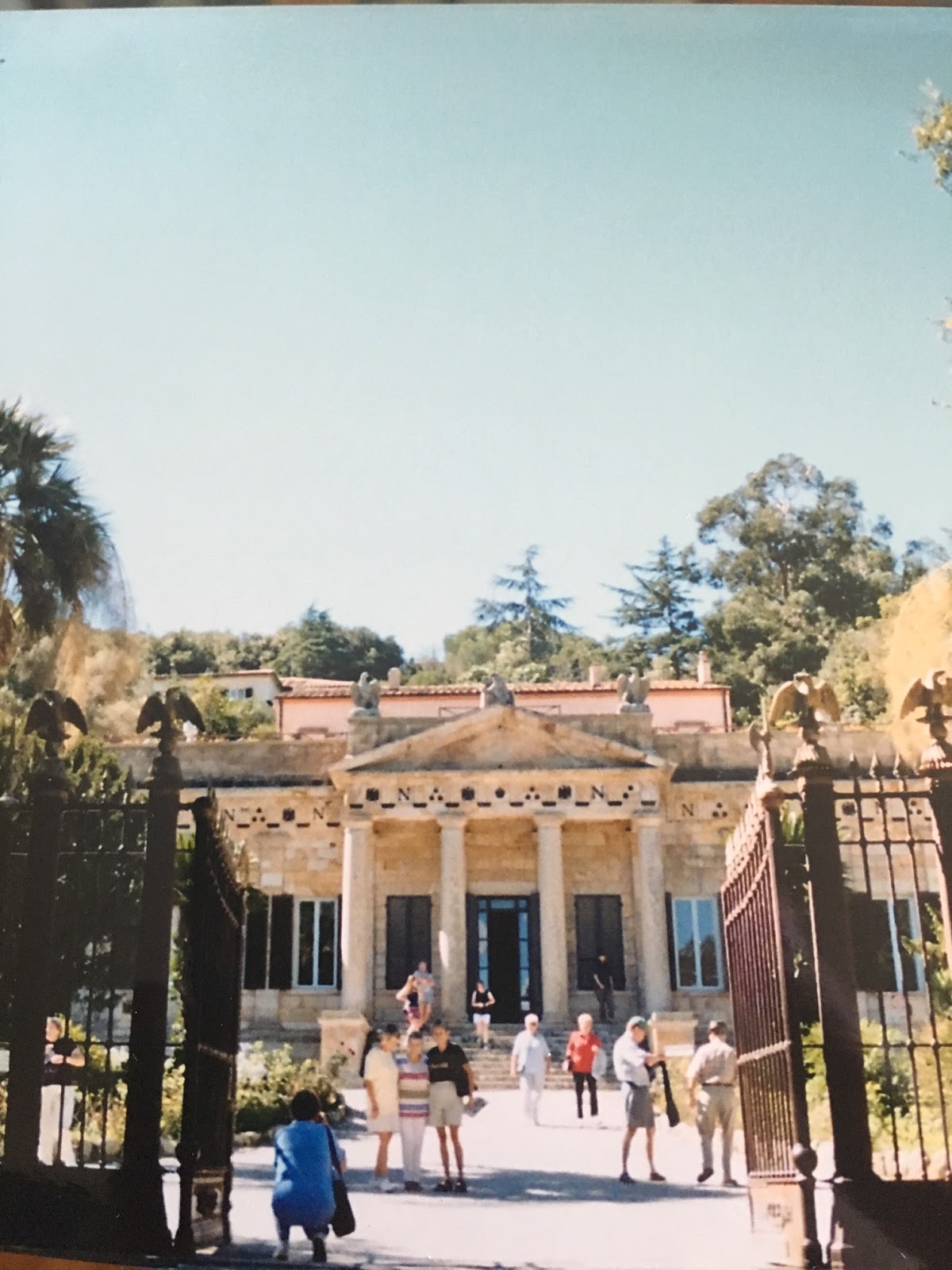
Cad won, as usual, and the Micra was finally parked. We bounded up to the Palazzina only to see “Chiuso,” those most dreaded of Italian letters. Undaunted, we took ourselves to the Emperor’s summer residence, Villa di San Martino, at 6 km from Portoferraio along the road to Marciana. The man was only on the island for a total of 10 months, but decorum at all times.


I am not an imperialist at heart, but I was jazzed to be walking through the exiled Bonaparte’s bedroom, and his study, and to look out where he surveyed the sea, when we finally got into his town residence the next day.

But what I remember most about Elba overall is color and sky: the pink of Bonaparte’s town residence under a huge, tropical blue sky. Later in the day we drove west, away from the towns, on a mountainous road above the sea. The sky there was huge, majestic, and humbling, and we drove into layers of grey and blue offset by the sun’s gold. Peter Gabriel was our soundtrack as we egg-and-darted along the rising road, going deeper and deeper into that space between sea and sky. I understood what could have made such an impression on Dumas.


It was September 2002 . . . 
This trip had a very poignant timing. I got on a plane in New York on September 12, 2002, the day after the first anniversary of the attacks.  It was still a sad, dark, heavy time, and unease all around, as we didn't know if there would be more murders a year after. But as we said, we have to keep moving, and so to the airport I went to start this trip.

We spent our first Elban evening in the hotel. The lobby was pleasant—-the white tile floors spoke to the beachiness of the location, and the décor was clean and modern. To the left of the bar was a baby grand piano. Cad plays by ear, and has a good tenor voice. He asked the manager if he could play for a bit, and he said yes. There were small clusters of guests scattered throughout the lobby, mostly German tourists.

Actually there are so many German visitors on Elba, and the language is so prevalent, that it is a little disorienting. “M.A., can we please go back to Italy?"

At the piano, Cad’s repertoire is easy listening on the sentimental side, but with a musician’s flair. I sat by his side as he sang Piano Man and She's Always a Woman and joined in for some harmonies on Thunder Road and Four Green Fields. He sang out, but it was not intrusive and we could hear the soft conversation buzz throughout. There was some sweet applause when the set ended. It was nice.

Ah, the drink break.

Refueled, Cad started playing again, noodling around a theme, then playing it straight out: Oh my gosh, it was America the Beautiful. I was stunned to hear the tune. I hadn’t been thinking at all about home, and that haunting melody can put a lump in my throat at the very best of times.

To keep from crying I tried to focus on Cad’s expressive phrasing, and somewhere in the second verse I heard myself adding the harmony. Cad modulated during a verse interlude, and we sang the last verse in a higher key, putting the “alabaster cities gleam/undimmed by human tears” into a stronger part of vocal ranges.

When the song ended, we realized that everyone in the room had stopped talking. I felt a little numb, very self-conscious, and a little embarrassed. How cheesy was this? Would we come across as obnoxious Americans?

There were several beats of complete, palpable, silence . . . and then the conversation buzz picked up again. A hug from the strangers in the room would not have felt more embracing.

Cad went to get us drinks, and we sat and drank, for quite a while.

The next day we left to go back to Rome.

Wednesday, June 13, 2012

Bloomsday in Rome; Polyphonic Grief on the Adriatic


Through much good luck I will be in Rome this Saturday, which is Bloomsday! Joyce moved there on July 31, 1906, with his young family when the school he was teaching in in Trieste had financial troubles and his employment wasn't certain.

Joyce very specifically chose to move to Rome,  but his time in the city was not happy. One big mistake was taking a position in a bank.  Jonathan deBurca Butler offered some very interesting thoughts about Joyce in Rome in Verbal magazine:

"From the very beginning his letters to Stanislaus speak negatively of the city and its people. His work in the bank was soul destroying. He often had to work 12 hours a day, copying out up to 200 letters James Joyce text portraitin an office where he had no interaction with the public.

His struggle was compounded by his drinking; a vice that infuriated his landlady, Signora Dufour and towards the middle of November she requested that he leave the accommodation on Via Frattina. Joyce expected to charm his way out of the tight spot but the Signora kept her word and he found himself out on the streets with a young family and nowhere to go. After four days searching, with suitcases and child in tow, he moved into 51 Monte Brianzo.

Today the area, which is near the wonderful Piazza Navona, is by no means objectionable but was rather grim in Joyce’s time. The house was located beside the river that Joyce disliked so much. 'The Tiber frightens me', he wrote. Its deep gorge and hasty waters apparently no match for the Liffey’s more placid demeanour."

It's too bad Joyce had such a rotten time in Rome, but with friends Alaric & Maurizio at the Irish-owned Scholars Lounge it will be an excellent place to celebrate the great writer on his special day.

When David Heard
From Rome I go to Ancona, an Adriatic seaside town, for a choral week with Patrick Craig built around the the text from 2 Samuel 18:23:


"When David heard that Absalom was slain, he went down to his chamber over the gate, and wept: and thus he said: 'O my son Absalom, my son, my son Absalom. Would God I had died for thee, O Absalom, my son, my son!"

We will sing multiple versions of this text of epic grief set by many Renaissance composers, which are some of the the most glorious choral pieces ever written. I'm such a sucker for bringing polyphony to life in the 21st century with other choral nerds. It's a nice bonus when it's an international bunch.

No blogging for a while. Please follow me on Twitter for tweets from Italy.

Sunday, August 29, 2010

Italian Hours: Updated

Henry James made fourteen visits to Italy, his first in 1869, his last in 1907. His travel essays were first printed in magazines, and some were collected for Transatlantic Sketches (1875) or Portraits of Places (1883). In 1909 William Heinemann published all the Italy essays as Italian Hours, complete with an index.

Yes, it was a marketing ploy to make the volume something travelers would bring along to consult during their own travels. It's a Lonely Planet guide for crazy English majors!


This intro by James for Italian Hours is manna from heaven for a travel blogger:

"Who shall analyse even the simplest Roman impression? It is compounded of so many things, it says so much, it involves so much, it so quickens the intelligence and so flatters the heart, that before we fairly grasp the case the imagination has marked it for her own and exposed us to a perilous likelihood of talking nonsense about it."

And so, with an authority like Henry James assuring me that it's easy to start babbling about Rome, about Italy, because of their extraordinary nature, let me tell you about my recent vacation.

This visit had a lovely scheme: four days in Rome, then the train to the Tuscan Casole d’Elsa (via Florence to Poggibonsi) for the polyphony workshop and concerts, then back to Rome for another day and night.

My time in Rome is extra wonderful because it’s in the company of my American friend Ric and his Italian partner Mau. They are a witty, engaging couple: Ric is a writer and film buff (when he’s not teaching ESL), and Mau is a composer. They live in Magliana, of Banda della Magliana infamy in the South-West periphery of Rome. It’s a great neighborhood for real life: on the metro line to the airport, great produce even in August when all Italians abandon the city, reasonable parking for the Vespa and car, a balcony on their apartment. In short, la dolce vita attained.


Sperlonga: In the footsteps of Ulysses

We took a day trip to the sea side town of Sperlong, a small, white-washed village on a promontory high above the sea, playground of the international jet set in the 1960s—think Warhol, Bridget Bardoe, Arthur Miller, Marlene Dietrich, Raf Vallone, Lucia Bose— but its deeper nature is ancient and mythical. The emperor Tiberius (AD 14 to 37) built a villa there, called Sperlunca in Latin, around a large grotto that opens to the Tyrrhenian sea. In 1957 an excavation of the site found enormous sculptures that had decorated the grotto, all depicting scenes of Ulysses.

The coast in the Lazio region between Rome and Naples is known as “the Ulysses Riviera” (Riviera di Ulisse), with Roman legend placing many of the scenes from the Greek Odyssey geographically in their own country: so Ulysses was imprisoned by enchantress Maga Circe on the wild slopes of Mount Circe (in Cicerco), and his men where eaten by the giant Laestrygonians in the Golf of Gaeta (or maybe Sicily), but you get the picture. Just as there are Roman versions of Greek myths, there is a geographically correct Roman version of Odysseus’ journey, as well as the Romans version of the hero's name: Ulysses. (I always wondered about that. Not surprising that Joyce, who lived in Italy much of his adult life, chose the Roman over the Greek for his novel.)

The sculptures from the Tiberius villa are in an exquisite museum on the grounds—-the blinding of Polyphemus is the most enormous and dramatic—but the highlight is going into the grotto itself, walking on the very surface that Tiberius and his guests trod, while themselves enthralled by the feats of Ulysses. In a twist of fate, while the emperor was banqueting in his grotto there was a sudden rock slide that killed many of his servants. Tiberius miraculously survived, then abandoned this summer palace and took up residence at another summer palace on Capri, where he will die.

The town of Sperlonga is a series of narrow walkways and stairs high above the beach, perched as a means of protection against the Saracens (and others), a scene which is repainted in the town every year. To get out of the blinding sun we had lunch in a cool, cavern bistro before we walked to the grotto.

On the way back to Rome we stopped in San Felice Circeo for a home cooked meal with Mau’s family. The national park wilderness of Circeo may have seen Ulysses centuries ago—the area certainly feels magical enough for it.

We stopped off at a lighthouse that has been in use since 1866. There was something about its single light that made me think of the blinding of the Cyclops. Those ancient stories, they have a way of sticking with you.


Wednesday, September 17, 2008

The Living Ballet on the Bicycle

Let us now speak of the bicycle--as the most elegant of transportation modes, not in the sense of sport of riding. My 10 days of living in Rimini were enriched by having a bicycle to get around.

On my bicycle I finally felt integrated into Italian life. Stripped of all monkish guides and traveling companions, it was just me, the city map, and the bicycle, and thus I joined the amazing dynamic that is Italian flow.

Rimini is a schizophrenic beach town. The beach side is like the worst of Ft. Lauderdale; the old town center has beautiful vestiges of ancient Roman engineering and medieval walls in a no-car zone.

My hotel was near the beach, and the music conservatory was in the old town. Each morning I bicycled down one of the city’s main boulevards to one of the bike paths in the park.

It is freeing and empowering to buzz around on a bicycle. Even though it is not with the speed of the sport, you still feel that “oneness” with the machine the athletes talk about. Riding each morning in a flowing skirt with flip flops on my feet and knapsack on my bike were some of the happiest moments of well being I have recently known.

Biking though a crowded pedestrian plaza is a challenging art. You can come up behind someone and stop for a few seconds and still not put your foot down-—you can actually hover for the nanoseconds it takes someone to step out of your path, when you start pedaling again. It is like a beautiful, living ballet.

Sometimes in the midst of the flow walkers and bikers try to share the very same space. Thumb on the bell, you can gently “brrrrrrrring” when coming up on walkers, or give a frantic, loud “BRRING, BRRIING” if impact is immanent.

Rimini embraces bicyclists; my hometown is not very hospitable to them, except maybe in Central Park. I won’t be biking down Broadway any time soon—I don’t have the nerves for it. For me a daily ride—like attending a music conservatory—is the road not taken, but at least now visited, with deep appreciation.

Friday, September 12, 2008

Super Flumina Babilonis: From TV to the Choir Loft

Super flumina Babilonis. That’s Latin for “By the Waters of Babylon."

In my daily American life, it reminds me of Don Draper and the gang in season one of Mad Men which ended with the Beats singing the folk version of the song

In my 10 days of being an Italian polyphony singer, the words, set by the Renaissance master Palestrina, were a clearer path to the Biblical roots of the Babylonian captivity of the Jews, cogently connecting us to the ancient sadness by the ancient Latin, sung in the slightly less ancient Basilica San Vitale in Ravenna.

Illic sedimus et flevimus: We sat down and wept

cum recordaremur Sion: When we remembered Sion

In salicibus in medio ejus suspendimus organa nostra: and we hung up our harps in the willows.

From the privilege of the choir loft, the celebrated mosaics were almost in arm’s reach. That was exciting. The view of the church from the loft was also memorable.

There were many things that were striking about participating in this international choral workshop in Rimini. One was how much of an Olympics air it had. Of the 25 people, half were the home team of Italians, then there were the Danes, the Dutch, a Russian from Moscow, several Brits, and three Americans. English was the lingua franca, followed by Italian.

The dinner conversation was interesting and varied, fueled by the diversity of day jobs. And it was there that I learned that most of my fellow singers don’t watch television. Nobody said it in the snobby way New Yorkers do—it sounded consistently genuine, and true (again, not like some New Yorker’s claims).

Well, I do a lot of things besides watching television, but I became aware of how many of my casual conversation references are tv-based. Travel. You can’t beat it for a dose of self-awareness.


One of the nonwatchers was Peter Phillips himself, the director of the Tallis Scholars. I didn’t know what to expect of this world-class conductor who runs summer workshops for amateurs. You would think the nonpros would be intolerable to him. But, it’s an easy way for him to be paid very well to stay in one place for a week, for a couple of hours’ work a day. The Tallis Scholars can't tour 12 months a year.

I have to say it was a thrill to sing under his direction. The control that he had over the group was sterling. And with his talent, we were able to pull off an 8-part piece. He was funny, engaged with what we were all doing, and down to earth.

One of his own next big projects is establishing a choir at Merton College, Oxford. I told him it’s a shame that the Inspector Morse series isn’t still filming there, (although the Sargeant Lewis sequels may be), but not being a tv-watcher, the reference meant nothing. Happily I also brought up Nesciens Mater, when he spoke about wanting to put the composer Jean Mouton on the map. That made him nod and smile.

Monday, August 25, 2008

Polyphony in Rimini

This summer is closing for me on some very special notes—including an F# from Palestrina’s Ego Sum Panis Vivus, a B flat from Guerrero’s Regina Caeli, a C# from Byrd’s Sacerdotes Domini-—and about a thousand others. I am off to take part in an international choral workshop run by Peter Phillips of the Tallis Scholars in Rimini, Italy (Fellini's home town).

The Tallis Scholars are the rock stars of a capella Renaissance polyphony. Started by Peter Philllips while a student at St. John’s College, Oxford, back in 1973, they had their first concert as TTS in 1976. From there, they developed “the sound”: distinctive, haunting, uplifting. It’s most dazzling when you see them live in concert, but their recordings are equally powerful.

Learning to sing Renaissance polyphony has been one of the great unexpected gifts in my life. What sets polyphony apart from other choral work is the equalness of the 4 (or 5 or 6) lines. It’s not a melody and a harmony. It’s a much more complex weaving of four independent parts that also, of course, stack to create chords. Polyphony requires rock-solid precision to allow the chords to lock in as they should. The group needs to feel the underlying beats absolutely and breath as one organism. The requisite blending of voices one into the next is very sensual. When it all comes together, it’s a heady experience.

For me, it also means finding a transcendent connection to the words of the Mass, either in the Mass parts themselves (Kyrie, Gloria, Credo, Angus Dei, Benedictus), or in settings of Bible texts: Ego Sum Panis Vivus—-I am the Bread of Life.

Peter Phillips, on the other hand, does not have this connection to the words of “the Christian fairy tale”; for him it is the brilliance of the music alone. Fair enough.

I am looking forward to singing under his direction. In his book What We Really Do, a memoir/telling of the history of the group, Phillips offers a peek into the Tallis Scholars’s personality as a group in a “Singers’ Argot,” many of which made me roar with laughter, sometimes from how understated or absurd the descriptions, and sometime because I was writing mental “yes how true” notes in the margin.

Here are just a few:

Gumby part. A non-academic term to describe a cantus firmus part in polyphony. It is a matter of some satisfaction to most of us that the majority of gumby parts were written for tenors, who, as everyone knows, are the divas of their trade.”

“Let’s just start it” Another of my catch phrases in rehearsal. The upshot is that we can find ourselves singing the beginning of a piece several times and never the rest of it. Mass settings are particularly vulnerable to this oversight: we get to know the Kyrie intimately but not the Agnus or the middle of the Credo. [Major head nodding on my part here.]

“Do you know the Victoria Requiem? Good. See you at Heathrow.”
[Said to a singer substituting for a regular. A confirmation of their disinclination to rehearse more than the barest minimum. If you knew how complex the Victoria Requiem is, you’d roar with laughter here too.]

As part of this workshop, this pick-up choir will sing at the 10:30 Mass at the great San Vitale in Ravenna (pictured above), and then after a week of rehearsals (and some beach time), give a concert in Rimini on Sept. 6.

And with this post, I am taking a blog break, to have time to learn the music before I go. Wouldn’t want the American contingent to seem lesser than the English and Italian singers.

I will be back midSeptember, and I hope you’ll come back then too.

Sunday, August 17, 2008

The Dancing Satyr Who Left the Sea

In 2008 I encountered an amazing aquatic story in a small fishing village in the southwest of Sicily called Mazara Del Vallo. In 1997 a fishing boat from Mazara found a bronze leg amidst the fish in its nets. Many odd things from the sea end up in nets, the detritus of millennia of shipwrecks. The captain turned it over to archeological authorities and went back to business. A year later, on March 4, 1998, the same boat and same captain were hard at work when one of their nets got caught on something on the sea floor. When a diver went down to free it, he saw that it was caught on some sort of bronze torso. He freed the net, put the torso into it, and signaled to bring it up.

After 2,400 years, the dancing satyr was breathing air again. The captain brought the torso to the same authorities. The leg from a year ago was from the same statue, a two-legged satyr (Greek saturos), with pointy ears and a space in the back for a tail. In mythology, lecherous, happy, dancing satyrs often accompanied the drunken god Dionysius. It turns out this was a very important find.

Some have dated it to 4th century BC, but it is at least from the Hellenistic period of the 3rd or 2nd century. The importance is in its distinction: the satyr is in a moment of ecstasy. His head is thrown back, his back is arched, his hair swings to the left, as it would if he were spinning. The Roman authorities did computer simulations of the piece, and determined that the physiology of the statue perfectly matches that of a whirling dervish. The sculptor was very, very skilled to achieve those details.

 After a 5-year renovation, the Dancing Satyr of Mazara was on display in Rome where thousands went to see this amazing new reminder of their own celebrated antiquity. Then the Italian government put a lot of money into a permanent display in Mazara del Vallo, were we saw it. Like the Venus del Milo, it doesn’t have arms, or a second leg, but that’s not much of an issue for something as old as it is.

 What stays with me about this story is the sheer magnitude of the 2,400 years that this statue lay on the bottom of the sea, quiet, patient, resigned. The Greek empire ended, the Roman empire ended, Christianity started, and there he be. Then somehow his leg becomes detached---maybe that happened in the initial accident that stopped his journey, maybe he landed intact, but the centuries wore away at the leg, until it was free. Either way, the leg floats up and into the lives of the fishermen, a harbinger of his presence until he could muster the power the next year to snag the net. 

 As I walked around the piece and marveled, I realized what a huge metaphor it is for the idea that some things will not stay submerged, not in our psyches, not in our past. Certain things have the power to come into light, no matter what the odds, nor how long it takes. A word to the wise, I’d say.

Monday, August 11, 2008

Our Sicilian Temenos

Persephone first crossed our path in Rome, freed as she was from the block of marble by the hands of Bernini only to be captured by Hades and forced into the underworld.

When her mother, Demeter, the goddess of all fertility, goes after her, she deprives the earth of its ability to grow food. Hades relents to the mother, and says Persephone can go, if she hasn’t eaten anything; he then tricks her into eating six pomegranate seeds. Demeter still strikes a deal with Hades: Persephone will spend 6 months in the underworld, during which her mother is sad and nothing grows, and then 6 months on earth, and her mother is so joyous that the earth blossoms into spring.

Legend believes that the very spot where Hades descended with Persephone is at Lago di Pergusa, near Enna, in the middle of Sicily. History says it became the seat of the sacred cult of Demeter.

We came to one of the worship sites of her cult at the strange sounding Selinunte.

Selinus is from the Greek name for the sweet-smelling herb Selinon, aka wild celery (heleioselinon – Apium graveolens) as well as mountain parsley (Oreoselinon – Petroselinum from which the English term is corrupted).

One of the glories of our rented beach house is that it sits at the edge of the archaeological park of the ruins of ancient Selinus. And so we are able to walk out our back door, down to the water, and a half hour later turn to walk up the hill directly to the ancient Acropolis, coming upon it by surprise, as the main entrance by car takes you to the Eastern hill temples.

Selinunte was the most westerly of the Greek colonies, established in 628 BC. Originally allied with Carthage, it switched alliance to Syracuse in 480 BC. Under Syracuse it grew powerful and wealthy, until it bothered its northern rival, Segesta, who called upon the jilted Carthage to help vanquish it. That brought Hannibal (an earlier one that the great), who destroyed the city in 409 BC. An earthquake in the Middle Ages brought down whatever structures were still standing. It was the Englishmen William Harris and Samuel Angell who started the excavations in 1823.

You can still get a sense of the teeming city on the Acropolis, where the thoroughfares are wide and intact. There are many temples in the city itself, mostly huge piles of rubble, except for two that have been partially reconstructed like a jigsaw puzzle.

One of our vacation party, a professor of Greek philosophy, brings the rubbles to life for us with commentary from the great thinkers. He also brought a pair of walkie talkies. It was a brilliant stroke to keep people connected amongst the rubble piles, which are so huge that you can’t see from one side to the other. It was part nerd, part practical. Just perfect.

From the Acropolis we make our way to the Eastern temples, outside of the city. There lies the celebrated Temple E, with 2 others. Temple E is the most completely reconstructed. What we didn’t entirely appreciate until later is it is one of the only temples you can walk into.

As we moved from column to column, I tried to sense the spirits of the original inhabitants, but the sun was so blinding and bleaching that I could see no shadows. And yet there we trod, where our distant, distant cousins worshipped Hera, (or Dionysius, the designations are not certain). Sitting and talking among the gigantic stones felt like inhabiting a dust to dust adage: their reality came to this—a pile of stones to be stared at by generations to come.

As we head back to the beach house we take the detour to the Demeter Temenos. The function of this sanctuary is linked to its place on the road from the Acropolis to the large necropolis of Manicalunga: funeral processions broke their journey here to call upon Demeter, the Goddess of Fertility and her daughter Persephone, Goddess of the Underworld and Sicily's chief goddess. There we saw the remains of one of the cult’s major places of worship, where Demeter was revered as Malophoros (Apple Bearer).

It boils down to the story of the mother who went to Hell to protect her daughter: the Greeks knew human nature very well.

Mary Taylor Simeti, who wrote the engaging Persephone’s Island, has her own take on the daughter: “Persephone, the eternal expatriate, the goddess of unreconciled contrasts and alternate allegiances, chose to eat the seeds of the pomegranate, that she might enjoy two roles, two worlds.”

Nice idea, or just making lemonade from her abduction.

Monday, July 21, 2008

Dust and Lust in Roma e Magna Graecia

The summer wanderings took me to Rome for a few days, before some friends and I headed to Sicily, where we had rented a beach house. My friends hadn’t been to Rome before, so it was a great excuse to revisit some of its top attractions—the Colosseum, the Forum, the Palatine, and the Vatican.

It was very hot in Rome, but I don’t mind heat. I like extreme weather, even when it’s oppressive temperatures and a merciless sun. We ambled along the upper tier of the Colosseum, our feet upon dirt so desiccated by the sun that we felt antiquity itself in the dust that engulfed us, Pigpen-like.

The next day we went to the Villa Borghese, which was new to me. Nestled in a huge park garden, offering some respite from the sun, it houses a mind-blowing collection of art.

Amidst the Caravaggios and Reubens and Raffaellos, what stood out were two life-size sculptures by Bernini: Apollo and Daphne, and The Rape of Persephone.

Classical-style sculpture is not a medium we experience much in modern life. We are somewhat immured to its accomplishments, to the other worldly achievement of Michaelangelo’s pieta—-how did he get the marble body of Christ to drape so poignantly in the lap of the calm Mater Dolorosa?

But the world of Gian Lorenzo Bernini, sculpting genius of 17th century Italia, is of Ovid and the ancient gods, goddesses, and nymphs.

Apollo and Daphne captures the process of Daphne turning into a tree. Apollo had angered Cupid, who maliciously shoots him with an arrow to fall in love with the nymph Daphne, and he shoots her with an arrow that makes her feel repulsed by his advances. As Apollo pursues her, she flees, and begs her father, the river god Peneus, to turn her into a tree rather than be touched by Apollo. It’s a terrible story about the interference of gods, and the dangers of lust, with poor Daphne losing her life.

The brilliance of the statue is that from one angle you just see a woman running from a man; it’s not until you walk around the piece that you see Daphne’s hands are already twigs. It’s a chilling moment to experience.

And then there was The Rape of Persephone, the daughter of Demeter, the goddess of all the fertility of the earth. There are many versions of the myth, as well as Ovid. But basically, Hades, god of the underworld, becomes besotted with Demeter’s daughter and asks Zeus’s permission to carry her off to his kingdom. While Persephone is playing in the fields of Sicily, the ground opens and she is swallowed up.

Here in the Villa Borghese is the violence of a woman being abducted against her will captured in marble that has startling life and motion to it. Particularly Hades’s fingers pressing into her flesh as though it were human, and you can practically hear the horrid three-headed Cererbus barking at her heals.

Bernini’s work raises the question if there can be beauty for such a violent act. Human nature has a need to project violence against women into various art forms-—we see it all the time in the plots of tv shows from Simon & Simon to The Sopranos. But that doesn’t have the layer of beauty and accomplishment of Bernini’s sculptures.

Much to think about as we head for a Roman dinner with friends before flying to Persephone’s Island.