Friday, April 10, 2020

Good Friday: Saint Peter's Worst Day


Thanks to Gwen Toth, the amazing director of music of the early music group ARTEK, I learned an astonishing piece by the great Renaissance composer Orlando di Lassus.

It's Lagrime di San Pietro, The Tears of Saint Peter, a setting of a twenty-verse poem by the Italian poet Luigi Tansillo (published in 1560), to which Lassus added a final motet.

The music is rich and soaring and dense and transparent all at the same time, like all the masterworks of Renaissance polyphony.

But it is the text that is such a discovery for me. The poet Tansillo imagines the grief beyond grief that Peter feels after he has actively denied Christ three times before the cock crows. 

At the Last Supper Jesus told Peter that he would disown him three times before the cock crowed.

Peter replied: "Even if all fall away on account of you, I never will." "I tell you the truth."

OF course that's not what happens. From Gospel of Luke, the third denial:

About an hour later another asserted, “Certainly this fellow was with him, for he is a Galilean." Peter replied, “Man, I don’t know what you’re talking about!” Just as he was speaking, the rooster crowed. The Lord turned and looked straight at Peter. Then Peter remembered the word the Lord had spoken to him: “Before the rooster crows today, you will disown me three times.” And he went outside and wept bitterly.


When Eyes Met

Tansillo's verse focuses on the image of Jesus turning and looking straight at Peter, imagining what it must have been like for their eyes to meet and for Peter to comprehend the magnitude of what he had done.

The entire poem is worth reading, because it tells such moving story, but these excerpts give you an idea. Peter projects his fear and shame onto Christ, that Christ is angry at him for the denial. But Christ has no such anger or hatred of Peter, and when Peter realizes this, he can barely stand it.


When noble Peter, who had sworn
that midst a thousand spears and a thousand swords
he would die beside his beloved Lord,
realized that, overcome by cowardice,
his faith had failed him in his great moment of need,
the shame, sorrow and pity
for his own failure and for Christ's suffering
pierced his breast with a thousand darts.

But the bows which hurled
the sharpest and most deadly arrows
into his breast were the Lord's eyes, as they looked at him;

It looked as if his Lord, surrounded by many
enemies and abandoned by his peers, wanted to say:
"What I foretold him has now come to pass,
disloyal friend, proud disciple"

"More cruel", He seemed to say, "are your eyes
than the godless hands that will put me on the cross;
nor have I felt a blow that struck me as hard,
among the many that did strike me,
as the one that came out of your mouth.

I found no one faithful, nor kind,
among the many that I deemed worthy to be called mine:
but you, for whom my love was so intense,
are more deceitful and ungrateful above all the others.
Each of them offended me only by leaving me:
but you denied me"

The words full of anger and love
that Peter seemed to see written
on the serene, holy eyes of Christ,
would shatter whoever who heard them.

Like a snowbank which, having lain frozen
and hidden in the depth of the valley all winter,
and then in springtime, warmed by the sun,
falls apart and melts into streams,
such was the fear which had lain like ice
in Peter's heart and made him repress the truth;
when Christ turned His eyes on him,
it melted and was changed into tears.

...

By denying my Lord, I denied
life itself from which every spirit springs:
a tranquil life that neither fears nor desires,
whose course flows on without end:
because then I denied the one true life,
there is no reason, none at all, to continue this false life.
Go then, vain life, quickly leave me:
since I denied true life, 1 do not want its shadow.”

So Peter is in despair, almost it seems to the point of suicide. But we know he rallies, and is the rock upon whom the Church is built. The stone rejected by the builders is now the cornerstone.

The end of the Lassus piece is an older, Latin motet re-set. Its words are also pretty incredible: Christ on the cross telling us that as horrific and painful are the nails and spears, they are nothing to the pain of ingratitude. Imagine that.


Behold, mankind, what I suffer for you,
To you I cry, I who am dying for you;
behold the pains with which I am afflicted;
behold the nails with which I am pierced.
There is no pain like that of the cross;
and great though my body’s suffering might be,
the pain of ingratitude, however, is worse,
such ingratitude as I have experienced from you.


Images
Caravaggio, The Denial of Saint Peter, 1610
 Peter's Denial by Rembrandt, 1660. Jesus is shown in the upper right hand corner, his hands bound behind him, turning to look at Peter

Saturday, August 3, 2019

History of a Two Weeks' Tour Through Switzerland


One night—it was in 1816, and one of those nights the Swiss believe God made for them alone—a boat approached silently, leaving behind her a wake brilliantly broken in the light of the moon. She drifted in towards the whitened walls of Chillon Castle and touched the bank without any shiver, without a sound, like a settling swan.


From it stepped a pale-faced man with piercing eyes, his uncovered head held proudly. He was wearing a black cloak that reached to his feet, which however, did not entirely hide the fact that he limped slightly. He requested to be shown Bonnivard’s cell. There he remained, alone, for a long time. When he had gone, another name was inscribed on the martyr’s pillar—Byron.

Alexandre Dumas, Travels in Switzerland, 1832, published 1843

It is now nearly three weeks since my Journey took place, and the journal I then kept was not very copious; but I have so often talked over the incidents that befell us, and attempted to describe the scenery through which we passed, that I think few occurrences of any interested will be omitted. 

My opening mirrors Mary Shelley's 1817 History of a Six Weeks' Tour through a part of France, Switzerland, Germany, and Holland. You can read the whole "little volume" on Gutenberg.

I came to Switzerland because of family, but I found myself living in the footsteps of long-beloved writers. My journey became my own bookshelf writ large, as I joined Dumas, the Shelleys, Byron, Mark Twain, J. W. Turner, Charles Dickens, Gibbon, Rousseau, Chateaubriand, and many others through the German- and then French-speaking parts of the extraordinary country.

My great grandfather Sebastian Anton Waldis was Swiss, his daughter was my maternal grandmother, Regina Caroline Waldis Brown. She passed down to us a small wooden box with the word Rigi carved on the bottom that her father brought with him on his long immigration journey. In our own middle age, my brother and I became interested in the Swiss heritage that we had long ignored, given the ethnic dominance of being O’Neill’s from Brooklyn.

Sebastian’s marriage certificate listed Arth, Switzerland as his birthplace. Odd sounding town. Google maps showed it to be a tiny hamlet on Lake Zug, about an hour south of Zurich, in the canton of Schwyz.  I planned a trip to visit his hometown, and to see more of country, then join with an organized bike tour out of Lausanne. And that is how I came to live in the heady world of Mt. Rigi and the surrounding towns of Weggis, Vitznau, Arth, and Lucerne, then over to Lake Geneva, Gstaad, and Bern.


Mark Twain's “Sunrise” on Mt. Rigi

Dining in a cable car from Weggis
“In a moment we were deeply absorbed in the marvel before us, and dead to everything else. The great cloud-barred disk of the sun stood just about a limitless expanse of tossing white-caps—so to speak—a billowy chaos of massy mountain domes and peaks draped in imperishable snow and flooded with an opaline glory of changing and dissolving splendors, while through rifts in a black cloud-bank above the sun, radiating lances of diamond dust shot to the zenith. The cloven valleys of the lower world swam in a tinted mist which veiled the ruggedness of their crags and ribs and ragged forests, and turned all the forbidding region into a soft and rich and sensuous paradise.  

We could not speak. We could hardly breath. We could only gaze in drunken ecstasy and drink it in.”  Mark Twain, Tramps Abroad, 1880

There is still a rush to be on the top of Mt. Rigi, called Rigi Kulm, at dawn to see the sunrise. I was happy to summit at midday. Mark Twain’s attempt is wrapped in his signature comedic happenstances: he and his traveling companion had slept all day.  What they first thought was the sunrise, they realized was sunset.  Which I saw from a unique dining experience in the cable car to Rigi Kaltbad from Weggis.  You can see how easily sunset and sunrise could be confused.

Arth, Brunnen, and Lucerne, as I fall into the footsteps of the Romantics

The hand-carved box great granddad brought from Switzerland, on Lake Lucerne

The Rigi-Bahn station at the top of Mt. Rigi

Arth itself having no good hotels, I stayed in Vitznau—the town Sebastian’s own grandfather Franz Joseph was from—on Lake Lucerne. Everything that has been written about the beauty of the Swiss lakes is weak in the face of their actuality. I brought GGdad's wooden box with me, to the shores of the lake. Arth being on the other side of Mt. Rigi, I needed to take the amazing cog wheel up one side of the mountain, and down the other.

The journey from Vitznau is the more dramatic as you ride at an astounding incline into the air, the town falling away as you enter the clouds. The journey down to Arth is miles and miles of the forest primeval. In Arth I visited the church of Sebastian’s baptism. Built in 1694, the baptismal font looked like it could be from 1854, and that brought his past into my present, into my journey.

Next I went to the Staatsarchiv in Schwyz to inquire for more details about Sebastian’s life, where I learned that he was in prison in the neighboring Brunnen for 4 years. Privacy laws attach to all court records from 1848 onward, and so I’m working with an archivist to get the record unsealed. My heart tells me it was for stealing a loaf of bread. This is a man who carried a tiny wooden box on the long journey from Switzerland, and named my grandmother after his mother and sister.

Mary Shelley had a very different experience of Brunnen:

“The summits of several of the mountains that enclose the lake to the south are covered by eternal glaciers; of one of these, opposite Brunen, they tell the story of a priest and his mistress, who, flying from persecution, inhabited a cottage at the foot of the snows. One winter night an avalanche overwhelmed them, but their plaintive voices are still heard in stormy nights, calling for succour from the peasants.

Brunen is situated on the northern side of the angle which the lake makes, forming the extremity of the lake of Lucerne. Here we rested for the night, and dismissed our boatmen. Nothing could be more magnificent than the view from this spot.  The high mountains encompassed us, darkening the waters; at a distance on the shores of Uri we could perceive the chapel of Tell, and this was the village where he matured the conspiracy which was to overthrow the tyrant of his country; and indeed this lovely lake, these sublime mountains, and wild forests, seemed a fit cradle for a mind aspiring to high adventure and heroic deeds.

Yet we saw no glimpse of his spirit in his present countrymen. The Swiss appeared to us then, and experience has confirmed our opinion, a people slow of comprehension and of action; but habit has made them unfit for slavery, and they would, I have little doubt, make a brave defence against any invader of their freedom.”  
Mary Shelley, History of Six Weeks' Tour
The steamboat serving Vitznau to Lucerne across Lake Lucerne

I took the steam boat from Vitznau to Lucerne. The water, the landscape: the very same the Shelleys experienced. It was like walking into the timeless spaces in Mary Shelly’s own travelogue. What delights me about travelogue is the voice, the voice of a writer you enjoy, now more directly speaking to you, sharing details with you, the potential fellow traveler.

“We departed the next morning for the town of Lucerne. It rained violently during the first part of our voyage, but towards its conclusion the sky became clear, and the sunbeams dried and cheered us. We saw again, and for the last time, the rocky shores of this beautiful lake, its verdant isles, and snow-capt mountains.”

The Shelleys and I Go Over to Lausanne 

“The rain detained us two days at Ouchy. We however visited Lausanne, and saw Gibbon's house. We were shewn the decayed summer-house where he finished his History, and the old acacias on the terrace, from which he saw Mont Blanc, after having written the last sentence. There is something grand and even touching in the regret which he expresses at the completion of his task. It was conceived amid the ruins of the Capitol. The sudden departure of his cherished and accustomed toil must have left him, like the death of a dear friend, sad and solitary.

My companion gathered some acacia leaves to preserve in remembrance of him. I refrained from doing so, fearing to outrage the greater and more sacred name of Rousseau; the contemplation of whose imperishable creations had left no vacancy in my heart for mortal things. Gibbon had a cold and unimpassioned spirit. I never felt more inclination to rail at the prejudices which cling to such a thing, than now that Julie and Clarens, Lausanne and the Roman Empire, compelled me to a contrast between Rousseau and Gibbon.” Percy Bysshe Shelley's July 12 letter in Mary's Travelogue

Is there a more naturally literary soul than Shelley? I love his angst about contrasting Gibbon and Rousseau.  I feel connected to the literary continuum by the nestling dolls of literary fandom. Shelley is moved by seeing where Gibbon finished Roman Empire in Lausanne, and he visited Vevai/Vevey where “Rousseau conceived the design of Julie.” For Dumas, it was tracking down Chateaubriand.

Hotel Angleterre, Lausanne
In Lausanne I did not make it to the plaque that shows where the Hotel Gibbon stood with its garden of acacia trees, but I made sure to see Hotel Angleterre et Residence where Byron wrote The Prisoner of Chillon.

My bike tour met up in a hotel next to Hotel Angleterre. We biked through the UNESCO Lavaux vineyards—producer of the lovely grape Chasselas—over to Vevey, on Lake Geneva.  From the town, we started biking around the glorious lake, through the district of Montreux, until the celebrated castle was in sight.


The Prisoner of Chillon


The display about Francois Bonivard at Castle Chillon, the inspiration for Byron's poem

There are seven pillars of Gothic mould,
In Chillon's dungeons deep and old

“We passed on to the Castle of Chillon, and visited its dungeons and towers. These prisons are excavated below the lake; the principal dungeon is supported by seven columns, whose branching capitals support the roof. Close to the very walls, the lake is 800 feet deep; iron rings are fastened to these columns, and on them were engraven a multitude of names, partly those of visitors, and partly doubtless of the prisoners, of whom now no memory remains, and who thus beguiled a solitude which they have long ceased to feel. One date was as ancient as 1670. ” Shelley's letter in Mary's Travelogue

Byron's signature carved into the pillar he thought was "the" pillar; or added by savvy Castle staff

The first thing every guide says at the Castle is how it is the most visited cultural site in all of Switzerland because of Byron. To this day.

The other tidbit is editorial: that things couldn’t have been too bad for Francois Bonivard because when he was freed, he married four times, and was always in debt because of his extravagant lifestyle. The implication being that he wasn’t damaged by being in prison from 1530 to 1536, and chained to a pillar for the last four of them. He was a prisoner of Switzerland’s religious wars: he was a Catholic monk who started fighting for the rights of the Genevese  not be ruled by the Duke of Savoy. He became a celebrated Protestant on his release, and so the marriages.

Bryon paints a very different, though mythical picture.  The real Bonivard had no 5 brothers (although one of the guides thought he perhaps had one sibling, but he was not imprisoned with him.)

Byron’s poem is a masterpiece of darkness and suffering. If Bonivard himself perhaps was not in extreme pain during his imprisonment, many people were devastated by the cruelty and barbarity of the religious wars

Their belief with blood have seal'd,
Dying as their father died,
For the God their foes denied;—

Sir Walter Scott's review Quarterly Review 16 (October 1816) 172-208:
"It will readily be allowed that this singular poem is more powerful than pleasing. The dungeon of Bonivard is, like that of Ugolino, a subject too dismal for even the power of the painter or poet to counteract its horrors. It is the more disagreeable as affording human hope no anchor to rest upon, and describing the sufferer, though a man of talents and virtues, as altogether inert and powerless under his accumulated sufferings. Yet as a picture, however gloomy the colouring, it may rival any which Lord Byron has drawn, nor is it possible to read it without a sinking of the heart, corresponding with that which he describes the victim to have suffered."

Is the signature Byron’s? I would think not. There's too much space between the "B" and "Y," which has lead to an odd dot being added through the years.

Lake Geneva/Leman is well served by a fleet of steamboats. You can see the enormous pistons

From the Castle, we took the steamboat back to Vevey.

“We sailed from Clarens to Vevai. Vevai is a town more beautiful in its simplicity than any I have ever seen. Its market-place, a spacious square interspersed with trees, looks directly upon the mountains of Savoy and La Valais, the lake, and the valley of the Rhone. It was at Vevai that Rousseau conceived the design of Julie.” Shelley's July 12 letter in Mary's Travelogue

Alphorn players on Lake Lucerne in Vevey for the Fete des Vignerons, 2019

The next day we headed for Gstaad, where Hemingway is still remembered, and then on to Bern. Making the journey to great grandfather’s hometown was a privilege. It was even more of a privilege to journey with the good education that brought me the richness of the Romantics in Switzerland.

Friday, November 9, 2018

The Centenary of the Armistice: A Personal Cycle Closes and a Gash That Never Heals


"Every war is ironic because every war is worse than expected... Its means are so melodramatically disproportionate to its ends... Millions were destroyed because two people, the Archduke Francis Ferdinand and his consort, were shot... But the Great War was more ironic than any before or since. It was a hideous embarrassment to the prevailing meliorist myth... It reversed the idea of Progress."
Paul Fussell


This Sunday, November 11, 2018, at 11:00 am, a personal gyre of history closes for me.

I entered college with an attachment to the First World War, if that’s what you can call it, because of T.E.Lawrence. I had read through Seven Pillars of Wisdom in high school and fallen under its heady spell. Lawrence was a gifted writer who embodied the English literary tradition from the inside, and he wrote his own mythology simply because he could: he knew the power of the trope and how to wield it (and saw an opportunity in the newsreels of his own personal Barnum, Lowell Thomas).

To my Freshmen amazement, there was a class on World War One Literature, taught by Paul Fussell, based on his own National Book Award-winning The Great War and Modern Memory. It’s a cultural study/close reading of the literary tradition before WW1—particularly poetry--- and how it changed during and in relation to the war.

We did not study Lawrence, but I discovered the vast and profound literature of Siegfried Sassoon, Robert Graves, Wilfred Owen, and the work of Sir Martin Gilbert, John Keegan, and Bernard Bergonzi. Few people were looking at this work in the 1980s, and it made a deep impression on me.

The Shell Shocked Lord Peter

Also in college I discovered the novels of Dorothy L. Sayers, and her Lord Peter Wimsey novels. Her novels are murder mysteries, not Zola-like realistic drama but it is notable that her sleuth is suffering from shell shock.  It is worked into the stories in such a matter-of-fact way, such was the reality of the fate of the returning servicemen from World War 1.

Wimsey is seen as a foolish ass in some ways to start, but we learn that he was severely injured by artillery fire near Caudry, France, and suffered a complete breakdown when he was demobbed. The foolish demeanor is his way of coping with the shell shock.

In Whose Body, the first Wimsey novel, when he pushes himself too far it leads him to hallucinate he is back in the trenches. Luckily his manservant Bunter is nearby:

"Put that light out, damn you!" said Wimsey. "Listen—-over there-—listen—can't you hear it?"

"It's nothing, my lord," said Mr. Bunter, hastily getting out of bed and catching hold of his master; "it's all right, you get to bed quick and I'll fetch you a drop of bromide. Why, you're all shivering—you've been sitting up too late."

"Hush! no, no—it's the water," said Lord Peter with chattering teeth, "it's up to their waists down there, poor devils. But listen! can't you hear it? Tap, tap, tap—they're mining us—but I don't know where—I can't hear—I can't. Listen, you! There it is again—we must find it—we must stop it . . . Listen! Oh, my God! I can't hear—I can't hear anything for the noise of the guns. Can't they stop the guns?"

"Oh, dear!" said Mr. Bunter to himself. "No, no—it's all right, Major—don't you worry."

"But I hear it," protested Peter.

"So do I," said Mr. Bunter stoutly; "very good hearing, too, my lord. That's our own sappers at work in the communication trench. Don't you fret about that, sir."

Lord Peter grasped his wrist with a feverish hand.

"Our own sappers," he said; "sure of that?"

"To be sure they will," said Mr. Bunter, "and very nice, too. You just come and lay down a bit, sir—they've come to take over this section."

"You're sure it's safe to leave it?" said Lord Peter.

A later novel, The Unpleasantness at the Belladonna Club, begins on Armistice Day, 1928, and the plot revolves around the fact that for the 2 minutes of silence at 11:00 am on November 11, nobody moves, so the killer can get to his target unseen.

It’s also notable for this exchange between Wimsey and Captain Fentiman from the war:

George: "I wish to God Jerry had put me out with the rest of ‘em. What’s the good of coming through for this sort of thing? What’ll you have?”

Wimsey: “Dry Martini.  Cheer up. All this Remembrance-day business gets on your nerves, don’t it? It’s my belief most of us would only be too pleased to chuck these community hysterics if the beastly newspapers didn’t run it for all it’s worth. However, it won’t do to say so. . . .How are things going for you?

George: “Oh rotten as usual. Tummy all wrong and no money. What’s the damn good of it, Wimsey? A man goes and fights for his country, gets his inside gassed out, and loses his job, and all they give him is the privilege of marching past the Cenotaph once a year and paying four shillings in the pound income-tax.”

* * * * *

That negative feeling toward the Remembrance Day services has been around since they began, particularly from the men and women who served. They ceremonies provide a psychological balm for some, and not for others. If there were no ceremonies, no remembrance, would that be better?

This lucite statue was created by the Commonwealth War Graves Foundation in collaboration with the Remembered and its inaugural Armistice 2018 Project, There But Not There. The poppy is from the gift shop at the Flanders Museum in Ypres, Belgium, the medieval Cloth Hall that was completely razed in WW1 and then rebuilt.

The problem of shell shock, of PTSD of the gash to the souls of the combatants--will continue as long as soldiers are sent to war to kill each other.  It's a matter of life and death for us all.

Wednesday, November 22, 2017

Giving Deep Thanks for My Courageous German Great Grandmother


"Mareichtag and I are speaking nothing but English now. So we should feel at home when we get to America."

"To America!" [Watch the wonderful scene.]

I am a life-long fan of Casablanca, and as the years have gone by, I have discovered more and more cosmic connections to it.

Ten years after I moved to West 103 Street in Manhattan, another fan succeeded in documenting that Humphrey Bogart was born right across the street from our apartment. The city put up an official street sign and plaque, and Lauren Bacall and Stephen Bogart came to the unveiling. It was my beloved film coming to life right on my doorstep.

 I now have a new connection the classic: the short scene of Herr and Frau Leuchtag on their way to America.

Because, it turns out, I am truly part German. My great grandmother on my mother's side--Susanna Sander Waldis--was German and came to America in 1875 as a 10-year-old girl.

On Saturday I am on my way to Trier, Germany—Prussia in her day—which we now have documentation to prove is the town of her birth.

Wherein My Brother Discovers a Talent for Ancestry Research
It’s been quite the road of discovery. As an O’Neill, the Irish/Brooklyn Irish Catholic American-ness was the dominant culture growing up. My identity as a daughter of Erin is very strong, forged from the Clancy Brothers/Bing Crosby-fueled spirit in the household led by my dad and his best friends, my faux uncles.

My mother’s side of the family was quieter. And Lutheran. Growing up we knew that her maiden name—Brown—had been changed at Ellis Island, when her paternal grandfather came over from Norway. His name was Jacob Jacobsen. He returned to Norway late in life, and relatives sent a photo of his gravestone to show the money they were sent to bury him had been correctly spent. So that was clear.

There was also a family story about four china plates that my maternal grandmother had, that her mother had “brought over on the boat from Germany.”

That might seem clear, but it was fuzzy. There was just that one story, and nothing else. So growing up, being one-part German had no resonance. It didn't seem quite true.

My brother became interested in our ancestry some years ago when the confluence of the DNA companies and records of all types being scanned made amateur  research possible.

Working Backwards: Finding the Immigrant Ship from Liverpool
We knew our great grandmother’s name: Susanna Sander (or Saunders). Pat found the record of her marriage certificate in Manhattan in 1885 to Anthony Waldis, a man from Switzerland!  And the marriage certificate had the names of both sets of parents and where they were born. That is how we learned of Lorenz Sander and Helene Berrens, from Trier, Germany.

Patrick next found a 10-year-old Susanna Sander on a ship manifest, leaving Liverpool, England in 1875.  It was the SS Kenilworth, and it docked in the port of Philadelphia on January 7, 1875.

The beauty of this: there are guilds of volunteers who type hand-written ship manifests into databases that can be searched.  Isn’t that wonderful.  If no one did that, then the handwritten documents would be completely silent.

As it happens, I had the opportunity to be in Liverpool in June. And so I found myself at Albert Dock, and the Maritime Museum, which is more and more exploring the enormous historical significance of Liverpool in the lives of hundreds of thousands of immigrants. The museum has a permanent exhibit where they try to re-create the experience of those ships in the late 1800s. I walked between the wooden bunks, around the large galley tables, all on an angle with the sound of water lapping against the walls, but I knew nothing can re-create immigrant steerage travel conditions in 1875.

Maritime Museum Immigrant Ship Experience; Liverpool, England

I tried to imagine little Susanna and her 44-year-old mom and 5 siblings, speaking no English, making their way to Liverpool--how?--and then waiting for their ship.

There is a statue on Albert Dock commissioned by the Mormons--the MVPs of genealogy--called The Crossing. It shows a 19th century immigrant family-- a mother and father with the kids--but I imagine the reality was many women traveled alone, crossing with their children, joining the husbands who went over earlier.

Liverpool, England; Albert Dock
The Maritime Museum has a great restaurant on the top floor. I raised a glass of wine to Susanna and her brave mother and siblings, getting on that ship, not knowing the language, not knowing what that 2-week voyage would be like, and what was ahead.

Liverpool, England; Maritime Museum at Albert Dock
Susanna grew up and made her way in the New World, married a man from Switzerland in Manhattan, and they moved to a farm near Honesdale, Pennsylvania.  Farm life is harsh, I don't think she had a particularly happy life. She had 10 children, only 2 of whom survived childhood: my grandmother Rena, and her sister, my great aunt Helen. My grandmother is the one who escaped the farm by becoming a maid for a Lutheran minister who lived in Carroll Gardens, Brooklyn.  She is one of the links that gave me the enormous gift of being born in Brooklyn. My great aunt Helen never escaped rural Pennsylvania.

I guess it's not so unusual that there weren't more family details of Susanna's immigrant experience. She had made it to America and did not want to be seen as an outsider.  She came to live with her daughter and my mom in Brooklyn around 1938 when she was in her 70s. My mom says that she spoke without any accent. How/when she learned English is not known. She was a voracious reader--mom says my grandmother was always going to the library to bring her new books. That makes me feel close to her, and I hope she found great enjoyment there.

Susanna died in Brooklyn in 1950 at 85, and is buried with her people back in Pennsylvania.

So, Which Religion Are We?
And now I have the very great privilege to return to Trier. I have never been to Germany, I’ve had no particular desire to visit, but I want to see where the Sanders came from, and great grandmother Susanna lived until she was 10.  Lost to history is any reason why they left.

There is one more little twist to this lineage tale. My mother was baptized Lutheran, as was her mother, and we assumed,  Susanna and her husband from Switzerland. My grandmother married a Norwegian American in the Swedish Seamen’s Church in Brooklyn, a Lutheran church.

I have an appointment at the Trier Diocese Archives office. They verified that they have parish records from 1800s showing the Sander family baptisms and deaths at Saint Gervasius Church.

Trier is a Catholic city. Saint Gervasius is a Catholic Church. So Susanna came to the US a Catholic.

Hmm.

We knew about the sadness of Susanna's 8 children dying.

We only recently learned a crucial detail from a cousin of my mom's: when the local rural priest came to bury one of the children, Susanna gave him some money (which is customary). He threw it on the ground and said it was not enough.

It’s an ugly, heartbreaking story. When Susanna’s later children were born, she had them baptized Lutheran.

In a twist of fate, my mother married a Roman Catholic, she later converted to Catholicism, and I was baptized Catholic. So I will return to Susanna’s homeland as a daughter of her original faith. It sadly made me pause to think of the thousands who have died over the centuries in religious wars between Catholics and Protestants, when it's really all in the family.

Happy Thanksgiving everyone! I'll continue the story on the other side.

Susanna Sander Waldis, circa 1930, rural Pennsylvania

Saturday, November 4, 2017

Thomas Hardy's Guy Fawkes Bonfire & the Lessons of Eustacia Vye


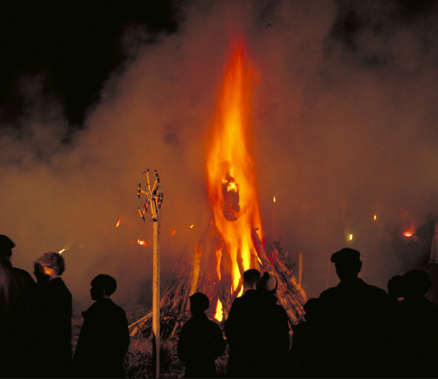
While the men and lads were building the pile, a change took place in the mass of shade which denoted the distant landscape. Red suns and tufts of fire one by one began to arise, flecking the whole country round. They were the bonfires of other parishes and hamlets that were engaged in the same sort of commemoration. Perhaps as many as thirty bonfires could be counted within the whole bounds of the district.

It was as if these men and boys had suddenly dived into past ages, and fetched therefrom an hour and deed which had before been familiar with this spot. The ashes of the original British pyre which blazed from that summit lay fresh and undisturbed in the barrow beneath their tread. Festival fires to Thor and Woden had followed on the same ground and duly had their day. Indeed, it is pretty well known that such blazes as this the heathmen were now enjoying are rather the lineal descendants from jumbled Druidical rites and Saxon ceremonies than the invention of popular feeling about the Gunpowder Plot.

Moreover to light a fire is the instinctive and resistant act of man when, at the winter ingress, the curfew is sounded throughout Nature. It indicates a spontaneous, Promethean rebelliousness against that fiat that this recurrent season shall bring foul times, cold darkness, misery and death. Black chaos comes, and the fettered gods of the earth say, Let there be light.

Thomas Hardy set his beguiling The Return of the Native in his beloved Wessex, around Guy Fawkes Day. 


Hardy's Bonfire on Egdon Heath and Eustacia Vye
Hardy wrote Return of the Native in 1878.  I love that he focuses on the primal urges of the bonfire—the Lux Fiat against the darkness—as the heart of the tradition, and not the echoes of the Gunpowder Plot with its religious baggage.

I read The Return of the Native in high school, a novel well matched to that time and place. Wildeve, the heath, the bonfires, the odd, red Diggory Venn character, cross-dressing mummers, burning a foe in effigy, Hardy’s relentless themes of loneliness and isolation—does anything more clearly speak to the surging angst of high school?

And to top it off, I connected with the tortured, sad, exotic figure of Eustacia Vye, deemed by a chapter heading to be Queen of the Night. It’s hard not to read Hardy as mocking his heroine, but this was a serialized novel during Victorian times, and modern irony was still waiting just over the horizon in the No Man's Land of World War I:

"Eustacia Vye was the raw material of a divinity. On Olympus she would have done well with a little preparation. She had the passions and instincts which make a model goddess, that is, those which make not quite a model woman."

Hardy’s Tess has gotten the serious attention through the years, and we won’t even talk about the effect Jude the Obscure's Sue Bridehead and Father Time have had on subsequent literature.

But for me, Eustacia is the character that made me feel less lonely in high school, because she was so solitary.

She enters the story silhouetted against the Guy Fawkes bonfire:

"When the whole Egdon concourse had left the site of the bonfire to its accustomed loneliness, a closely wrapped female figure approached the barrow from that quarter of the heath in which the little fire lay.

Her reason for standing so dead still as the pivot of this circle of heath-country was just as obscure. Her extraordinary fixity, her conspicuous loneliness, her heedlessness of night, betokened among other things an utter absence of fear."

A tract of country unaltered from that sinister condition which made Caesar anxious every year to get clear of its glooms before the autumnal equinox . . . was not, on the face of it, friendly to women."


Hardy's language is a joy: "extraordinary fixity." It is astounding that he would write of a woman in terms of such strength—"utter absence of fear"—while understanding that such fearless independence can also be isolating. That was comforting to hear in high school.

Eustacia suffers from yearnings of grandeur: she is trapped by class and circumstance to live on the heath, which she detests, while she’s tormented by delusions of living in Paris. She yearns for love in an equally distraught way. Much of the book is overwrought passages about her comings and goings on the heath, as she walks between bonfires.

Yet, amid all the hype, I found a metaphor that seared into my teenage memory.

". . . a clue to her abstraction was afforded by a trivial incident. A bramble caught hold of her skirt, and checked her progress. Instead of putting it off and hastening along, she yielded herself up to the pull, and stood passively still. When she began to extricate herself it was by turning round and round, and so unwinding the prickly switch. She was in a desponding reverie."

Important lesson for women: beware the brambles of life because they will snag the hem of your dress if you are not careful. If you are not vigilant, they will keep you motionless, throw you into a desponding reverie,  or worse. Clear them away, or at the least, walk around them.

Here's the rub: It’s not always easy to see these low-growing thorns, especially when your gaze is focused elsewhere than on your feet, like when looking up at a glorious sky or into the eyes of a beloved or at the bobbing head of a toddler. And that's when you can get ensnared . . .

But since high school, I have been on the outlook for those brambles. And it has helped. Thanks, Hardy.

Monday, September 4, 2017

Twin Peaks The Return: The Day After

This is not another recap of Twin Peaks: The Return, just some observations I offer as part of the wonderfully participatory arena the whole TWR has provided.

I enjoyed the whole series, and loved both parts of the finale. I also loved reading all the intellectual interpretations about the huge subtleties within the art.

One of the questions the one-armed man asks in the Black Lodge (two times actually) is “Is it future or is this past?"  That idea is more prescient than Lynch could have possibly known when he wrote it, given the recent nuclear testing in North Korea and our government's heightened rhetoric.  For me, there are 2 real-life touchpoints to the series that will stay with me for a long time.


Trinity

How eerie that David Lynch’s masterwork Twin Peaks: The Return ends on the weekend when I get a NY Times email alert: North Korean Nuclear Test Draws U.S. Warning of ‘Massive Military Response.

The art-house highlight of The Return—the extraordinary Episode 8—-is Lynch’s meditation on the ever-living effects of Trinity, the July 16, 1945 test of the A-bomb. Born in 1946, his early childhood was awash in “Drop, duck, and cover” taught in schools in the 1950s to prepare Americans to survive a nuclear attack. Children across the country went through actual drills where they methodically hid under their desks, as though that would save them.  Or they filed in neat little 1950s lines into "fallout shelters" in the school.

That anxiety of a nuclear attack seems to have had an enormous impact on Lynch’s young artistic mind. Throughout The Return Lynch brings us the ever ominous evils of electricity and multiple nightmares, including the “Gotta light?” walking incineration who kills all in his path. We get it. Mankind often faces manifestations of pure evil, many of his own doing.

The real-life threat of a war over nuclear war provides a whole new dimension of scary behind the simpler debatable semiotics of our beloved TV series.


The Return finale also made me think of the 1983 TV event that was The Day After, which aired on Sunday night, November 20. It was watched by more than 100 million people, including me. Even so, the possibility of nuclear war did not seem real to me then, so the horror of what happens to the fictional families in Lawrence, Kansas, and Kansas City, Missouri just seemed like any horror film. [Lynch, by the way, is from Missouri.] Today I fear war over nukes is entirely possible.

The Day After is also notable for the live panel that ABC broadcast from Washington, right after the broadcast.  Ted Koppel hosted Henry Kissinger, Carl Sagan, Brent Scowcroft, William F. Buckley, Jr., Elie Wiesel, and Robert McNamara along with a studio audience.

Koppel opens with: “There is some good news. Look out the window. It’s all still there. It’s not too late yet.”  The panel is highly worth watching.


ABC also opened 1-800 lines with counselors if people wanted to talk to someone after watching the US suffer such destruction.

Like the TV show, which had no clear conclusion, the North Korea situation continues on in all of its evilness.

Gotta light?


Laura Palmer

The finale works its way back to the story of Laura Palmer. As many have said, the whole story exists because a young woman was raped and murdered by her father (possessed by a demon, in order to explain it).

One of the most poignant moments of the finale is Agent Cooper going back in time to the night Laura will be killed. He is “the thing that’s over there in the woods” from the prequel Fire Walk With Me. He stops Laura and takes her hand to lead her away from continuing on to her death.

That moment. That moment of intercession.

The most human of longings: IF ONLY.

IF ONLY someone had been there to stop the violence.


That is a powerful truth in our real world. It made me think of all the women who have been murdered—usually by men—because there was no one there, at that moment, to intercede. We know the names of some of these women because they are in the news, like Katina Vetrano,  raped and murdered while jogging in Brooklyn. But there are countless, countless names we don’t know. I travel alone a lot, and I am super aware of surroundings. I have experienced women dawdle in a secluded ATM area if I enter and everyone else has left, and I have done the same. But it's never, ever enough . . .

In our fantasy story, we don’t know if the intercession was entirely successful. But that’s a commentary on how you can’t mess with time travel. Has Agent Cooper never seen Doctor Who?


Having Twin Peaks: The Return end on Labor Day is perfect. It was a summer appointment for we who stuck with it.  Many are calling “fraud” on Lynch for another incoherent, lazy, over-indulgence that shows he has long lost his magic.

Given the state of the world and our own crass government, I celebrate the artistic expression from a kid from the Show Me state. Long may we all go on Lynchian voyages together.


Thursday, August 31, 2017

Two Women for the Ages: Princess Diana & Mother Teresa, 20 Years in Heaven

 Time marches on. It is twenty years now since these two extraordinary women died 6 days apart in 1997. They had met just two months earlier that year, June 18, 1997, when Diana visited one of the Missionaries of Charity in the Bronx. 

How oddly fitting that Princess Diana and Mother Teresa, who had some connections in life, are connected to each other in death because they died six days apart in 1997. The coverage of Diana’s death made for a somewhat memorable Labor Day weekend that year, which then rolled right into the coverage of Mother Teresa.

And now, this week, we pause to remember that it has been twenty years since Diana died in a car crash. At the ten year anniversary, the book Mother Teresa: Come Be My Light came out, along with an article in Time that put forth the extraordinary idea that Mother Teresa basically lost her faith just at the moment she started the work with the poorest of the poor for which she is known.

Princess Diana, Escaping for Love
I happened to be awake 20 years ago when the first reports of Diana’s car accident broke into CNN. Shortly after, her death was announced, and it was shocking, in the way that John F. Kennedy Jr.’s death was. Young people with all the earthly gifts possible, dying in sudden, violent ways makes one stop for a moment. You intellectually know that this very day can be your last, but incidents like this make that idea more tangible.

I haven’t read Tina Brown’s book nor any of the cottage industry of tell all rags on the princess, but I have kept up with her story over the years. We share a birth year, but while she was getting married in 1981, I was off crewing on a schooner and didn’t get to see the wedding. My feminist friends at college had given me a “Don’t Do It Di” button, which their English counterparts had made up following a headline in the feminist magazine Spare Rib. But I didn’t understand it back then. I didn’t know what they were talking about, why shouldn’t she marry her prince, an actual prince? I think theirs was a general invective against the patriarchal monarchy, but how eerily prophetic was their warning.

The draw of the Royals, for most people, is simply that it’s a family writ larger than in our own homes. The saddest part of their particular mess is the triangle of Charles and Camilla and Di. Having a husband/lover who is always thinking of another is a soul crushing, living hell. It’s a shattering experience, and whatever personal struggles and demons Diana had herself—-bipolar/borderline personality, bulimia-—the unrelenting presence of Camilla in her marriage doomed any spec of happiness she might have known.

And to make it worse, Diana was horribly subjected to the subtle and not so subtle power plays from everyone around her. For instance, Camilla supposedly is responsible for Di getting into that monstrosity of a wedding dress, under the guise of the old guard helping her. Parker-Bowles supposedly laughed and laughed with her friends at how successful she was in making the wedding of the century look buffoonish. (This sickening power play is at least a plausible explanation for that nightmare in taffeta.)

It also illuminates how utterly Diana’s mother was missing from the whole equation, and what a devastating absence it proved to be. Frances Althorp Shand Kydd was an enigmatic woman. She also married young, to an older man of stature, and found herself in an unhappy marriage. She had an affair with Peter Shand Rydd, and a year later divorced Diana’s father and married him. (He would leave her years later for a younger woman.) It seems that with this kind of split, where Lady Althorp's own mother testified against her in the custody hearing in favor of Lord Althorp getting custody of their children, she wasn’t very close to her daughter at all, and that’s very sad for both of them.

In the end, I admired Diana for playing the hand she was dealt. She developed her dazzling style and looks as a way to parry the blows to her self esteem from the Royal family. She refused to stay in a sham marriage, and believed that she could have actual love with the right man, if she could find him. She saw two little boys through their early childhood with much genuine love and caring. And in the larger historical dimension, she reinvigorated the monarchy for all time. It was a short life well lived.

Mother Teresa, Losing Her Faith
Mother Teresa died six days later on Sept. 5. She was 87 years old, and her death was neither sudden nor violent. The ten-year mark saw the publication of Mother Teresa: Come Be My Light, a collection of letters in her own hand that speak to her loss of belief in God. Teresa had been an ordinary teaching nun of the Sisters of Loreto of Ireland for 15 years when she received a “call within the call” to leave her convent and work with the misery of the world’s poorest poor.

What follows is a life that has been lionized and pulled apart from every angle. Either her homes for the poor are badly run or they aren’t. There are questions of where all the donations to her Sisters of Charity go—so the accounting is questionable. There’s the question of her judgment, in aligning herself with the likes of Charles Keating. Nothing here is surprising. Human institutions and their leaders are always corrupt in some way.

But her internal loss of faith is startling. For fifty years she struggled to regain her faith in Christ: “for there is such terrible darkness within me, as if everything was dead. It has been like this more or less from the time I started 'the work.'"

Even the Eucharist had no meaning for her, which pretty much caps it: “I just have the joy of having nothing — not even the reality of the Presence of God [in the Eucharist]."

For the cynics team, this means she lead a life of complete hypocrisy. That she “knew” there was no God, and she didn’t have the courage to admit it. Of course she has no more actual knowledge on the subject than any of us. She was canonized a saint in the Roman Catholic Church on September 4, 2016.

Just as Princess Diana was subjected to much armchair psychology, there are theories in the Time piece that Mother Teresa needed to sabotage her own success. Maybe. Maybe she wanted to leave her institution just as much as Diana wanted to leave hers, but didn’t have the strength or ability to make it happen.


I find much to learn from both of these larger-than-life women, and it all comes back to love. As a late teenager Diana thought she had found it in Charles, and she paid for her misperception for the rest of her life, and one could argue, with her life. Mother Teresa once felt a presence of Christ’s love so strong that it negated the need for the love of an earthly kind. She was surprised and saddened when she later felt that His love had abandoned her, and she faced fifty years in a depressed darkness where she simply continued on as best she could. Such is the reality of many lives.

The two women admired one another, and I read somewhere that Diana is buried with a rosary that was a gift from Mother Teresa. Considering what an RC custom that is, it seems a little unlikely, but it’s a lovely thought.

Here’s the stirring hymn from Diana’s funeral, I Vow to Thee My Country.