Friday, October 30, 2015

Orson Welles's War of the Worlds: First-hand Accounts from Steve Allen, John Houseman, and Howard Koch

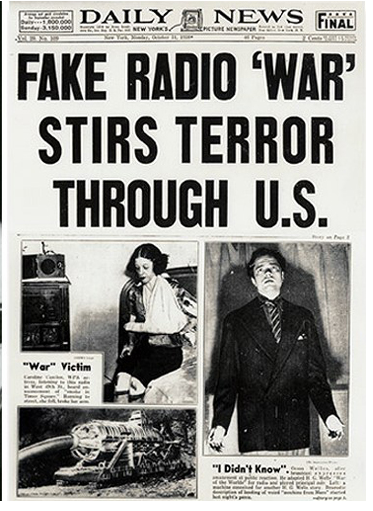
'Twas the night before Halloween, 79 years ago in 1938, and America experienced a collective reaction to a media phenomenon—not unlike news flashes we now experience on Twitter—except the reaction was in "real life," not virtual.

They had been listening to the radio, surfing around the dial, when they alit on Orson Welles's "War of the Worlds" broadcast on his radio series, Mercury Theater on the Air. The thing is many people didn't hear the program from the beginning, when it was announced that it was the weekly fictional adaptation of literature, this week was from H.G. Wells. Instead they came in to some orchestra band music playing, which was interrupted by news bulletins of an alien invasion of Martians in Grover's Mills, New Jersey.

The bulletins were so authentic sounding, and on the esteemed CBS broadcasting network, that people believed the outrageous claims.

I had the happy privilege of editing a catalogue about Orson Welles for the then-Museum of Broadcasting in 1988: we convinced Steve Allen to tell his own story about that night and got a great description of what it was like to be "victimized" by the broadcast when he was 17; interviewed John Houseman about it; commissioned a recollection from Howard Koch who wrote the radio adaptation (and great films like Casablanca); and reprinted Dorothy Thompson's brilliant article for the Herald Tribune, "Mr. Welles and Mass Delusion." The catalogue is sadly out of print, but below I offer juicy chunks of it.

Steve Allen: The End of the World, and High Time

In was in the year of our Lord 1938—the last year, I briefly thought, that the Lord was to vouchsafe to us—that my mother, my Aunt Margaret, and I (along with several million other Americans), went through an experience that not many will ever be privileged to share. We were on hand when the world came to an end.

The occasion was the famous Orson Welles "War of the World" broadcast. I have never before told the story of my own response to that broadcast, because I have seen the reaction of those who were not victimized by Welles to those who were. It is the standard reaction of the level-headed citizen to the crackpot. In my own defense, and in that of all the other crackpots who went squawking off into that unforgettable night like startled chickens, a word of explanation. Admittedly anyone who heard the entire Welles broadcast from beginning to end and believed a word of it should be under observation. Unfortunately millions did not have the opportunity. For various reasons a great many people did not hear the first few minutes. If some of these were in the mood for dance music, they accepted what a randomly discovered orchestra was playing, lighted cigarettes, or picked up magazines and settled back to listen.

In a room on the eighth floor of the Hotel Raleigh, an ancient and run-down hostelry on Chicago's Near North Side that was our home that year, I was lying on the floor reading a schoolbook. Feeling in the mood for background music, I turned on our radio, fiddled with the dial until I heard dance music, and returned to my book. In the adjoining room Aunt Margaret and my mother were playing cards.

After a moment the music was interrupted by a special "flash" from the CBS News Department—the authenticity of which there was not the slightest reason to doubt—to the effect that from his observatory a scientist had just detected a series of mysterious explosions of a gaseous nature on the planet Mars. After this fascinating bit of intelligence, the announcer said, "And now we return you to the program in progress," and music was heard once more.

There soon followed a series of news items, each more exciting than it predecessor, revealing that the strange explosions on Mars had caused a downpour of meteors in the general area of Princeton, New Jersey. One of them in crashing to the earth had cause the death of several hundred people. CBS at once dispatched a crew to the scene, and it was not long before firsthand reports began coming in.

With disbelief rising in his throat, a special events man on the scene near Princeton reported that one of the Martian meteors appeared to be no meteor at all, but some sort of spaceship. The National Guard had roped off the area, allowing no one near the gargantuan hulk.

By this time my mother and Aunt Mag were huddled around the speaker, wide-eyed. The contents of the news broadcast were inherently unbelievable, and yet we had it on the authority of the Columbia Broadcasting System that such things were actually happening.

But if our credulity had been strained up to now, it had yet to face the acid test. The network next presented an army officer who made a dignified plea for calm, stating that the National Guard and the New Jersey police had the situation completely in hand. The network interrupted his sermon with another report from the scene, frankly emotional in nature, which confirmed the suspicions that there might be life of some kind inside one of the rockets. The description of grotesque monsters by this time seemed in no detail too fantastic. Their slavering mouths, jellylike eyes, and the devastating fire they directed toward the soldiers who dared stand and face them were all minor details, no longer clear in my mind.

The National Guard troops dispatched to the scene were massacred almost at once by the hug interplanetary invaders (there were several of them now, for other ships were landing) and in the confusion of the battle the network's facilities were impaired and its man-on-the-spot was cut off in midsentence.

CBS, however, was equal to the occasion. Civic and government spokesmen were rushed to microphones; dutifully—and ineffectually, as it turned out—they instructed the populace not to panic. An airplane was set up over the troubled area, and the network continued with its blow-by-blow description.

My mother, my aunt, and I looked at each other, not knowing what to say.

"Why do you think we ought to do," I said.

"There's only one thing to do," my mother responded. We can all go over to church and wait there to see what happens," She referred to the Holy Name Cathedral, not many blocks from our hotel.

Just then we heard the word "Chicago" on the radio. "More spaceships have been reported over Cleveland, Detroit, and Chicago."

"Jesus, Mary, and Joseph," Aunt Mag shouted, "We'll be killed right here in this hotel. Let's get out of here."

"You're right," Mother said, "We'll go over to the church."

I was putting on my coat, still too shocked to say much. Oddly enough, and this I recall quite clearly, my predominant emotion was not fear, but blank stupefication. I remember saying "Gosh," idiotically, over and over, and frowning and shaking my head from side to side. I couldn't believe it, and yet I had to, on the basis of years of conditioning. CBS had never lied to me before.

Aunt Mag was still fluttering around the room. The door was now ajar, but she was like a bird that , with its cage opened, doesn't know just where to fly.

"Are you all right," my mother asked me.

"Gosh," I said resourcefully, and we headed for the door. By this time people all over the nation were having similar reactions. Many stayed glued to their radios and heard the reassuring conclusion to the program, but millions, like us, rushed off wildly. Police stations, newspapers, and churches were badly shaken by the first wave of frightened, fleeing citizens.

My mother and aunt ran down the hall. I followed at a slower pace, not because I was trying to maintain a shred of discretion, but because I was too stunned to move with speed. Rounding a corner we burst upon a dignified-looking young woman holding a little girl in her arms.

"Run for your life!" my mother cried at the woman. She looked at her with no expression whatsoever.

"Pick up your child and come with us!" Aunt Mag shouted, wild-eyed. The woman paused a moment and then laughed right in her face.

Mag was outraged. "Oh, yes, " she sputtered with withering sarcasm. "Go ahead and laugh! But for the sake of that dear baby in your arms don't you laugh. You ought to get down on your knees," she shouted like a complete nut, "instead of laughing at people. We're going to church to pray, and that's what you ought to be doing right now this minute, praying!"

We were now at the elevator.

"Hurry up and take us down," my mother gasped. "They're up in the sky."

"Who is?" asked the young elevator operator, aghast.

"How do we know who it is," my aunt shouted. "But you'd better get out of this hotel right now while you've still got the chance."

"Yes ma'am. What did you say the matter was?"

"They're up in the sky!" she repeated. "Haven't you been listening to the radio?"

"No, ma'am."

"Well, you'd better do something, let me tell you. The radio just said they're up over Chicago, so you'd better run for your life."

I am sure that if the elevator operator had been convinced that an interplanetary invasion was underway, he would have faced the challenge as bravely as the next man. But instead he apparently concentrated on the idea that he was cooped up in a tiny cubicle with three dangerous lunatics. Fortunately for his nervous system, we arrived at the main floor; he yanked the door release and shrank against the back wall as we thundered past him into the lobby.

Though we had been met with icy disbelief twice in quick succession, we were ill-prepared for the sight that now greeted us. The lobby, which we had expected to find in turmoil, was a scene of lobby-like calm. Nowhere was there evidence of the panic we had come to accept as the norm in a few short minutes.

The elevator man peered after us from what was now the safety of his cage as we raced to confront the blase desk clerk. "Is something wrong?"

"Well," said my aunt with a contemptuous sneer, "it's the end of the world, that's all that's wrong."

I started to explain that on the radio—and then in some clear, calm corner of my mind I heard something. It was a radio, making soft sounds in a corner of the lobby, and the sounds were not the sort a radio would make at a time of worldwide crisis.

A wave of shock passed through me, as, in the instant, I saw things as they really were. Turning to my mother, I began speaking very fast, explaining exactly what had happened. For a split second she wavered, and then for her, too, the ice broke.

Light, followed by painful embarrassment, dawned on Aunt Mag. Like bewildered sheep we retreated, excruciatingly aware that all heads were turned toward us, that the clerk was smiling at us in a frightfully patronizing way, and that never again would we be able to walk through the lobby without casting our eyes to the floor.

John Houseman: The Show's Producer


Q: You wrote in you book Run-Through about "The War of the Worlds" that there were factors why you thought people were so frightened.

Houseman: Whole books have been written about it. The factor I mentioned was the timing. The timing in the sense we had just had the Munich crisis. At that time, for the first time in the history of the world, people found that the medium from which they got their news more quickly and completely than newspapers was radio. So it was a time when "the box" had suddenly become very important and very vital in the life of the country. And, with Munich just over, there was a general air of fear and panic and a feeling of doom, and a sense that war, international war, was inevitable. So people were pretty well primed for this latest catastrophe. If our broadcast had happened before before Munich I don't know that it would have had the same effect.

Q: Did Campbell's Soup become your sponsor after WOTW?

Houseman: Not immediately. The immediate effect was that we thought we were going to be fired. Nobody was at all sure how they felt about us. We were heroes and we were also a disgrace. They couldn't make up their minds. I know I had interviews with Mr. Paley and Mr. Stanton. Somewhere in the back of their minds they thought maybe this would turn out for the good. Which indeed it did when Campbell's Soup decided that if we could sell the Martians we could sell chicken soup.So we became the Campbell Playhouse. As a result we all, especially, Orson made more money, but it wasn't as much fun.

Q: What made Orson Welles so unique?

In general my whole theory about him has always been that while Welles was a very effective actor and a brilliant director, first and last he was a magician. If you examine all his best work, including Citizen Kane, you'll find that what he was really doing was a magic act. That was true of his Julius Caesar and when he did Marlowe's Doctor Faustus. He was at his best when he had very strong material which he could develop and enrich as a magician.

Howard Koch: The Man Who Wrote the Script


My friendship with Orson began in the late thirties when I wrote the weekly radio plays for his and John Houseman's Mercury Theater on the Air on CBS. While many of us contributed to the broadcasts in our various ways, it was Orson's charismatic personality which gave them their distinction and popularity. He played the leads, directed the shows, and with Houseman's collaboration, selected what was to be done and how it was to be done.

It was Houseman who gave me the job—and job it was—of sixty or so pages to be written every week.The pay was the magnificent sum of $75 (raised to $125 after "The War of the Worlds"), but the experience was worth more than any salary.

When I wrote my first of the radio plays—a real-life saga of misadventures in the Arctic called Hell on Ice—I still had not met Orson and was not all certain of my tenure on the program. The day it was finished I got a call to come to his office. My first impression of him was one of size: he seemed to fill the room. His gaze was penetrating, more than a look—it was also an appraisal. There was scarcely any introduction, Orson having little time or patience for the amenities. In his hands he had my opened script and read aloud a line from one of the scenes, a poetic image that could be visualized by a radio audience. His question was right to the point: "Is that a quote or is it your own line?" When I said I had written it, he made no comment but I knew I was in, that Houseman's selection had been confirmed.

For my third assignment I was handed a copy of H.G. Wells's The War of the Worlds, with instruction from Orson to dramatize the whole first section in news bulletin form and to make it contemporary. I rebelled. Written the way he wanted it meant practically a new story with only the idea of the invasion and a description of the Martian machines and weapons that could be used from the Wells material. In six days! I urged them to substitute a story by a friend of mine, but Orson was adamant. It was a race to the deadline with Houseman going back and forth from my apartment to the studio with whatever number of pages I had ready. The final pages went down just before broadcast.

To what extent Orson anticipated the public reaction to that broadcast neither I nor anyone else will ever know. The news photo which appeared in the press the next morning picturing a man overcome with remorse and contrition was not altogether convincing. Later than morning I was in the theater where the press conference had just been held when I was Orson coming out of one door and Houseman another, exchanging a congratulatory gesture which spoke volumes.

In a way, I was one of the victims. They had tried to reach me during the night to alert me to what was happening, but I was dead to the world, too exhausted to hear the phone. The next morning I went for a hair cut. Walking from my apartment down West 72nd street, I overheard ominous bits of excited conversations with such words as 'war" and "invasion" in the air. I rushed into the barbershop, "Has Hitler attacked? Are we at war or something?" The barber laughed and held up a morning paper with the headline: "Martian Invasion Broadcast Panics Nation." That was a moment I will never forget.

For the next several days it was an open question whether we would come out of the affair as heroes or villains. Police had stormed into the studio and, over Orson's protest, confiscated all the scripts they could find. Fortunately my working script, from which copies could be made, was safe in my apartment. Gradually the tide of public opinion turned in our favor, largely through an article by Dorothy Thompson, then a very influential columnist, in which she wrote that we had done the country a favor by alerting the people to the dangers of panic should a real enemy ever attack.

During the next month lawsuits were brought against Mercury and CBS by people claiming they had suffered injuries as a result of the broadcast, but none ever got to court. Although there were many minor accidents reported in the mass flight from the fictional Martians, we were relieved by the fact that there was no proof of an actual death. The American sense of humor eventually asserted itself in the many accounts of amusing incidents that have become part of the history of the event.

The "Panic Broadcast" as it was referred to at the time changed the course of our lives. After several months I left the program to become a screenwriter for Warner Brothers, and when the program ended, Orson and Houseman left for Hollywood where Orson directed Citizen Kane. he and Houseman parted ways, and that seemed to mark a turning point in Orson's career. I hope I do neither of them an injustice when I say that I feel Houseman was the base on which Orson's statue was erected. From the time they separated, Orson lived more the life of a celebrity than that of an artist.


Dorothy Thompson: Mr. Welles and Mass Delusion. New York Herald Tribute, November 2, 1938

"All unwittingly, Mr. Orson Welles and the Mercury Theater of the Air have made one of the most fascinating and important demonstrations of all time. They have proved that a few effective voices, accompanied by sound effects, can convince masses of people of a totally unreasonable, completely fantastic proposition as to create a nation-wide panic.

They have demonstrated more potently than any argument, demonstrated beyond question of a doubt, the appalling dangers and enormous effectiveness of popular and theatrical demagoguery.

They have cast a brilliant and cruel light upon the failure of popular education.

They have shown up the incredible stupidity, lack of nerve and ignorance of thousands.

They have proved how easy it is to start a mass delusion.

They have uncovered the primeval fears lying under the thinnest surface of the so-called civilized man.

They have shown that man, when the victim of his own gullibility, turns to the government to protect him against his own errors of judgment.

The newspapers are correct in playing up this story over every other news event in the world. It is the story of the century.

And far from blaming Mr. Orson Welles, he ought to be given a Congressional medal and a national prize for having made the most amazing and important contribution to the social sciences. For Mr. Orson Welles and his theater have made a greater contribution to an understanding of Hitlerism, Mussolinism, Stalinism, anti-Semitism and all other terrorisms of our times than all the words about them that have been written by reasonable men. They have made the reductio ad absurdum of mass manias. They have thrown more light on recent events in Europe leading to the Munich Pact than everything that has been said on the subject by all the journalists and commentators.

Hitler managed to scare all Europe to its knees a month ago, but he at least had an army and an air force to back up his shrieking words.

But Mr. Welles scared thousands into demoralization with nothing at all.

(snip)

If people can be frightened out of their wits by mythical men from Mars, they can be frightened into fanaticism by the fear of Reds, or convinced that America is in the hands of sixty families, or aroused to revenge against any minority, or terrorized into subservience to leadership because of any imaginable menace.

The technique of modern mass politics calling itself democracy is to create a fear – a fear of economic royalists, or of Reds, or of Jews, or of starvation, or of an outside enemy – and exploit that fear into obtaining subservience in return for protection. I wrote this column a short time ago that the new warfare was waged by propaganda, the outcome depending on which side could first frighten the other to death.

The British people were frightened into obedience to a policy a few weeks ago by a radio speech and by digging a few trenches in Hyde Park, and afterward led to hysterical jubilation over a catastrophic defeat for their democracy.

But Mr. Welles went all the politicians one better. He made the scare to end all scares, the menace to end menaces, the unreason to end unreason, the perfect demonstration that the danger is not from Mars by from the theatrical demagogue."

(Entire article transcribed here)

Postscript
Much has happened since this much ado from the original bad boys of media, Orson Welles and John Houseman, including the full Hollywood treatment of The War of the Worlds by no less than Tom Cruse and Steven Spielberg. Subsequent research has claimed that the panic wasn't as widespread or active as has gone into legend, but certainly many people felt "lied to" because of the early verisimilitude of the news bulletins.

For me, it was a thrilling scare from a lot of very talented people. The perfect gift for Halloween.

Tuesday, October 6, 2015

Kairos in Croatia, aka Carpe Diem, Trogir-Style

Left: Trogir, Croatia, Town Hall. Bas relief of Croatian hero, Petar Berislavić sculpted by  Ivan Meštrović. Right: Full-size bronze statue of Ivan Meštrović sculpted by American Malvina Hoffman.

I spent the week of Labor Day in the extraordinary country of Croatia, where history lives in layers and layers and layers.  And to these ancient layers I experienced current day, living layers of history that felt so dense I found it hard to think about, hard to write about when I got home. The trip was another in the series of "sing Renaissance polyphony and see the world."  I met up with a an international group of singers, brought together by an Englishman who runs Lacock Courses, in Trogir for a week of rehearsals, followed by a free concert in the famous St. Lawrence Cathedral.

When I got back to Gotham I found myself in the Brooklyn Museum, where I had not been in more than a decade, because a niece has moved into Brooklyn, right down the block.

It is a particularly wonderful museum. One exceptional feature is the Visible Storage on the 5th floor, where you can wonder amongst lots of the collection in storage while not on display. The space has a magical feel to it, like you have passed through some secret panel at the back of a closet into a realm of secret treasures.

The treasures are behind glass--that is how they store them. But in the middle of it all was a large-as life piece of sculpture. Because of the hand gesture I first thought it was Shakespearian of some sort. But the tag identified the figure as

Ivan Meštrović.

A month ago that would not have meant anything. But I now know that he is one of the master sculptors of the 20th century. And Croatian. And I have pictures of his work in Trogir. See photo above.

WHAT ARE THE ODDS?

Kairos Among the Winding Streets

Trogir was named a UNESCO Heritage site in 1997:

Because of the continuity of of its settlements since Ancient Greece. It is the best-preserved Romanesque-Gothic complex not only in the Adriatic, but in all of Central Europe. Trogir's medieval core, surrounded by walls, comprises a preserved castle and tower and a series of dwellings and palaces from the Romanesque, Gothic, Renaissance and Baroque periods.

Even a cursory synopsis of its history (courtesy Wiki) is dense:

Trogir was founded by Greeks 3 BC.  In the 9th century there were Croatian rulers, then 1123 it was nearly completely demolished by the Saracens. But the people rebound, and prosper. 1420 they are ruled by Venice, until its fall in 1797, when Trogir becomes part of the Hapsburg Empire, which ruled until 1918 (except for the French Occupation of 1806 to 1814). After WWI Trogir, along with Croatia, gets subsumed into Yugoslavia. During WWII it was occupied by Italy until 1944, when it was subsumed into second Yugoslavia. Croatia declared independence in 1991 and when the fighting stopped in`1995, it was a sovereign nation.


One of the city's treasures is a bas relief of Kairos, from the 3rd century BC.

Kairos is the god "of the moment" of the "fleeting opportunity."

He is an embodiment of the idea of Carpe Diem, from Horace's Odes. And he is almost a symbol of the city, you can find his likeness on every conceivable souvenir.

The poet Posidippos explained the iconography of the figure:

"He walks on tiptoe with wings on his feet because he's always in a hurry; clutches a razor because he is sharper than the tips of a knife; he has a tuft of hair over his forehead but he's bald in the back because people must grab him as they approach. Once he's gone by, it is too late."

And because of the layers of Trogir, this very important Hellenistic treasure is in the Benedictine monastery of St. Nicholas. I loved learning of this impish Greek god, the embodiment of the most human of desires to not miss out, and to see it everywhere in this ancient town.

Trogir is small, with narrow winding streets. I found it a little claustrophobic, and was very glad to be staying across the bridge, where there was more space, more air.

The church of St. Peter, where we had rehearsal each day.
The view of the walled city of Trogir from my B&B in  Ciovo, across the bridge

The Kamerlengo Fortress Castle, at the end of the town
Night in the Trogir town square


The Modern Layers Amidst the Ancient Stones 
As I wandered about this intriguing Eastern European nation, I was conscious of a complex intersection of current and recent tragedies. 

•The exodus from Syria, which has been going on for years,  hit a new critical point the end of August/beginning of September. The coverage was wall-to-wall on BBC.  The enormity of the suffering, the impotence of "Europe" to deal with it, were juxtaposed for me with holiday makers of every nationality on the beautiful island that is Trogir.  For the most part, my fellow vacationers looked like the solid middle class trying to enjoy its measured time away from work.  And then the enormous yachts came in. . . . 

•Burning Man 2015 paralleled my Croatian sojourn, Aug. 30 to Sept. 7.  70,000 + people choosing to wonder in the desert of Nevada, searching for creativity amidst the harsh conditions of the Playa,  paralleled 100,000 + immigrants in various deserts facing daily, literal,  life and deaths situations.  The two extreme ends of the human condition weighed upon my heart.

•Hope in the Turmoil of Tudor England: This was the theme of the week, devised by Patrick Craig, an English countertenor superstar.  He has an extraordinary talent to bring the historical context that music is written in to life and  is the most empathetic person I have ever met.

Patrick described--from his imagination--what it might have been like for Catholics during the English Religious Wars (I'm paraphrasing): 'So you are having your Mass at home, because the government will not allow you to worship how you wish. If there is a knock on the door--because you have been ratted out---everyone in the room would have a job: you scoop the Bible & the chalice into a basket, you help the priest into the "priest hole," you hide any music. And the music itself, from the genius of Byrd, reflected a depth of conviction combined with a frisson of people under constant siege." And most poignant of all to me: Patrick isn't Catholic.

*14 year anniversary of 9/11: This was the first 9/11 I have not be at home, the Upper West Side of Manhattan. It happened that the free concert the group was giving in the town's St. Lawrence Cathedral was on Sept. 11. And it happened that the dress rehearsal was at 3:00pm, which is 9:00am New York time.  And it happened that the first piece we rehearsed was a setting of the Lord's Prayer by John Sheppard.  So it happened that at 9:03 am NY time I was singing, "forgive us our trespasses, as we forgive them which trespass against us." No one ever said Christianity is easy.  And then I was more than happy to sing "but deliver us from evil . . . "

8:46 first plane hit North Tower; 9:03 second plane hit South Tower; 9:37 Pentagon hit; 9:59 South Tower falls; 10:03 Shanksville; 10:29 North Tower Falls.

The concert on September 11, 2015 in St. Lawrence Cathedral, Trogir. 


Saturday, September 19, 2015

Sing Polyphony & See the World. But not Cuba.


September 19, 2015: I'm watching Pope Francis arrive in Cuba, in advance of this visit to the US. I tried to go to Cuba 3 years ago, shortly after Pope Benedict visited, to sing in one of the polyphony courses I do around the world.  It was an idea before its time: the US Department of the Treasury wasn't having it. 

Here is my non-travel tale from 2012:


-->
Cuba: the Pope [Benedict] didn’t have a problem getting into the country, but this lowly American alto couldn’t make it happen.

This tale of non-travel amidst my usual travelogues begins late last year when I learned of a thrilling opportunity to sing polyphony in Cuba, at an international workshop organized by Andrew Van Der Beek, who lives in England and runs the Lacock courses in Europe.

The course is in Havana, under the direction of the Spanish conductor Carlos Aransay, starting on Palm Sunday April 1 and ending with a FREE concert in the main cathedral on Holy Saturday on the 7th.

Here is the course description:
 “A week for singers of all ages and nationalities in the historic centre of Cuba's capital city. The course will be directed in English and Spanish, and will end with a public performance in Havana cathedral. The general aim is to explore Cuba's musical heritage with a leading specialist conductor, in a relaxed and convivial setting.

"Our concert will be in Havana cathedral on Holy Saturday, so we begin with Alonso Lobo's Lamentationes Sabbati Sancti, one of the most sublime and vibrant settings of these powerful texts. The year 2012 is an important one for Cuba: the 400th anniversary of the apparition of Nuestra Señora de la Caridad del Cobre, Cuba's patron saint and dedicatee of the church where we will be rehearsing. We will commemorate the event with two hymns to the Virgin: Ave Maria by Heitor Villa-Lobos (1887-1959), one of the most beautiful settings I have come across, widely performed in Latin America; and Salve Regina by William Byrd, the five-part setting. Early English choral music is virtually unknown in Cuba, and this is just stunning with its canons and quick ascending scales.”

Wow. Choir nerd heaven. (I had no idea that the Pope would be in Havana just days before the course started.)

The wrinkle for me is that Americans cannot travel independently to Cuba because of the economic sanctions enacted 60 years ago. President Obama relaxed some of the restrictions in Jan. 2011, allowing for some travel under very specific, spelled-out provisions that are in keeping with “U.S. policy.”

And so I began my saga to try to attend this workshop.

Rest Easy: Our Wire Transfer Officers Are Very Alert

The first indication that this was not going to be easy was when I tried to wire the down payment for the course to Andrew. I was wiring the money from Chase, and I had put in the note “Havana” because I was registering at the same time for a second course Andrew is running, in Italy, and I wanted him to be able to distinguish the two down payments.

Now, I knew that I would have to apply for a license to travel to Cuba, which was going to be my next step, when my bank Chase called to basically say they had confiscated my $234 dollars, which they could neither pay to the beneficiary (Andrew) nor return to me unless I got a license from the Treasury department. They followed up with this email:

Please be advised JPMorgan Chase is required under the U.S. Treasury dept. Asset Control regulations to hold wire transfer funds USD $236.50 due to the reference Cuba . This reference may be associated with Cuban Sanctions. The funds are now in a JPMorgan Chase Blocked funds account. Chase cannot release the funds to the beneficiary nor can we return the funds back to you unless you obtain a license from the Treasury office. In order to obtain this license you should apply to the following address or website.

All triggered just because I put “Havana” in the notation. Comforting to know that Chase officers are not asleep at the wheel. But I was still surprised, because I was paying pounds sterling to an Englishman in England! Not much supporting of Communism in that.

Licensed to Travel

An American needs to apply for a “license” to travel to Cuba from the Treasury Dept., the Office of Foreign Assets Control to be specific—not the State Department—because the policy sanctions against Cuba are specifically economic.

The T-Dept. has a good website that spells out the sanctions, and spells out what provisions you can apply to travel under. There is a general license, and they specific provisions.

I applied under “31 CFR § 515.567 Public Performances, Athletic and Other Competitions, and Exhibitions,” which seemed to be dead-on for my situation.

“You may request a specific license authorizing certain travel-related and additional transactions incident to participation in a public performance, clinic, workshop, athletic or other competition, or exhibition in Cuba. The event must be open for attendance and, in relevant situations, participation by the Cuban public.”

The provision even specifies a workshop. And the course has a free concert, which some students from a local conservatory will participate in. I expected a slam dunk approval.
Instead, my application to travel to Cuba for this workshop was denied because the performance provision does not “contemplate” the specificity of this international workshop.

(Side note, “contemplate” is a very active verb for a provision. Who knew our government was such a fan of personification.)

Such is the downside of bureaucracy: it leaves no room for common sense interpretation.

I know that an international workshop of singers who are not in any sort of permanent group is not specified in the provision, but the spirit of this activity is absolutely within the spirit of the provision.
I felt so strongly that my request was actually within “U.S. policy” I appealed my rejection. There is no formal actual appeal, you just reapply again, and try to emphasize anything that will show that your request fits within the provision. In the appeal I played up being a Roman Catholic, going to sing a FREE concert on HOLY SATURDAY, for my fellow Catholics in Havana.

I made that new application on December 27, and three months later they still had not made a determination, which basically ran out the clock on me.

I respect that there are national interest situations that put the good of the country above the individual’s rights and liberties. And so I didn't go.

I am glad that my European musician friends will be in Havana next week, bringing the sublime music of polyphony alive amid the ancient stones of the Cuban capital cathedral.

Up next for me: Petitioning to to get my confiscated funds back. A least there’s a specific form on the OFAC website to apply. Bureaucracy at its most efficient when you need it.


Thursday, September 3, 2015

Leaving for the Land Where "Games of Thrones" & "Doctor Who" Film: aka, Croatia


I leave tomorrow for an end-of-summer,  Labor Day weekend vacation. Destination: Croatia. Trogir, to be exact. The entire island is an UNESCO heritage site.

Why write new, when you can just quote Wiki:

Trogir has 2300 years of continuous urban tradition. Its culture was created under the influence of the ancient Greeks, and then the Romans, and Venetians. Trogir has a high concentration of palaces, churches, and towers, as well as a fortress on a small island, and in 1997 was inscribed in the UNESCO World Heritage List. "The orthogonal street plan of this island settlement dates back to the Hellenistic period and it was embellished by successive rulers with many fine public and domestic buildings and fortifications. Its beautiful Romanesque churches are complemented by the outstanding Renaissance and Baroque buildings from the Venetian period", says the UNESCO report.
Trogir is the best-preserved Romanesque-Gothic complex not only in the Adriatic, but in all of Central Europe. Trogir's medieval core, surrounded by walls, comprises a preserved castle and tower and a series of dwellings and palaces from the Romanesque, Gothic, Renaissance and Baroque periods. Trogir's grandest building is the church of St. Lawrence, whose main west portal is a masterpiece byRadovan, and the most significant work of the Romanesque-Gothic style in Croatia.

Pretty amazing, yes?
I am drawn there by the prospect of a Renaissance Polyphony workshop, lead by the extraordinary Patrick Craig.  The music and theme of the week he has chosen: "Hope Amidst Turmoil in Tudor England," with brilliant compositions by the usual suspects: Tye; Sheppard; Taverner; Morely; Weelkes; Tompkins; and my favorite: Byrd. Whom we Catholics claim as our own, though scholarship has placed him on various sides of the Reformation divide through the years.

After a week of rehearsal, we will give a free concert of this extraordinary music in the famous St. Lawrence Cathedral. Anyone in the neighborhood, please come by.

And as fate would have it: that concert is on 9/11. This is the first 9/11, I will not be home. And so for that day, I again offer my own witness.

If I have to be anywhere other than NYC on this most New York City of all days, giving a free concert in an Eastern European city that has known great strife and sadness itself seems like a good place to be.
And now for the pop cultural conundrum: Game of Thrones films in Split (nearby to Trogir), and there is a now a tour: "Get a behind-the-scenes look at the hit HBO series ‘Game of Thrones’ on this 3.5-hour tour of the show’s filming locations in Split. Hear insider gossip about the series, see where Daenerys Targaryen plotted her return to power, and creep around the cellars where the slaves conspired with the Unsullied Army to overthrow the masters."

Now, I don't watch Game of Thrones. But, it's unlikely I'll ever be back in the region. So, do I find time to take that tour? More importantly, I'm hoping to stumble on some of the streets from Doctor Who: Vincent and the Doctor in Trogir. 
Doctor Who: Vincent and the Doctor, recreating Van Gogh paintings in Trogir

Please follow me @mapeel on Twitter for dispatches during the week. 

Tuesday, August 25, 2015

"Clarence Sent Me": Still Missing the Big Man as Born to Run Turns 40


I wrote the post below back in 2011 when the Big Man, Clarence Clemens, died. And now, August 25, 2015, Born to Run is 40 years old. It was great to see Springsteen and the E Street Band sing-off Jon Stewart with the rock anthem, but it's still hard not having Clarence on the defining sax sound. 

Born to Run. The song itself is exquisite poetry with a soul rousing sound. But every song on the album is extraordinary. For 3 generations now that collection of songs is a touchstone of yearning, love, and fear that touches the soul like few things can.  It's often said that the music of Bach is so complex and musically deep that it reveals the mind of God, and as a singer, I agree with that.  But Bruce. Bruce reveals the complexity of God's love for the strivings of humanity . . . and, clearly, his preferred groove (sorry Bach). 

In the day we sweat it out on the streets of a runaway American dream 
At night we ride through the mansions of glory in suicide machines 
Sprung from cages out on highway nine, 
Chrome wheeled, fuel injected,and steppin' out over the line
H-Oh, Baby this town rips the bones from your back 
It's a death trap, it's a suicide rap 
We gotta get out while we're young 
`Cause tramps like us, baby we were born to run 

Wendy let me in I wanna be your friend 
I want to guard your dreams and visions 
Just wrap your legs 'round these velvet rims 
And strap your hands 'cross my engines 
Together we could break this trap 
We'll run till we drop, baby we'll never go back 
H-Oh, Will you walk with me out on the wire 
`Cause baby I'm just a scared and lonely rider 
But I gotta know how it feels 
I want to know if love is wild 
Babe I want to know if love is real 

Beyond the Palace hemi-powered drones scream down the boulevard 
Girls comb their hair in rearview mirrors 
And the boys try to look so hard 
The amusement park rises bold and stark 
Kids are huddled on the beach in a mist 
I wanna die with you Wendy on the street tonight 
In an everlasting kiss 

One, two, three, four!

The highway's jammed with broken heroes on a last chance power drive 
Everybody's out on the run tonight 
But there's no place left to hide 
Together Wendy we can live with the sadness 
I'll love you with all the madness in my soul 
H-Oh, Someday girl I don't know when 
We're gonna get to that place 
Where we really wanna go 
And we'll walk in the sun 
But till then tramps like us 
Baby we were born to run 


The Death of the Big Man

It’s hard to lose a towering talent. My older brother was a fan of Southside Johnny and Bruce, that’s how I was introduced to the music. Born to Run then cut into my soul and touched every inch of its teen age fiber and I was cast as a fan for life.

Bruce and Clarence are both great storytellers with a love of the dramatic and the witty. Here’s a great story that Dave Marsh used at the end of his 1979 book,  Born to Run: The Bruce Springsteen Story. It's from the 1978 tour, Bruce talking to the audience in the middle of Growin' Up. He's telling about his mom & dad and their attitude toward his rock dreams.

Bruce Springteen's Concert Patter

“Anyway, one day my mom and pop, they come to me and say, ‘Bruce, it’s time to get serious with your life, This guitar thing . . .it’s okay as a hobby but you need something to fall back on.' My father, he said, “You should be a lawyer’--which I coulda used later on in my career. He says, ‘Lawyers, they run the world.’

“But my mother used to say, ‘No, no, no, he should be an author, he should write books.’ But me, I wanted to play the guitar.

“Now, my mother, she’s real Italian, and my father, he’s Irish. So they say, ‘This is a big thing. You should see the priest. Tell him we want you to be a laywer or an author. But don’t say nothin’ about that God-damn guitar.’

“So I went to the rectory. ‘Hi, Father Ray, I’m Mr. Springsteen’s son.’ I tell him. ‘I got this problem. My father, he thinks I should be a lawyer, and my mother wants me to be an author. But me, I got this guitar.”

“Father Ray says, ‘This is too big a deal for me. You got to talk to God,’ who I didn’t know too well at the time. ‘Tell him about the lawyer and the author,’ Father Ray says, ‘but don’t say nothin' about that guitar.’

“Now I was worried. Where was I gonna find God, right? So I go find Clarence—-he knows everyone. Clarence says, ‘No sweat, I know right where he is.’ So I show up at Clarence’s house in my mother’s car-—an old Nash Rambler. Clarence looks at me. He says, ‘You gonna go visit God in that? Man, he’s got like, people in Cadillacs, you know, He aint’ gonna pay attention to anybody shows up in a Nash Rambler.’ But it’s all I got.

“So we drive way out of town, and I say to Clarence, ‘Man, you sure you know where we’re goin’?’ Clarence says, ‘Sure, I just took a guy out here the other day.’ So we finally come to this little house way out in the woods. There’s music blasting out and a little hole in the door.

“I knock and this eye peeps out. I say, ‘Uh, Clarence sent me.’ So they let me in. And there’s God, behind the drums. On the bass drum it says: ‘G-O-D.’ So I said, ‘God, I got this problem. My father, he wants me to be a lawyer. And my mother, she wants me to be an author. But they just don’t understand---I got this guitar.’

“God looks at me. He says, ‘I know, I know. See, what they don’t understand is, Moses screwed up. There was supposed to be an Eleventh Commandment. Actually, Moses was so scared after ten-—it was a great show, the burning bush, the thunder, the lightening, you shoulda seen it-—he went back down the mountain. You see, what those guys don’t understand is that there was supposed to be an Eleventh Commandment. And all it said was:

LET IT ROCK!

* * *

So now the Big Man has met the Man Upstairs. And if Bruce is right, then he’s right at home, letting it rock.

Sunday, August 9, 2015

The Three Musketeers, a la Richard Lester at the FIlm Society of Lincoln Center

.
Thanks to Andy Webster's NY Times article, I'm on my way to filling in the gaps of my 'Dumas on film' knowledge. The Film Society of Lincoln Center is presenting Richard Lester: The Running Jumping Pop Cinema Iconoclast series and I'm thrilled that they are including Lester's trilogy of the French classic brought to life by a bunch of Englishmen.  The first two films were shot at the same time, and broken into The Three Musketeers and The Four Musketeers because d'Artagnan does become a Musketeer midway through the novel. I've seen the former many times, and am happy to go see its counterpart.

That is followed by Lester's 1989 The Return of the Musketeers. The idea was to follow Dumas to his lesser-known sequel, called Twenty Years After (Vingt Ans Apres).  It's a terrific read, bringing our heroes to the scaffold of Charles I in England. I'm sure the film makes up its own plot, as it substitutes Milady's son for a daughter, played by none other than Kim Cattrall.  The film has a place in the annals of sad film notoriety because Roy Kinnear, who played Planchet, died as a result of an on-set accident, which, as the Film Society site tells us,

". . . lead Lester to renounce directing features. But the resultant film (never released in the U.S. and currently unavailable on DVD), with its jocularity and swashbuckling action, provides a fitting valedictory to both men’s careers."

This post of my love for the novels is one of my earliest for this blog, back in the day of 2007.

* * * * *
I watched a little of Richard Lester's 1974 The Three Musketeers the other evening for the fourth or fifth time, and it proved to be a powerful cinematic madeleine for me.

There’s nothing quite like a teenage passion, especially when it’s the discovery of a book or a film that recognizes your own DNA. The passion that made my heart sing at that simpler time in my life was the world of Athos, Porthos, Aramis, and D’Artagnan.

Now no eye rolling out there.

Oh, I had visited with Sir Walter Scott, read the obligatory Victor Hugo, and danced a little with Sabatini. But nothing got under my skin the way Alexandre Dumas did with his novel The Three Musketeers and its sequels Twenty Years After and Le Vicomte de Bragelonne (or Ten Years Later).

I was self aware enough in high school to be a little concerned that I might be Miniver Cheever.

Mivinver loved the days of old
When swords were bright and steeds were prancing;
The vision of a warrior bold
Would set him dancing.

Miniver cursed the commonplace
And eyed a khaki suit with loathing;
He missed the mediæval grace
Of iron clothing.

Miniver Cheevy, born too late,
Scratched his head and kept on thinking;
Miniver coughed, and called it fate,
And kept on drinking.

Or, as Joni Mitchell explains it, “All Romantics meet the same fate some day/Cynical and drunk, and boring someone in some dark café.”

So I knew I was at risk, but reading the Musketeers was so exciting I couldn’t help myself.

It’s Dumas’s strength of voice. He moves the story along so easily, primarily through those masterful character pictures. We watch Entourage now, but what is that but an updating of this seminal story about the effect that true friends, real fellow travelers have on each other’s lives.

Steed had an interesting point about the 1998 Man in the Iron Mask film, that it was the old actor guard--Jeremy Irons, Gerard Depardieu, Gabriel Byrne, John Malkovich-- bowing, literally, to Leo DiCaprio, the new king. Dumas never wrote a novel with that title. It’s actually one plot line in the gargantuan Vicomte de Bragelonne that was later published as a freestanding book. One of my earliest, deeply literary experiences was finding the entire 9 volumes of Vicomte in the Hofstra University library when my older brother was there. He took them out for me one by one, and I needed to use folio scissors to open many of the pages. I felt like I had found a portal into the “world of literature.”

Get the Damn Motto Right
And so I have a serious fan’s sense of privilege when it comes to anything related to Dumas. Claude Schopp may be the preeminent Dumas scholar, but I’m his amateur counterpart.

And I must state, unequivocally, that the famous Musketeer quotation is

ALL for one, one for all.

Not the other way around. It comes at the end of chapter 9, and it’s D’Artagnan’s line, whether he says it in English or in French.
“And now, gentlemen,” said D’Artagnan, without stopping to explain his conduct to Porthos, “All for one, one for all--that is our motto, is it not?”

“And yet--” said Porthos.

“Hold out your hand and swear!” cried Athos and Aramis at once.

Overcome by example, grumbling to himself, nevertheless, Porthos stretched out his hand, and the four friends repeated with one voice the formula dictated by D’Artagnan: “All for one, one for all.”

Yes, the whole point is that the are ALL for one, not the ego of one for the group. I have seen it wrong everywhere, even in a WSJ article about the novel! Although I must say the fanfic community gets it right, and a Fraiser episode did too.

In November 2002 Dumas’s remains were disinterred from his home village and moved to the Pantheon where he rightfully took his place with France’s literary giants. His casket was draped with a blue covering, and there it said “Tous pour un, un pour tous.” Pictured above.

The French may get a lot wrong, but they are not going to get this detail wrong. This should put to rest any lingering confusion.

And Now “The Plot Thickens”

Even with all these deep connections I have to this writer, to these characters, my grandmother made it even more special.

Toward the end of her 93 years on earth, she was getting fuzzy about things. Not Alzheimer’s, just some hardening of the arteries. One day Grammy was talking to my mother, who was her sole caretaker, telling her that she had had a husband who was a mailman “who came home every day.”

My mother said, “Yes, I know Mom. Your husband was my father.”

Grammy looked at my mother with her bright, bright eyes, then dropped her head down, and with a little shake and smile, said “The plot thickens.”

It was one of the funniest family moments of all time.

And it is the title of Chapter 11 of The Three Musketeers, as Cardinal Richelieu's machinations unfold and we get closer to meeting the great villainess Milady. Dumas isn’t particularly credited with coining this phrase, but I couldn’t find an earlier citation for it. The French is L'intrigue se noue. 

 It is a rare teenage passion that gains more resonance as time goes by.

My own remembrance of my past love for this world has led me to order the new translation of 3M by Russian translator expert Richard Pevear that came out in 2006.

As for the length of this post, it must have something to do with that madeleine metaphor. I guess you evoke it at your own risk.

Tuesday, August 4, 2015

What the Hell, Britannia: Minions AND Mission Impossible Spotlight London


I don't often partake of the summer movie madness, but I happened to see Minions and Mission Impossible: Rogue Nation on one weekend, trying to beat the heat and get some deluxe air conditioning.

Mild spoilers ahead.

I saw Minions first, and I was charmed.  As many have said, the story is not that compelling, but spending time listening to the delightful gibberish and unquenchable élan of the distinctive little yellow ones more than makes up for any weakness. I like this description from The Guardian:

A ramshackle band of capsule-shaped, banana-yellow incompetents babbling like an unruly congregation of helium-sucking Esperanto-speakers don’t seem like your average celluloid heroes.

What I did not know before I went was that the plot centers around the arch villain Scarlett Overkill wanting to steal the actual Crown Jewels, right off the head of Queen Elizabeth II if necessary.

That brought our heroic trio--Kevin, Stuart, and Bob--to London for an extended sequence of lots of British humor/gags, including TV presenters having ubiquitous cups of tea in china cups; the trio popping out of the sewer at "Abbey Road" just as the even more famous quarter's legs are walking over it; Buckingham Palace; the Royal Corgis; the Tower of London; Bob assuming the throne (albeit shortly), and the Minion hordes landing on Albion's shores and taking afternoon tea in their bowler hats. It hits every cliche, I mean icon.

As charming as it all is, it seemed culturally tone-deaf for an American audience of elementary kids. Certainly seemed that way for the urban kids (of all races) I saw it with, and I don't know what kind of resonance all the Brit stuff is having in the Heartland. Although the solid gold soundtrack of classic British rock from The Stones, Kinks, Turtles, Who, and of course the Fab Four is timeless, and a great way to introduce the next generation to that collective brilliance. Illumination Entertainment, the production company, is based in Santa Monica. It was written by Brian Lynch, a guy from New Jersey. So again, I don't know what the Anglophilia was all about. (If they had based the plot around a surfing story a la Beach Boys, that would have made a little more cultural sense for the home team).


And Then There's Ethan's London


A mere 24 hours after the Minions, I was transported back to London in an Imax theater experiencing M:I. The IMF goes to Casablanca and Vienna, but London is given pride of place: the key action starts there, and the extended, clever ending sequence is British to the core. (One note: they could have had Ethan and Ilsa pass by some Pearlies as they are running through the backstreets. Maybe next time.) IMAX brought stunning aerial shots of London at night that truly transported the audience into Ethan's hyper-real, elite world.


Mission Impossible: Rogue Nation is a terrific action movie: funny, smart, sexy, it pays off in every small way you want it to. For me, the icing on the cake was the great use of the original TV music theme whenever the action became especially MacGyver-like on steroids (if I may mix my TV references).


A tale of two Londons: that of the Minions, and that of Ethan Hunt. Both slick, each idealized, a real moviegoing treat to see them both in one weekend. But it was a surprise to see that London, of all the world capitals,  is so front and center in the summer 2015 movie zeitgeist.

Oh, and a cautionary note for that other London film coming to the US in November. You had better step up your game, Mr. Bond.  Ethan Hunt has you on the ropes. And if MI beats Spectre in fan popularity and box office, then, in the immortal words of Alec Baldwin/Alan Hunley, it will "set US/UK relations back to the Revolutionary War." Oh yes, "KING BOB!"