Saturday, October 13, 2012

Funked by the Emmys, Revived by Rick and AJ

I have been afflicted a bit lately from the nearly 6-year itch of the blogger, which hits different people at different times. Tim Footman recently chronicled his own near-anniversary with an homage to "old style blogging," when unrelated ideas flowed so easily, one to the other.

Besides the general wear and tear of weekly blogging, my funk had an odd trigger: the Emmy Award show at the end of September. Not who won/who didn't win, but the show itself.

Starting right as it began with the taped segment "Backstage," which was set in the bathroom with Kathy Bates, Christina Hendricks, Zooey Deschanel, Connie Britton, Martha Plimpton, and Mindy Kaling. Bates hears someone crying and opens a stall to see Lena Dunham, naked, binge eating on the toilet. Then finds the source of the crying is Jimmy Kimmel, crazy eyebrowed with too much botox so he isn't going to go on.

The women say they can punch him into shape, and start punching him in the face one by one.

I don't think award shows of any kind should have a sense of self importance, but it's pretty low to locate your sensibility in the toilet, even with Jimmy Kimmel as host.

I have long been a cheerleader for the intelligent creativity of TV, celebrating its spectrum from Three's Company to Scenes from a Marriage, which Bergman made for Swedish television, fascinated by the power of the "miniseries" to bring people back in front of the screen several nights running. And here I was being assaulted by the industry's projection of itself in the lavatory, with an eating disorder and physical violence, which many people thought was funny. I hated all the Kimmel taped pieces, particularly the mock In Memoriam.

With all the talent who come together to create Homeland and Modern Family, this is how the industry presents itself on "their night." I found it so depressing and disappointing that it took my voice away for a while.

The next day I saw a picture of Jim Parsons and Zooey Deschanel presenting that I love for its composition and color, and for the easy elegance of the actors, even if they look like they escaped from a Pushing Daisies episode. But beneath this facade of beauty, New Girl and Big Bang Theory are on Neil Genzlinger's "Trends That Deserve the Unwelcome Mat," for their reveling in urine gags. Crap, we're back in the bathroom.

I agree with Genzlinger that this is an unwelcomed trend, which worries me a little. He's the guy who took on what is clearly Seinfeld territory, "Really," without referencing Seinfeld. As Jerry declared, "You crumbled a bit of civilization off there yourself."

Rick or AJ?

Well, the funk has lifted, fueled in part by the ridiculous Funny or Die, "Greatest Event in Television History," from Paul Scheer, Adam Scott, Jon Hamm, Paul Rudd, Jeff Probst and their love of Simon & Simon. It's completely over the top, but done by guys who love and know television from its smallest pixel to every inflection that we all picked up on since our impressionable childhood viewing.

Simon & Simon has that great, lame, 1980s magnetism about it. I was just in San Diego and took a city trolley tour. They did not mentioned Simon & Simon when going over the Coronado Bridge, but I will write to tell them they really should.

Sunday, September 16, 2012

Tumblring in Washington, DC

I happened to find myself in Washington DC this past week, as 9/11 bled into the horrifying murders of Ambassador Chris Stevens, information officer Sean Smith, security specialist Glenn Doherty and a fourth American whose name I don't think has been released.

Except for a quick visit to the Library of Congress archives three years ago, I had not been in the capital or capitol since a junior high school trip.

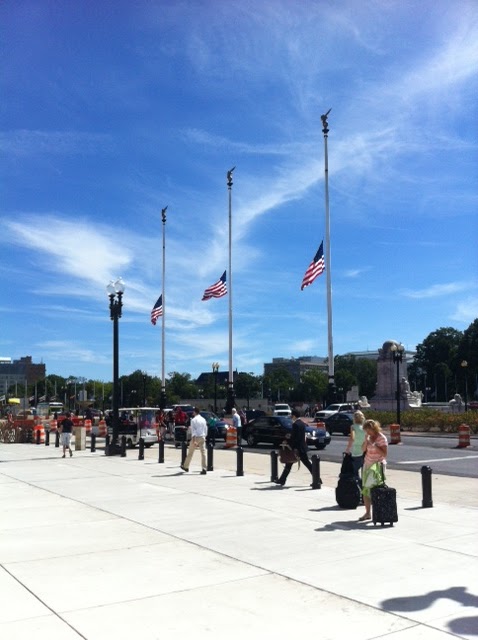
The first thing that struck me is the presence of the flag at half staff: unlike NYC, flags are omnipresent, and the constant visual reminder of the national deaths is very poignant.

Our national monuments are impressive, as they need to be to help with the nation building behind E Pluribus Unum. I enjoyed a nighttime bike tour to see their illuminated state, and then returned to see them during the day. That's when they come to life with thousands of visitors: particularly moving are the number of Asian visitors at the Vietnam Memorial, and the elderly veterans in wheelchairs with comrades and friends at the WWII memorial.

Here's my Tumblr-homage to the monuments of the District of Columbia.


Sites:
Union Station; Jefferson; FDR with Eleanor; MLK; Lincoln; Korea; Vietnam; WWII; Washington; Memorial to the Japanese-American Patriotism in WWII, colloquially known as the Internment Memorial. The names of 10 internment camps are on one side, with the numbers of how many Japanese American were held. My guide said that as the war progressed and the army needed more fighters, men in the camps were conscripted. The names of the men from the camps who died in combat are listed in the bottom picture.

Tuesday, September 11, 2012

"Out of the Clear Blue Sky": The Story of Cantor Fitzgerald and 9/11


In August I attended some of the DocuDays films at IFC, and one that has stayed with me is Out of the Clear Blue Sky: it's an insider's look at the story of Cantor Fitzgerald and 9/11. With the distance of 10 years it tells the sad, unique story of this company and how people have picked up and moved on as they can from such personal devastation.

Cantor Fitzgerald is a financial services company that specializes in bond trading: it's one of twenty primary dealers who trade U.S. government securities directly with the Fed. In 2001 its corporate headquarters were floors 101 to 105 of the North Tower at the World Trade Center. When terrorists flew American Airlines Flight 11 into the tower, the Cantor people were 2 to 6 floors above impact. Of the 960 employees who worked there, the 658 people who were at their desk all died. The only Cantor employees who lived weren't at the office, or had left the floors for one reason or another.

The deaths from this one company were 24% of all WTC victims.

Filmmaker Danielle Gardner gained the trust of the company and the families to weave the many sides of the complicated overall story together very well: the rise, fall, and rise again of the CEO then and now, Howard Lutnick, who was often seen on TV in the days immediately following the attacks; how the executives regrouped and tried to see who was alive, who was dead, and in the next breath had to decide whether they would fold the company or try to go on; what it meant that they had to borrow $70 billion dollars, which they were given a very short time to pay back.

The story of the cold business of literally making money for people alongside the obscene loss of life gets at the very heart of the attacks. The Towers were targeted because of their connection to the very center of the capitalist system: this wasn't a museum, this is where much of the business of making money in a global economy took palace.

As distasteful as it might seem to be thinking of money at that time, to close the company would be giving the terrorists what they wanted. And so, while in complete shock, Lutnick—who lived because he happened to be taking his son to the first day of school that morning—–set up a crisis center at the Pierre Hotel in midtown for the families as he huddled with whomever was still alive to see if the company could remain open. In those first days relatives still hoped that loved ones would be found, and the agony and despair of that crisis center makes the enormity of the day easier to grasp for the viewer because of its personal level.

One ugly fact on the business side is the phone call the major bond companies had in the afternoon of the the 11th. Lutnick says that a major competitor pushed for the bond floor to reopen on Thursday, the 13. The stock exchange didn't reopen until the following Monday, and there was no reason the bond trades had to go earlier, except that the competitor was hoping to pick up some of the business that Cantor couldn't handle, if they came back on line at all. Yup, capitalism as cold-blooded as it gets.

Cantor did get back online on Thursday, just barely, and that side of the story is fascinating to see unfold told by the people who were there, completely parallel to what was going on in the family crisis center at the Pierre.

I don't remember Howard Lutnick on TV, crying. Apparently he went on nearly every morning/talk program in the week after the attacks. Then there was a controversy that Cantor stopped paychecks for the 658 the week after the attacks. There are nuances to the situation, which I'll leave to the film. But the company fairly quickly set up support groups for the families. First they did it by geography--North Jersey, Long Island, Connecticut, etc---but they soon learned that people needed to be with those shared the same pain, and so it became Widows, Parents, Fiancees, Siblings, etc. All brought together because someone worked at a specific company.

The Cantor Culture

I experienced a small taste of the financial services culture myself. In the late 1980s I worked for a mutual fund company, Lord, Abbett & Co, as a shareholder reports writer/editor. Wall Street had a glamor back then, and I was curious.

Lord Abbett wasn't as high-powered as Cantor in my day. But the bond traders were connected to the world in a unique way at a time  before the internet. Topical jokes went like lightening across their network, and it was a band of brothers, where women were few and far between. It was often a frat party atmosphere, but it was only the smartest guys and they who knew the stakes were very big and very serious. Hence Oliver Stone's Wall Street.

Cantor Fitzgerald was started in 1945 by B. Gerald Cantor and John Fitzgerald. From the stories from the surviving family members, you see Cantor as a company that encouraged bringing in qualified friends and siblings. That's why the number of parents who lost 2 children in the collapse was 27. Widows also lost brothers, because friends brought friends in and marriage ensued. 955 children lost a parent. 38 pregnant wives were left behind. It just can't be said enough: the personal toll of this one company is enormous, and the interviews with some of the parents 10 years out are some of the most poignant moments of the film. So calm, so eloquent, still in shock.

I hope Out of the Clear Blue Sky is shown on TV. The interviews with employees about what it was like to work up in the clouds as well as the attacks and aftermath are a valuable and important oral history. And the last shots of the film, which I won't give away, are very moving as they softly portray the important message, 11 years out: never forget.

Cantor Fitzgerald now has 1,700 employees. The terrorists just didn't get it: you can't kill an idea. Thank God.

A clip from the film.

Monday, September 10, 2012

Travels with Cadfael: The Songs of Elba


"I wanted to ask you why you stopped at the Isle of Elba."

"It was to carry out an order from Captain Leclère. As he was dying he gave me a package to deliver to Marshal Bertrand there.
"

So that was Edmond Dantes’s excuse—a deathbed promise. Cadfael and I had no such noble focus. Did you know that Dumas decided to write The Count of Monte Cristo after visiting Elba himself? He was traveling with a nephew of Bonaparte’s, and as they sailed back from Elba he saw the other islands in the Tuscan Archipelago——Gorgona, Capraia, Pianosa, Montecristo, Giglio, and Giannutri——and vowed to write a novel in memory of the trip. So there must be something captivating going on there. . . .

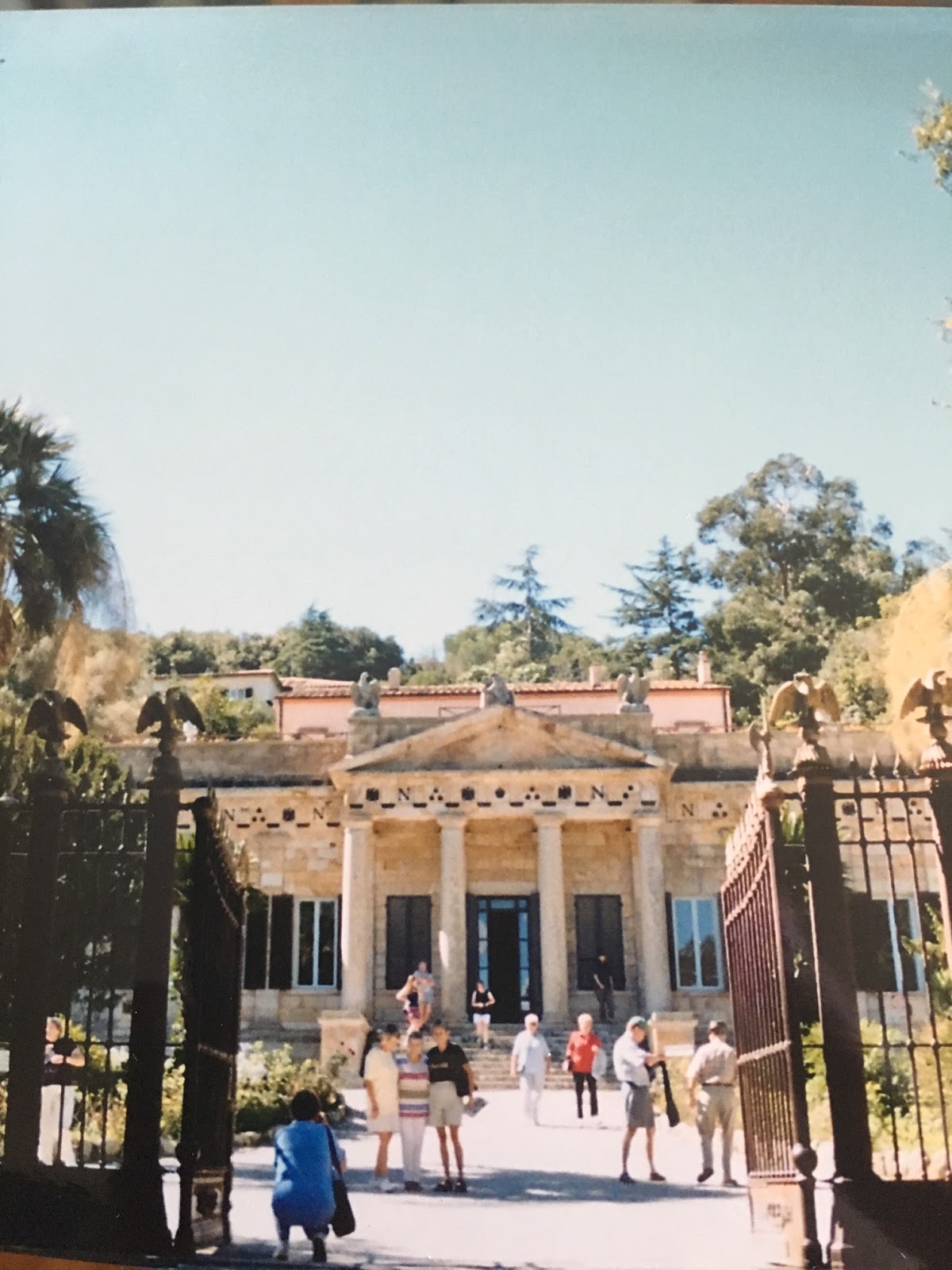
I visited Elba during my heady days of travel with my friend the Benedictine monk Cadfael. We were visiting Tuscany, and I wanted to be a completist, so off to Elba we went, driving southwest from San Gimignano to the port of Piombino for the ferry to Portoferraio, the city of Napolean Bonaparte’s first exile.

Our first foray to visit the Emperor’s town residence--Palazzina dei Mulini, located in the highest part of Portoferraio between Fort Stella and Fort Falcone--was nearly thwarted by the port’s tiny stone streets, and the fact that there is no place to park. Being a New Yorker I thought I understood the meaning of those words, but I was close to weeping after circling through an eternity of narrow stone streets that wouldn’t allow us to get where we needed. Luckily, Cad is deeply unflappable, and an extremely skilled driver. He piloted the Micra onto sidewalks, performed the drive-backwards-up-an-entire-hilled-street maneuver, and coaxed the mighty Micra down a flight of stairs—all to outflank those one-way signs.

Cad won, as usual, and the Micra was finally parked. We bounded up to the Palazzina only to see “Chiuso,” those most dreaded of Italian letters. Undaunted, we took ourselves to the Emperor’s summer residence, Villa di San Martino, at 6 km from Portoferraio along the road to Marciana. The man was only on the island for a total of 10 months, but decorum at all times.


I am not an imperialist at heart, but I was jazzed to be walking through the exiled Bonaparte’s bedroom, and his study, and to look out where he surveyed the sea, when we finally got into his town residence the next day.

But what I remember most about Elba overall is color and sky: the pink of Bonaparte’s town residence under a huge, tropical blue sky. Later in the day we drove west, away from the towns, on a mountainous road above the sea. The sky there was huge, majestic, and humbling, and we drove into layers of grey and blue offset by the sun’s gold. Peter Gabriel was our soundtrack as we egg-and-darted along the rising road, going deeper and deeper into that space between sea and sky. I understood what could have made such an impression on Dumas.


It was September 2002 . . . 
This trip had a very poignant timing. I got on a plane in New York on September 12, 2002, the day after the first anniversary of the attacks.  It was still a sad, dark, heavy time, and unease all around, as we didn't know if there would be more murders a year after. But as we said, we have to keep moving, and so to the airport I went to start this trip.

We spent our first Elban evening in the hotel. The lobby was pleasant—-the white tile floors spoke to the beachiness of the location, and the décor was clean and modern. To the left of the bar was a baby grand piano. Cad plays by ear, and has a good tenor voice. He asked the manager if he could play for a bit, and he said yes. There were small clusters of guests scattered throughout the lobby, mostly German tourists.

Actually there are so many German visitors on Elba, and the language is so prevalent, that it is a little disorienting. “M.A., can we please go back to Italy?"

At the piano, Cad’s repertoire is easy listening on the sentimental side, but with a musician’s flair. I sat by his side as he sang Piano Man and She's Always a Woman and joined in for some harmonies on Thunder Road and Four Green Fields. He sang out, but it was not intrusive and we could hear the soft conversation buzz throughout. There was some sweet applause when the set ended. It was nice.

Ah, the drink break.

Refueled, Cad started playing again, noodling around a theme, then playing it straight out: Oh my gosh, it was America the Beautiful. I was stunned to hear the tune. I hadn’t been thinking at all about home, and that haunting melody can put a lump in my throat at the very best of times.

To keep from crying I tried to focus on Cad’s expressive phrasing, and somewhere in the second verse I heard myself adding the harmony. Cad modulated during a verse interlude, and we sang the last verse in a higher key, putting the “alabaster cities gleam/undimmed by human tears” into a stronger part of vocal ranges.

When the song ended, we realized that everyone in the room had stopped talking. I felt a little numb, very self-conscious, and a little embarrassed. How cheesy was this? Would we come across as obnoxious Americans?

There were several beats of complete, palpable, silence . . . and then the conversation buzz picked up again. A hug from the strangers in the room would not have felt more embracing.

Cad went to get us drinks, and we sat and drank, for quite a while.

The next day we left to go back to Rome.

Friday, August 3, 2012

My Six Frames of Film History: Vertigo Now #1


I wrote the post below in 2008 when the film community was celebrating the 50th anniversary of Vertigo. Now the cinephile community is a chatter at the news that Hitchcock's Doppelganger fantasy has pushed Orson Welles's fake bio pic of Citizen Kane out of the #1 spot in Sight & Sound's every 10 year "what's the greatest film conscensus a la critics" where it has been since the poll started in 1952.

And there was much explicating. 

Roger Ebert: The king is dead. Long live the king. Welles' "Citizen Kane" has been dethroned from the Sight & Sound list of the greatest films of all time, and replaced by Hitchcock's "Vertigo." It's not as if nobody saw this coming.

Nick James, S&S editor: Vertigo is the ultimate critics’ film because it is a dreamlike film about people who are not sure who they are but who are busy reconstructing themselves and each other to fit a kind of cinema ideal of the ideal soul mate.”

Peter Bradshaw, The Guardian: My own theory is that Vertigo's rise in esteem coincides with academic critical fascination with female sexuality and the male "gaze". The world is ruled by men; they see what they want to see, and the visibility and comprehensibility of women's emotional lives are constructed by the male observer: Stewart's agonised cop Scottie thinks a beautiful woman is the reincarnation of another. How irrational is he being? 

I've never found Jimmy Stewart's ensorcellment very appealing here nor his manipulation of the object of his obsession, I mean poor Judy Barton. But there is no dishonor to Welles's artistry for Hitchcock to take the top spot. 

My little connection to the new "greatest film ever":

* * * * * * * * *

The film community is bidding 50th anniversary wishes to Hitchcock’s Vertigo, which opened on May 9, 1958. It isn’t one of my favorite Hitchcock, which include Rebecca, Strangers on a Train, To Catch a Thief, and Rear Window. But in 1995 I visited Robert Harris and James Katz at their offices on the Universal Studios lot. They were deeply into the restoration of Vertigo, and one of Novak’s original suits was hanging on the door as part of their color exploration.

We had an interesting lunch, and Harris gave me 6 frames from the Interneg they had made from the original film for their restoration work. I always felt a little guilty about this, since Vertigo isn’t one of my favorites. But I had it framed in an archival shadow-box method to display, and over time I have become very attached it to.

The photo above is from my frames: Madeleine at the foot of Golden Gate Bridge where she attempts suicide. Even in its 1” x 1 ½ “ size, it is stunning. I have my shadow box in a window nook, so that the diffused light will illuminate it. In the morning those fifty-year-old clouds look like Magritte, and the solitary iconic silhouette of the woman is endlessly engaging and haunting.

All that film history, captured on the proverbial celluloid, removed from its sprockets and appreciated as the art it is on the Upper West Side.

Saturday, July 28, 2012

Team USA, London2012


The opening ceremony was an extravaganza that revealed much of the Anglo-Saxon soul, from its love of a boy soprano singing "Jerusalem," to the pagan bonfire of the lit cauldron.

The American commentary was uniformly dreadful. During the healthcare/children's literature scene: "These kids don't look too sick," and just too many other lines to quote. I choose not to think about that right now.

I am a fan of the US uniforms, although the China manufacturing is UNFORGIVABLE.

The berets look better on the athletes than they did in the renderings and on the models. Love the longer skirts on the women, and the white socks and sneakers.

For context (yes, a jab at NBC's decision not to livestream opening ceremony) photos from Games past, from a great slideshow over at Sports Illustrated, with vintage photos of Olympic fashion through the years. All credits over there.


Sunday, July 1, 2012

Andrew Sarris: Looking at Radio & Television with me

I'm 2 for 2 for being out of town when a distinguished critic of my acquaintance dies. First Paul Fussell, who I studied and learned to drink scotch with, and on June 20, Andrew Sarris, who I worked with on a screening exhibition at the then Museum of Television & Radio in the 1990s as editor of his essay for us.

As many recalled, Sarris was an intellectually generous man who was always interested in a good discussion about film and its place in modern culture and didn't patronize the young and not famous.

For a series of museum monographs, we asked critics from different disciplines to look at our collection and chose programs that interested them. For Sarris we specifically asked him to look at actors from stage & screen who appeared on radio and television. From his essay on the importance of radio and TV to capture performances:

To listen to even a 45-minute Streamlined Shakespeare on the radio in 1937 starring an over-the-hill John Barrymore in recitations of his classic roles of the 1920s, such as Hamlet and Richard III, was better than no Shakespeare at all. And, certainly, no listener in 1937 could have anticipated that a not yet pop-legend Humphrey Bogart would contribute such a fantastic collector's item to posterity as his reading of Hotspur's death scene in a truncated radio adaptation of Henry IV.

Tallulah Bankhead in the Theatre Guild on the Air: All About Eve in 1952: People in-the-know insisted that Bette Davis imitated Bankhead in The Little Foxes and All About Eve in 1950. Here, in 1952, the original had a chance to play a role made famous by her alleged mimic. Joseph L. Mankiewicz's very literate script lent itself well to radio adaptation.  Lux Radio Theatre: Dark Victory with Bette Davis and Spencer Tracy in 1940. Here Davis reprised her tear-jerking screen success of a year earlier. Tracy would have been too big a movie star to play the thankless supporting role of her leading man on the screen, but on the radio the biggest stars could drop a notch or two in status without embarrassment.

snips

On TV, George Cuckor's production of James Costigan's Love Among the Ruins achieved a lyrical power in the twilight glow exuded by Laurence Olivier and Katharine Hepburn in the 1970s. Blythe Danner and Frank Langella breathed new life into Tennessee Williams's The Eccentricities of a Nightingale, the playwritght's preferred version of the stage and screen drama that was called Summer and Smoke. The Iceman Cometh on TV was generally considered superior to the earlier Broadway production of Eugene O'Neill's greatest play. Katharine Cornell in Producer's Showcase: The Barretts of Wimple Street in 1956 offered television audiences an opportunity to see a theatrical legend who had studiously avoided movies, except for a cameo in Hollywood Canteen.

Olivia de Havilland & Jason Robards, Jr. in ABC Stage 67: Noon Wine in 1966, directed by Sam Peckinpah: Peckinpah's direction of deHavilland and Robards in his adaptation of a bizarre short novel by Katherine Anne Porter throws light on a more complex sensibility than was indicated in many of the violent movies he later directed. Ingrid Bergman in Hedda Gabler, 1963: Bergman never got to do Ibsen in all her years in Hollywood, and certainly not with a cast as brilliant as Michael Redgrave, Ralph Richardson, Trevor Howard, Dilys Hamlett, and Ursula Jeans. This is television at its most culturally ambitious.

snips

We shall never hear Garrick and Coquelin, but our descendants will hear Gielgud and Olivier, and once radio was followed by TV, their images would be preserved along with their voices. Helen Hayes, Katharine Cornell, Celia Johnson, Laurence Olivier, Vanessa Redgrave, Judi Dench, Kim Stanley, Ralph Richardson, Michael Redgrave et al. have found a permanent home in the electronic memory of television, which like radio, never realized its ultimate role in the preservation of acting traditions until it was almost too late. To this end this exhibition is dedicated.

Reading the list of actors and actresses that interested Sarris in our collection reminds us that he was born in 1928, and had a classical eye in terms of the pantheon of great performances. He was a link to this history of actors and roles with an oceanic knowledge and deep love of the art form. Some of this work is fading as we lose his generation. He cited Helen Hayes in Robert Montgomery Presents: Victoria Regina in 1951: Hayes re-created her most celebrated Broadway role for the comparatively new medium of television, which invariably gave her the Great Lady treatment for millions who had never seen her in the theater.  There are few left who would know or care about Hayes's signature performance. Rest in peace, Mr. Sarris.